Fan Zhang

6 articles · 30 co-authors · latest: 2026-08-13
46 citations · h-index 4 · 11 papersData: Semantic Scholar

We have retold 6 papers by this author. 1 of them with a full read. most often about: topological insulator, topology, floquet_mobius_topological_insulator. 30 co-authors across our retellings.

Links in the knowledge graph
Mesoscale2025-06-023 minarXiv:2506.01401
A Möbius Strip Shaken in Time: Quantum Edges with No Static Counterpart
An ordinary insulator conducts no current, neither in its interior nor along its edges. A topological insulator is a different story: it remains insulating inside but conducts electricity without loss along its edges.
Materials2026-01-111 minarXiv:2601.06791express
A Magnetic Mirage in Ruthenium Oxide Films
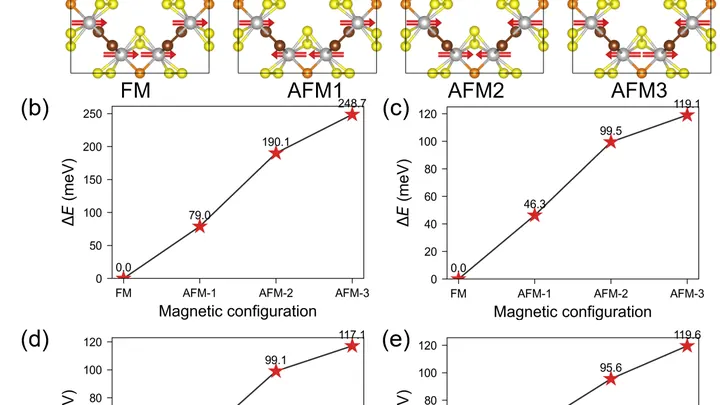
A ruthenium oxide film is like a soap bubble film stretched over a frame, but made of atoms. For a long time, it was believed that in this film, ruthenium atoms align in a magnetic order, like compass needles pointing in opposite directions. This order was dubbed altermagnetism, and great hopes were placed on it for future electronics.
High Energy2026-01-121 minarXiv:2601.07688express
Record-Bright Flare from a Gamma-Ray Burst
In October 2022, the space-based detector GECAM-C caught the most powerful gamma-ray burst ever seen, GRB 221009A — an explosion that briefly became the brightest source of gamma rays in the sky. But the most interesting part came after: the instrument detected a series of additional flares, and one of them was record-breaking.
A Laser Maze for Hunting Space-Time Tremors
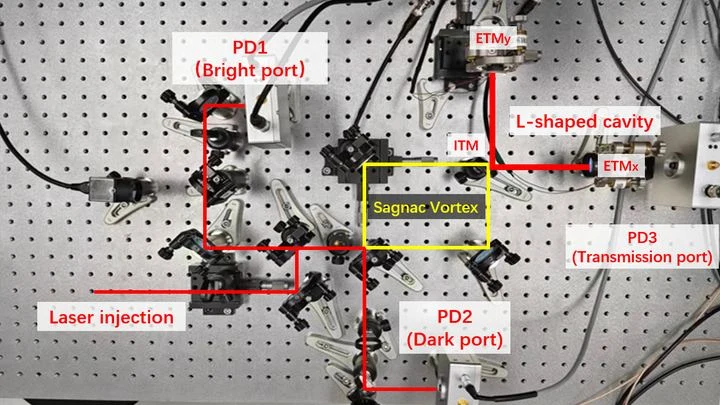
Gravitational waves are ripples in space itself, caused by events like colliding black holes. To hear these ripples, we build giant L-shaped facilities: a laser beam travels down two arms, bounces off mirrors, and returns. If space has been slightly squeezed or stretched, the light arrives with a difference, and we see a signal.
Mesoscale2026-08-091 minarXiv:2608.08697express
Magnetic Patterns in Graphene
Graphene, a sheet of carbon just one atom thick, can change its magnetic properties the way water changes shape: sometimes flowing, sometimes freezing into ice. In a new study, physicists peered inside this process for the first time using a sensor the size of a needle tip.
Materials2026-08-132 minarXiv:2608.13093express
Magnetic layers that glow and remember
In an ordinary semiconductor, it is hard to get two things at once: strong magnetism and a tightly bound electron-hole pair that is born when light is absorbed. Magnetic impurities, which make a material magnetic, also prevent the electron and hole from staying together: they are like noisy neighbors that do not let the pair exist in peace.