In 1913, French physicist Georges Sagnac conducted an experiment proving that rotation affects light propagation in a closed loop, contrary to doubts about the applicability of classical physics. He assembled a ring interferometer on a rotating table and recorded a fringe shift — direct evidence that light 'feels' rotation. This can be compared to two floats on a circular whirlpool: one drifts with the current faster.
History
Predicted and experimentally confirmed by Georges Sagnac in 1913. He used an interferometer with an area of 0.86 m² and measured rotation with an accuracy of a few degrees per minute. Later, in 1925, Albert A. Michelson and Henry Gale built a giant open-air interferometer measuring 0.6 × 0.3 miles to measure Earth's rotation. With the advent of lasers and fiber optics, the effect became the basis of modern navigation instruments.
How it works
Applied in ring laser and fiber-optic gyroscopes, measuring angular velocity with high precision. Limits: the effect occurs in any metric theory of gravity, but its interpretation may vary depending on the reference frame. In strong gravitational fields, general relativistic corrections must be considered; at extremely low rotation rates, accuracy is limited by noise.
In practice
Fiber-optic gyroscopes in airplanes, rockets, and smartphones, measuring rotation without mechanical parts.
Fun fact
Sagnac's first experiments took only a few minutes, but the accuracy was such that he could detect the Earth's rotation — though this required significantly increasing the loop area.
The two states of a strontium atom are like twins running down the same track, but one is slightly higher than the other. Usually, the light used to manipulate atoms pushes one twin harder and the other more weakly. Here, they chose a wavelength of 813 nanometers—'magic'—where both get the same kick.
On the wall: light and dark fringes. That’s what light looks like when it cancels itself out.
Way back in the 17th century, Christiaan Huygens suggested that light is a wave.
In the first 10⁻³⁵ seconds after the big bang, the most rapid part unfolded. Space expanded faster than light — that's expansion of the universe (inflation). Almost the entire score was performed by a single field, the inflaton, conducting the tempo and key.
The vacuum is not as empty as it seems. If an observer moves with acceleration, the vacuum around them heats up: this was predicted by William Unruh back in the 1970s. The effect is akin to black hole radiation, but in flat space.
Two beams of light race around a closed loop, heading toward each other. Since the speed of light is constant, when the ring turns, one beam has to catch up with a moving finish line, while the other meets it sooner. Their meeting creates a pattern, and from that pattern we can tell how fast the whole system is spinning.
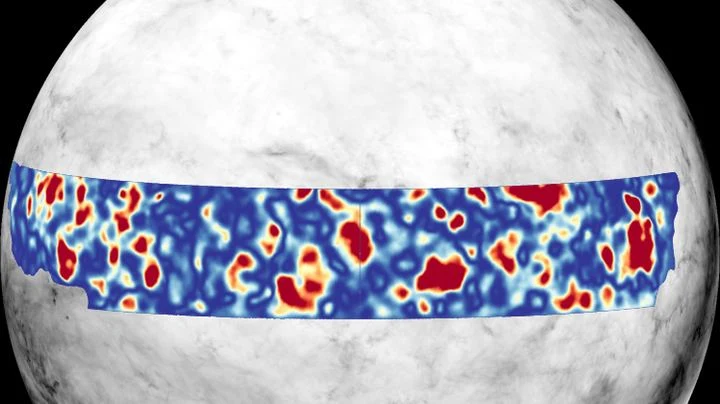
Moving clumps of galaxies and invisible dark matter create wakes in the afterglow of the Big Bang, like boats stirring a pond. This wake, the moving lens effect, is so subtle it shifts the light’s temperature by only a few millionths of a degree: comparable to detecting a candle’s heat from across a continent.
Light, like a shaken rope, oscillates in a specific plane. Astronomers and engineers often rotate images using a three-mirror system, the so-called K-mirror, but this inadvertently rotates the plane of oscillation as well. For precise measurements, that's a problem.
If you drop an ice cube into a glass of water, it will float until it melts. But if you cool the water slowly, at some point it all freezes at once: that's a first-order phase transition: abrupt, with a clear boundary.
The compass needle trembles when a truck rumbles by. Similarly, in a tiny gyroscope, a device that senses rotation, any noise drowns out the useful signal. For a long time, engineers couldn't shrink a gyroscope down to fingernail size without sacrificing accuracy.
The solution came in a two-loop architecture.
An atomic gravimeter works like a very precise scale for gravity: it tosses up a cloud of atoms and watches how fast they fall. But these instruments have a hidden flaw — the shape of the signal they produce is slightly skewed. This skew, like a ruler with a chipped edge, subtly shifts every measurement.
A superconducting contact is like a narrow bridge between two shores, carrying current without friction. Place such a bridge near a massive star, and it will feel time flowing slower near the star's surface. Clocks on the shores tick at different rates, and the current begins to oscillate differently.
But if the star rotates slowly, the picture gets more complicated.
A beam of light passing through a transparent plate usually keeps its color. But if you stack the plate from thin alternating layers, it becomes a grating that reflects and transmits waves selectively. This has long been used in lasers and optical filters. Now such gratings have been made to vibrate, and light started changing color.
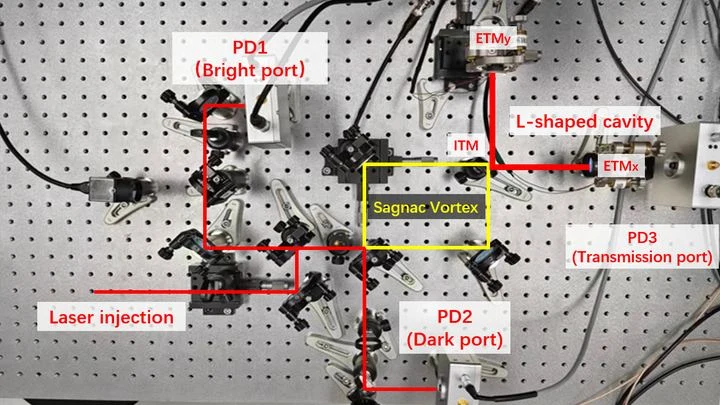
Gravitational waves are ripples in space itself, caused by events like colliding black holes. To hear these ripples, we build giant L-shaped facilities: a laser beam travels down two arms, bounces off mirrors, and returns. If space has been slightly squeezed or stretched, the light arrives with a difference, and we see a signal.
Mass curves spacetime like a heavy stone pressing into an asphalt road. Light passing by skirts around this dent, its path lengthens, and it arrives late. Astronomers have observed this Shapiro effect many times near the Sun and planets.
A new plan proposes to recreate this delay on a lab bench.
Mass curves spacetime like a heavy stone pressing into an asphalt road. Light passing by skirts around this dent, its path lengthens, and it arrives late. Astronomers have observed this Shapiro effect many times near the Sun and planets.
A new plan proposes to recreate this delay on a lab bench.
Sound waves on a chip usually spread in all directions, like whispers echoing around a dome. In a gyroscope, this creates noise that obscures rotation. But a new design forces sound into a one-way flow. By tapping the sound path at several points with precise timing, backward-traveling waves cancel out, while forward waves reinforce.