Gravitational wave interferometry is the technique that made the first direct detection of gravitational waves possible in 2015. It uses large-scale laser interferometers, like LIGO and Virgo, to measure minuscule changes in the distance between mirrors—changes as small as a thousandth of the width of a proton. When a gravitational wave passes, it stretches and squeezes spacetime, causing the arms of the interferometer to change length slightly, which alters the interference pattern of the laser light.
History
The concept was proposed in the 1960s by Soviet scientists Gertsenshtein and Pustovoit, and independently by Rainer Weiss in 1972. The first detection was made by LIGO in September 2015, announced in February 2016.
How it works
A laser beam is split into two perpendicular paths, each traveling to a mirror and back. The two beams are then recombined, and their interference pattern is measured. If the arm lengths are equal, the beams cancel out (destructive interference). A passing gravitational wave changes the relative arm lengths, causing a tiny signal to appear. To achieve the required sensitivity, the interferometers use high-power lasers, suspended mirrors to isolate from seismic noise, and multiple reflections to increase the effective path length.
In practice
It is used to observe gravitational waves from merging black holes and neutron stars, opening a new window into astrophysics and testing general relativity in strong-field regimes.
Fun fact
The LIGO detectors are so sensitive that they can measure a change in length smaller than the size of an atom's nucleus over a 4-kilometer arm.
The two states of a strontium atom are like twins running down the same track, but one is slightly higher than the other. Usually, the light used to manipulate atoms pushes one twin harder and the other more weakly. Here, they chose a wavelength of 813 nanometers—'magic'—where both get the same kick.
Light passing through a glass of murky water dims — some of it is absorbed. That's how many liquid-analysis instruments work: they measure how much light was lost and infer the composition from that. But if the liquid is heterogeneous, like soup with chunks, a single number isn't enough: you need to know where exactly more absorption happened.
Gravitational-wave detectors are like extremely sensitive ears: they pick up the trembling of space when black holes or neutron stars collide somewhere in the universe. But even the most sophisticated "ears" cannot hear everything. The new LIGO A# project is like replacing the eardrum with a thinner, more sensitive membrane.
A quantum particle can be a wave, and pass through two paths at once. But if something 'peeks' at which path it took, the wave disappears. This effect is called loss of interference. Usually, photons or air molecules do the peeking.
You're listening to the faint whisper of stars, and nearby someone keeps moving a chair. In gravitational wave telescopes, that role is played by scattered light: it reflects off trembling surfaces and creates false signals.
In pursuit of gravitational waves, ripples in spacetime left by black holes and neutron stars, detectors like LIGO pump their arms with light of dazzling intensity.
The space antennas LISA and Taiji each consist of three satellites flying around the Sun behind Earth, forming a triangle with sides millions of kilometers long. They measure how the distance between them changes when a gravitational wave passes, like ripples on a pond from a thrown stone.
Two sensitive microphones are listening to the Universe. One hears a low hum, the other hears almost nothing. It's not a malfunction: it's about how they are oriented.
Gravitational-wave observatories like LIGO don't just catch loud bursts from black hole mergers.
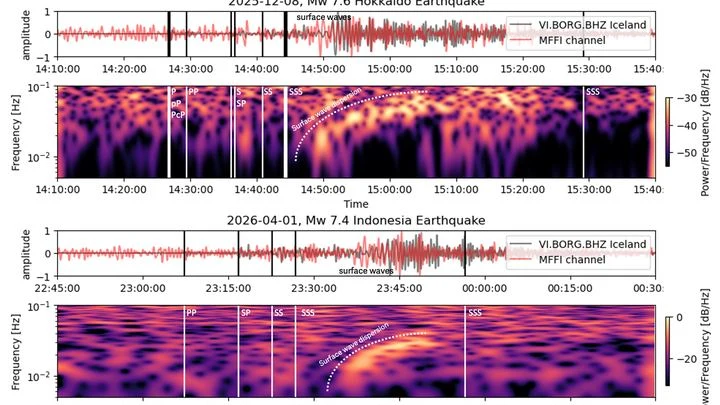
The planet-spanning web of undersea internet cables acts like a giant ear. The glass thread inside responds to water movements: currents, tides, and distant earthquakes bend the cable. Light traveling along the thread takes slightly longer: this delay is measured on shore against a reference. That’s how the speed of light reveals itself.
A translator records a multi-hour conversation. If they try to hold the entire dialogue in their head, they're bound to garble details by the end. That's roughly how gravitational observatories work: they listen to the 'conversation' of massive bodies spiraling together.
The Universe is pervaded by an invisible substance — ultralight dark matter, which doesn't collide with ordinary matter but can tremble like a taut string. Its oscillations alter the world's most fundamental properties: the electron charge, the speed of light — as if the tuning of a single cosmic note slightly drifts.
LIGO, Virgo, and KAGRA detectors act like giant microphones, listening in on gravitational waves — vibrations of space itself. The new GWTC-5.0 catalog recorded 161 black hole mergers, bringing the total count to 390 events.
Imagine a giant inflatable balloon with galaxies painted on it. As it inflates, the pattern stretches and neighboring dots move apart. The rate of that stretching is the Hubble constant. Astronomers usually catch light from distant stars and see how much it has reddened due to the stretching of space.
Two beams of light race around a closed loop, heading toward each other. Since the speed of light is constant, when the ring turns, one beam has to catch up with a moving finish line, while the other meets it sooner. Their meeting creates a pattern, and from that pattern we can tell how fast the whole system is spinning.
Ever since Paul Dirac theoretically predicted antimatter, physicists have been hunting for the tiniest differences between particles and their antiparticles.
Frozen cake batter is dotted with tiny raisins. If the batter is uniform, all the raisins will puff up evenly, and the cake will be smooth. But if the batter has denser spots (some sweeter, some more bland) the raisins will be distributed unevenly: dense in some places, sparse in others.
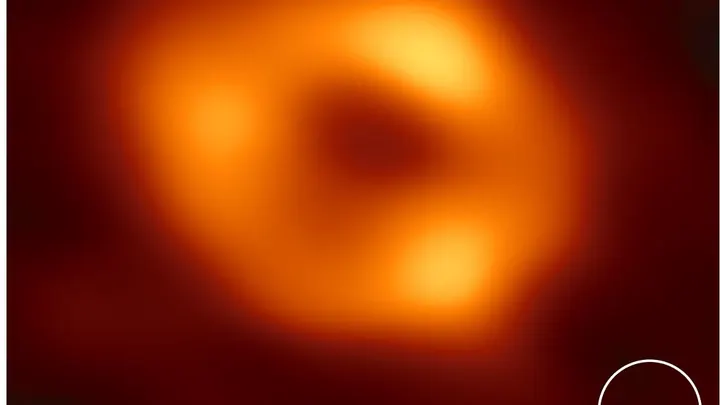
Einstein's theory of gravity explains how mass warps space and time. Its predictions have been tested near Earth, but the most grueling tests lie around black holes, where distortions reach their breaking point. Until now, astronomers saw them as blurry smudges on an underexposed photo.
A pendulum swings with such precision that, had it been counting seconds since the Big Bang, it would have drifted by only half a second by today. That is the stability of the new portable ultraviolet laser — the heart of aluminum atomic clocks.
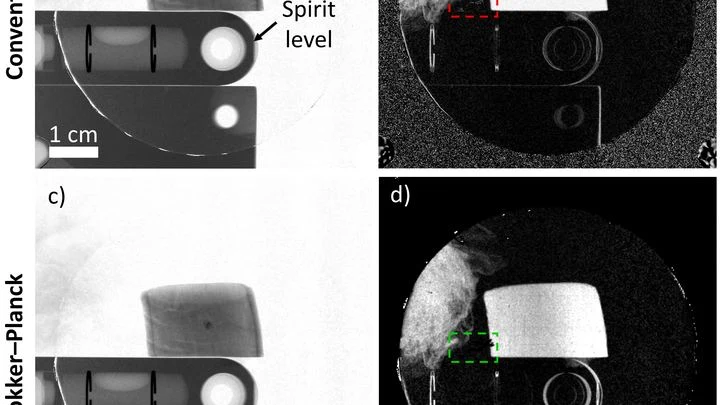
An X-ray machine with gratings takes not one but three pictures at once: a regular image, a map of beam deflections invisible to the eye, and an image of tiny structures that scatter light. Together, they help spot, for example, emphysema or pulmonary fibrosis. But there's a catch: to separate these three layers, you need a clever mathematical trick.
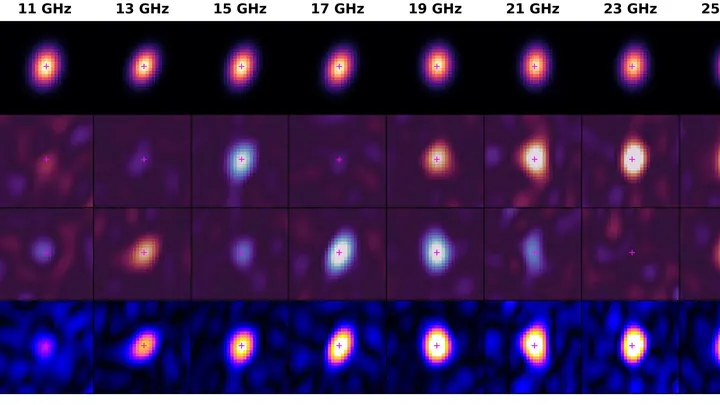
Radio waves from a gamma-ray burst — the cataclysmic death of a massive star whose flash briefly outshines an entire galaxy — reach Earth polarized. This means their electric field oscillates predominantly in a single plane, like a compass needle frozen in a magnetic field.
A tiny glass bead hangs in a laser beam like a speck of dust in sunlight. Around it is a rarefied gas: atoms of krypton, xenon, and heavy molecules of sulfur hexafluoride. They collide with the bead, and each hit transfers a tiny impulse, like a pea thrown at a taut sheet makes it tremble.
Impulse is a measure of motion: mass times velocity.
An atomic gravimeter works like a very precise scale for gravity: it tosses up a cloud of atoms and watches how fast they fall. But these instruments have a hidden flaw — the shape of the signal they produce is slightly skewed. This skew, like a ruler with a chipped edge, subtly shifts every measurement.
A gamma-ray burst is like a shot from a cosmic cannon: a brief but dazzling flash that outshines an entire galaxy for a few seconds. But when observed in the hardest gamma-ray band (photons with energies above a gigaelectronvolt), the signal often gets lost in the noise, like a whisper in a noisy hall.
According to Einstein's theory, massive objects cause spacetime curvature, like a heavy ball warping a rubber sheet. As they accelerate, they create ripples — gravitational waves, akin to the circles from a stone dropped in a pond.
Pluck a guitar string, and it vibrates — the air around it carries the tremor to your ear. Spacetime vibrates differently: when a gravitational wave passes through, it stretches and squeezes slightly. Spotting such a tremor at frequencies from 10 kilohertz to 100 megahertz is the challenge that new detectors are being built for.
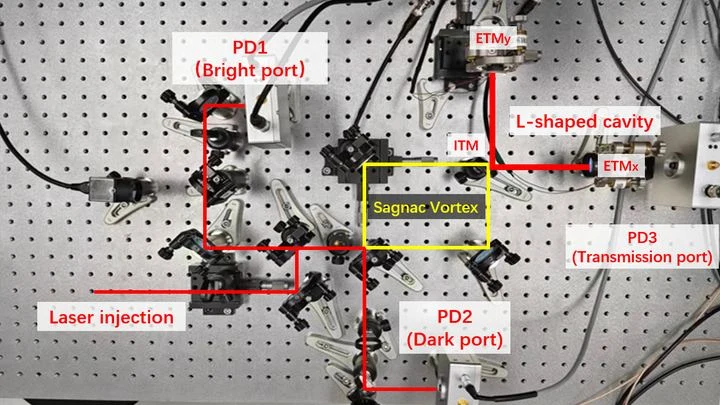
Gravitational waves are ripples in space itself, caused by events like colliding black holes. To hear these ripples, we build giant L-shaped facilities: a laser beam travels down two arms, bounces off mirrors, and returns. If space has been slightly squeezed or stretched, the light arrives with a difference, and we see a signal.
The theory of gravity by Einstein — general relativity — rarely intersects with quantum physics in direct experiments. Here, scientists built a 50-kilometer glass labyrinth on a table and sent single photons through it.