Oxide membranes learn to remember express
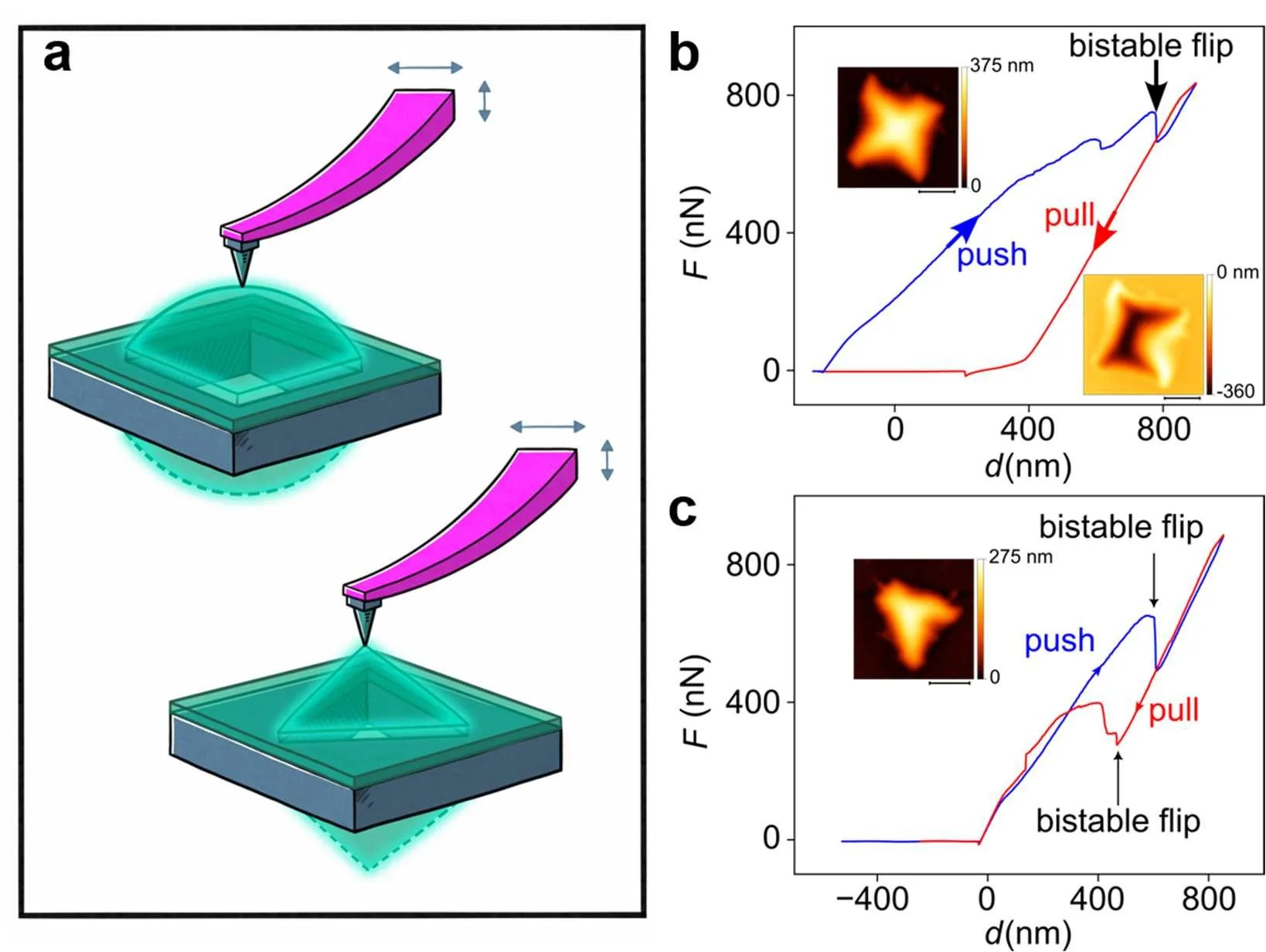
A thin film of metal oxide lies on a surface with a tiny pit. If you gently compress the film from the sides, it won't crumple — instead, it will bow downward into the pit or bulge upward like a hump. Both positions are stable, like a canning jar lid that is either concave or convex and doesn't flip back and forth on its own. This behavior is called bistability, and that's exactly what researchers achieved in ultrathin crystalline films of strontium titanate and barium titanate oxides.
The film was grown on a sacrificial layer and then transferred onto a substrate with pre-etched pits. Residual stress in the crystal caused the film to buckle. The direction of the buckle depended on the pit geometry and the film's own stiffness. The researchers measured the topography with an atomic force microscope and the electric potential with a Kelvin probe. It turned out that in different stable positions, the electric field distribution inside the film differs, especially in ferroelectric barium titanate. With a light tap of the probe, the film can be snapped from one position to the other and back.
Such a mechanical switch requires no continuous current, doesn't wear out from cycling, and works at room temperature. From many such cells, you could build memory where a bit is stored by the film's deflection and read out by changes in the electric field. This is a step toward nanomechanics, where information lives not in charge but in shape.
Original abstract
as written by the authors arXiv:2601.17959
Mechanical instabilities in thin solids offer a powerful route to engineer nonlinear responses, yet their controlled use in functional crystalline oxides has remained largely unexplored. Notably, by changing the aspect ratio of solids, the energy landscape around equilibrium can be modified to induce non-linearities under lateral stresses through non-lateral deformations. These nonlinear systems can develop multiple local energy minima where the system can settle and switch between states through the application of a driving force. Crucially, recent advances in oxide thin film growth have enabled the fabrication of freestanding oxide membranes, paving a viable path for their use in bistable architecture, particularly at the nanoscale. Here, we demonstrate that freestanding oxide membranes, such as SrTiO3 (STO) and BaTiO3 (BTO), relax into well-defined metastable buckling states when transferred onto lithographically defined cavities. The membrane deformation is determined by the interplay between built-in residual strain, bending stiffness, and cavity geometry, resulting in reproducible bistable states with distinct strain distributions. Using a combination of atomic force microscopy, in-contact Kelvin probe measurements, and finite-element modelling, we reveal that these mechanically locked states directly shape the electromechanical potential landscape of ferroelectric BaTiO3. We further demonstrate reversible snapthrough transitions between mechanically degenerate states, establishing complex oxides as deterministic, geometry-tunable building blocks for nonlinear nanoelectromechanical architectures. Our results illustrate a general strategy for exploiting mechanical instabilities to encode and manipulate functional responses in ultrathin crystalline membranes.
Strontium titanate is the same material used to make synthetic diamonds for jewelry, just without the impurities.