Oxide membranes learn to remember express
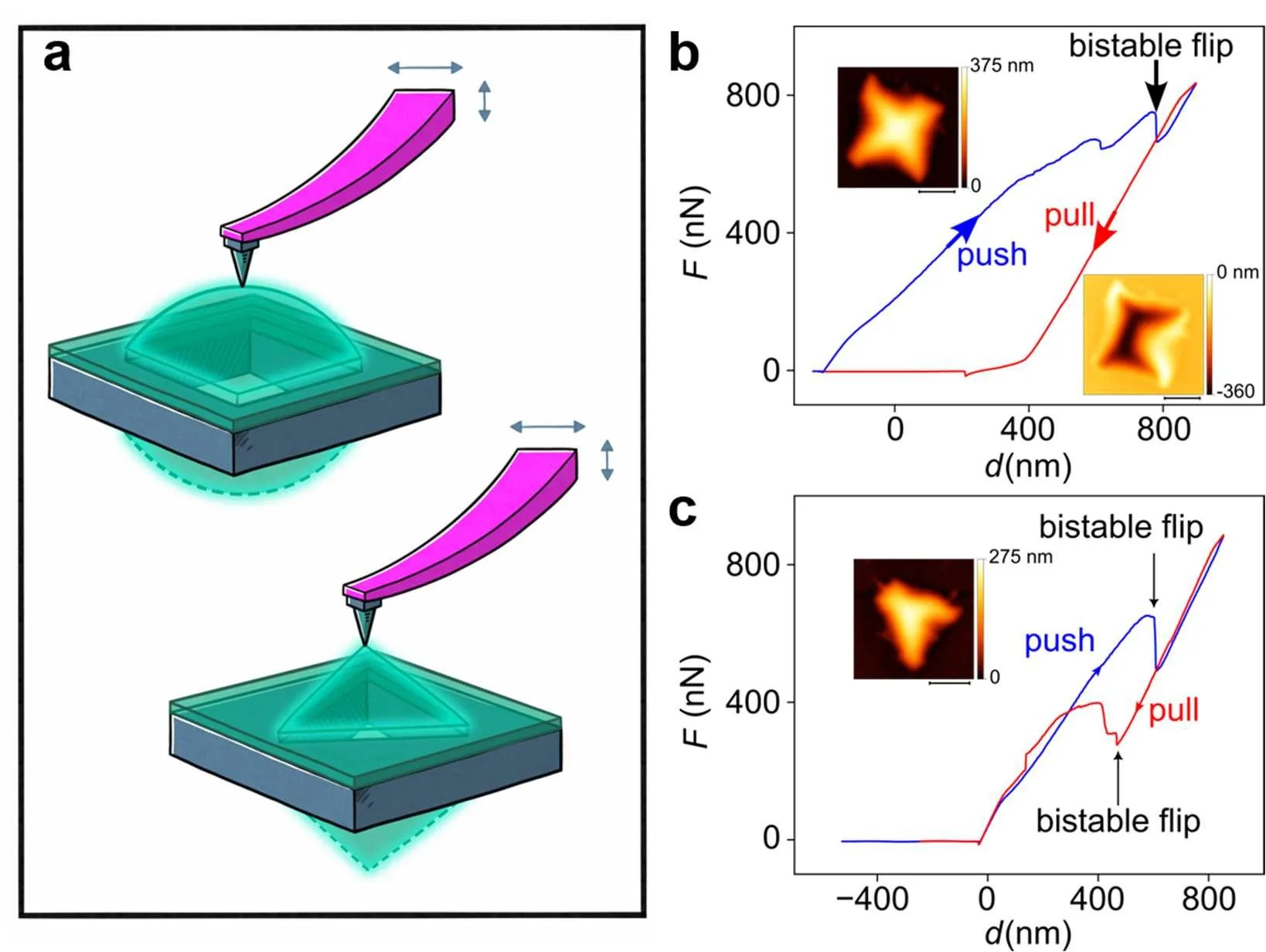
A thin film of metal oxide lies on a surface with a tiny pit. If you gently compress the film from the sides, it won't crumple — instead, it will bow downward into the pit or bulge upward like a hump. Both positions are stable, like a canning jar lid that is either concave or convex and doesn't flip back and forth on its own. This behavior is called bistability, and that's exactly what researchers achieved in ultrathin crystalline films of strontium titanate and barium titanate oxides.
The film was grown on a sacrificial layer and then transferred onto a substrate with pre-etched pits. Residual stress in the crystal caused the film to buckle. The direction of the buckle depended on the pit geometry and the film's own stiffness. The researchers measured the topography with an atomic force microscope and the electric potential with a Kelvin probe. It turned out that in different stable positions, the electric field distribution inside the film differs, especially in ferroelectric barium titanate. With a light tap of the probe, the film can be snapped from one position to the other and back.
Such a mechanical switch requires no continuous current, doesn't wear out from cycling, and works at room temperature. From many such cells, you could build memory where a bit is stored by the film's deflection and read out by changes in the electric field. This is a step toward nanomechanics, where information lives not in charge but in shape.
Strontium titanate is the same material used to make synthetic diamonds for jewelry, just without the impurities.