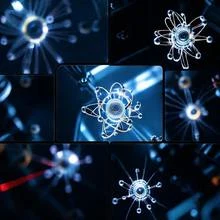
Strontium is a soft, silvery alkaline earth metal that has become a key player in the quest for practical quantum computers. In these experiments, individual strontium atoms are trapped and cooled with lasers, then used as qubits — the quantum equivalent of classical bits. Its appeal lies in its rich internal structure: strontium has multiple stable isotopes and a unique combination of electronic and nuclear spin states, giving researchers flexible 'handles' to store and manipulate quantum information with remarkable precision.
History
Strontium was discovered in 1790 by Adair Crawford, who recognized it as a new element in a mineral from a lead mine in Scotland. Its use in quantum computing emerged in the early 2000s, with pioneering work on strontium ion traps and neutral atom arrays.
How it works
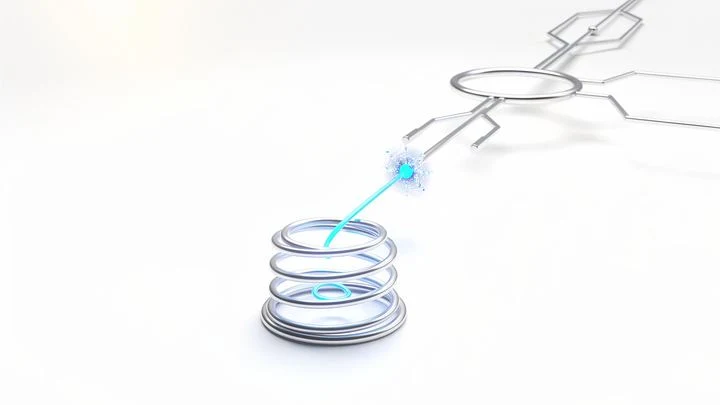
A single strontium atom is held in an optical trap — a tightly focused laser beam that acts like a microscopic bowl. Lasers also cool the atom to near absolute zero, slowing its motion so it can be precisely controlled. The qubit is encoded in two long-lived electronic states of the atom, and quantum operations are performed by shining carefully tuned laser pulses that drive transitions between these states. The atom's nuclear spin can serve as an additional quantum memory, and its optical transitions are so narrow that they can be used to build ultra-precise atomic clocks, which in turn help synchronize quantum operations.
In practice
Strontium atoms are used in neutral-atom quantum computers, where arrays of hundreds of atoms are manipulated to perform calculations, and in optical lattice clocks that keep time with an accuracy of one second in 15 billion years.
Fun fact
Strontium's name comes from the village of Strontian in Scotland, where the mineral was first found.
A ship in a bottle is assembled from the inside, not the outside: masts and sails are pulled through the narrow neck, and once inside the glass they settle into the right pose on their own. Chemists have done something similar with a single cobaltocene molecule, which they pulled into the gap between layers of a two-dimensional crystal.
An extra electron in a molecule is like a passenger barely hanging onto the step of a departing train. Such a 'passenger' turns the particle into an anion — a negative ion. Studying it is tough: the bond is weak, the electron cloud is diffuse, and any jolt can knock the electron off.
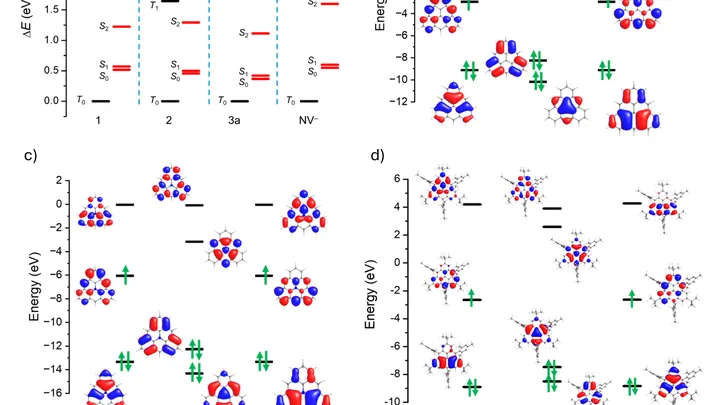
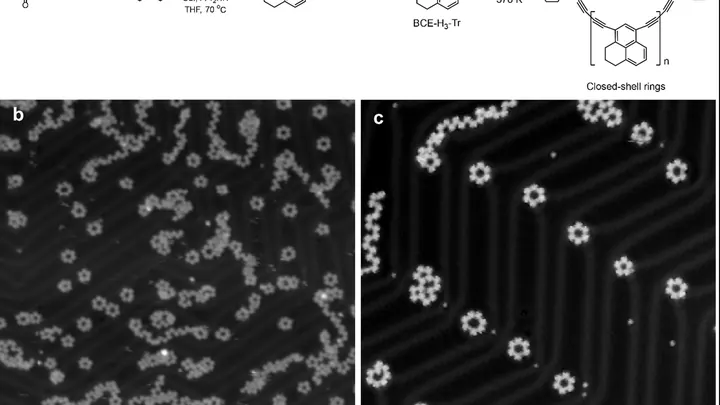
At the heart of a future quantum computer might lie a tiny organic molecule shaped like a triangle. It has two 'extra' electrons that don't pair up. Such molecules are called diradicals, and their electrons can store information in a special, quantum way.
Building a quantum network node is like teaching a dancer to balance on a carbon thread over an abyss. One leg must spring lightly from the wire, hurling photon-messengers into the external world. The other must grip the rope tightly, guarding precious quantum information.
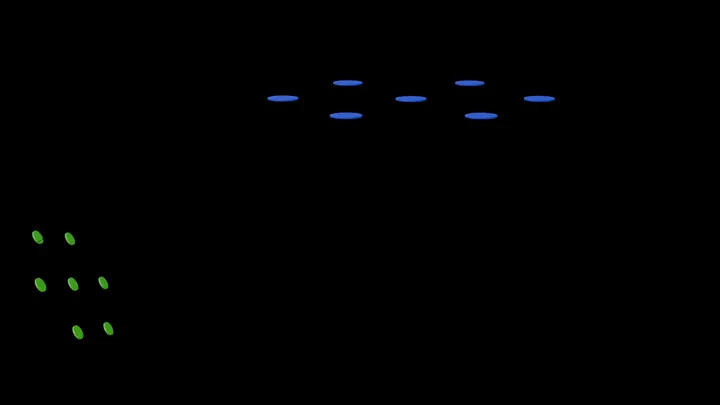
A tiny crystal of charged atoms, trapped in a trap, trembles with heat. Each ion oscillates like a ball on a spring, and these vibrations hinder using the crystal for precise quantum operations. Usually, excess energy is removed with a laser — the beam hits the ions and slows their motion, like a stream of air damping a pendulum.
Even at absolute rest, atoms emit a faint noise — unavoidable quantum jitter. In the debates between Einstein and Bohr, this noise, like an unceasing whisper, blurs the interference fringes from an atomic slit. Overcoming this limit was considered impossible.
Energy transfer in photosynthesis is like a children's slide: it bends under the weight of one, reshaping the path for the next. That's what happens in a leaf: an excited molecule instantly reshapes the 'landscape' of its neighbors.
Physicists reproduce this effect using ions suspended in a vacuum trap.
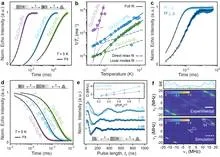
Quantum networks need a mediator between storage — spin — and carrier — light. No single molecule had ever pulled off such a feat. But now physicists have found a solution. They placed a carbene molecule into a crystal and cooled it to -269°C.
Holding a phone number in your head while people shout and slam doors around you is nearly impossible. That's roughly the life of a quantum bit, a qubit, in an ordinary material: the nuclei of neighboring atoms, like tiny magnets, constantly jostle it and erase information. To keep a qubit from forgetting, you need to find it a quiet spot.
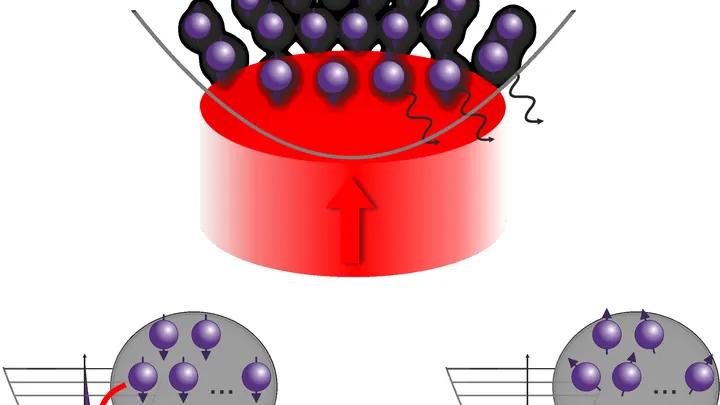
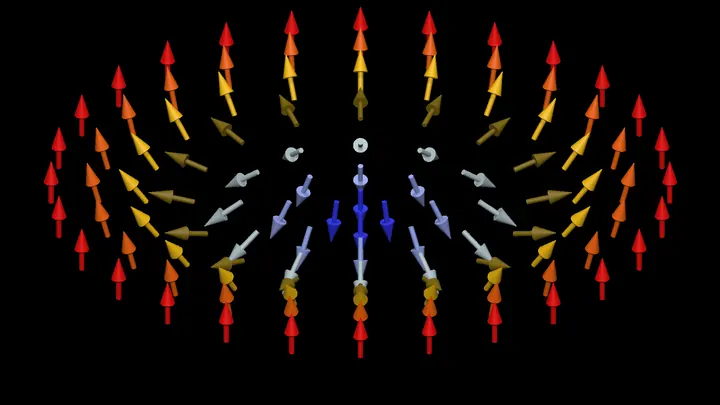
In a field trap, scientists assembled a crystal — 150 ions at ultra-low temperature. Each ion behaves like a tiny magnet, capable of rotating in any direction. By controlling forces that depend on this rotation, physicists made all the magnets swirl into a common vortex called a skyrmion.
A three-seat swing never stops: one rider is always left hanging. That’s a frustrated magnet — a perpetual dance with no rest. To study it, physicists built a quantum simulator from 256 atoms, meticulously mimicking the crystal TmMgGaO₄.
A ring of magnetic atoms resembles a round dance where each participant holds hands with their neighbors. In ordinary magnets, each atom has its own permanent magnetic moment, and they interact like little arrows striving to align opposite to each other.
A chunk of nuclear fuel inside a reactor is not just a solid. When heated, the uranium atoms in it start to 'wiggle' their magnetic moments, and this motion changes thermal conductivity and other properties.
A fridge magnet attracts a paperclip: we can feel that field with our hands. Now shrink that field by a billion times. Atoms inside our bodies emit such weak signals, and they are very hard to catch.
Scientists built the sensor from special molecules that themselves behave like tiny magnets.
A tiny needle glides over the surface like a finger over a page written in Braille. That's how a scanning tunneling microscope works: it feels the atomic landscape and turns bumps into a picture. But when you need to add a magnetic field, the design hits a wall.
A bread recipe written in disappearing ink: while you read, the original fades. That's how qubits behave — any measurement changes them irrevocably. Copying them is forbidden by the 1982 theorem (Вуттерс, Зурек): a qubit contains энтропия — unknown information that can't simply be doubled.
Quantum computers promise to describe molecules with perfect accuracy, but their main nemesis is noise. Every extra qubit and every extra operation add errors. Chemists and physicists have now devised a way to compute molecules with half the qubits: the HSQD method.
A quantum computer is like an orchestra where electrons and nuclei play different instruments. Usually, the conductor needs two batons: microwaves for electrons and radio waves for nuclei.
In a diamond crystal, a tiny defect sometimes occurs: a nitrogen atom takes the place of a carbon atom, and nearby a lattice site is empty. Electrons in this spot behave like a spinning top that can rotate in different directions. These 'spinning tops' are ready-made cells for future quantum computers and ultra-sensitive sensors.
A lone ion in a trap jitters like a swing, and each oscillation introduces an error into quantum calculations. Traditionally, jitter is suppressed by cooling almost to absolute zero: this is bulky and expensive.
In a laboratory at Purdue University, a laser beam strikes a crystal of hexagonal boron nitride, and in response, a single point of light flashes. This is not just luminescence; it is a signal from a spin defect, a pair of electron spins, one of which is coupled to a carbon-13 nuclear spin.
A chess game where pieces move only for castling, and all strikes are delivered from a standstill. That's the strategy physicists at Infleqtion chose for their 114-qubit quantum processor Sqale. Instead of shuttling neutral atoms to a dedicated zone before every operation, they learned to entangle them right on the spot using fine optical tweezers.
A quantum computer is like an orchestra where strings and brass play in different languages. Superconducting processors operate with microwave photons in centimeter-scale circuits, while spin qubits, such as nitrogen-vacancy centers, store…
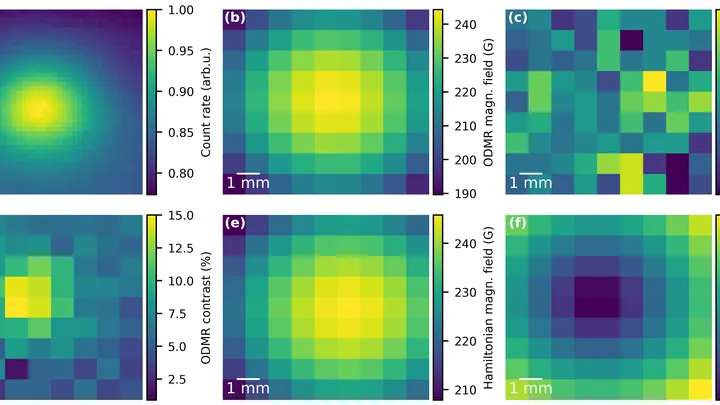
Inside a diamond, you sometimes find tiny flaws — a spot where a carbon atom is replaced by nitrogen, with a vacancy right next to it. Physicists call this an NV center (a nitrogen-vacancy defect). Such a defect acts like a magnetic needle that can store information in its spin.
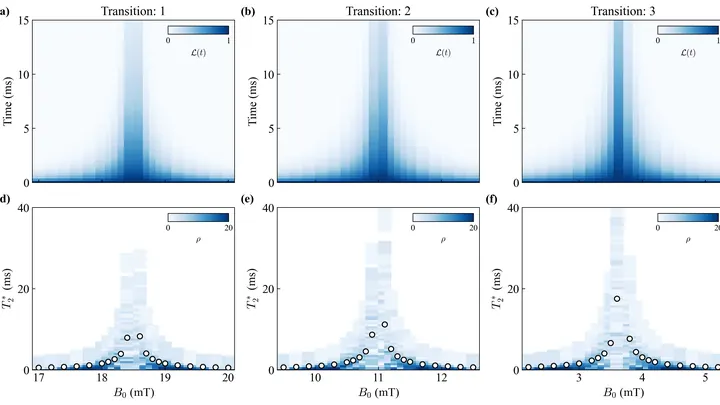
Hidden within the bulk of a diamond are tiny flaws — places where a carbon atom is replaced by nitrogen, with a vacancy gaping nearby. These defects, like beacons, can store and transmit quantum information. But around them rages a magnetic storm: the nuclei of atoms in the crystal jostle, creating interference.