A stable state is a condition of a system that persists unless disturbed by an external influence. In physics, stability can mean mechanical equilibrium, like a ball at the bottom of a bowl, or dynamical stability, like a planet in orbit. Stable states are crucial for understanding everything from atomic structure to planetary systems. They are not static—many stable states involve ongoing processes, like the steady-state of a living cell or the thermal equilibrium of a star.
History
The concept of stable equilibrium dates back to ancient mechanics, but its modern formulation in thermodynamics and dynamical systems was developed in the 19th century by figures like Henri Poincaré and Aleksandr Lyapunov.
How it works
A system settles into a stable state when small perturbations are damped rather than amplified. This often involves energy minimization: the system seeks the lowest available energy configuration. In quantum mechanics, stable states correspond to eigenstates of the Hamiltonian, where the system's properties do not change over time. In complex systems, stability can emerge from feedback loops, as seen in biological homeostasis or climate regulation.
In practice
Stable states are exploited in technology, such as in error-correcting codes for quantum computing, where stable qubit configurations protect information from decoherence.
Fun fact
Some stars are in a stable state called 'main sequence,' where the outward pressure from fusion balances the inward pull of gravity, allowing them to shine steadily for billions of years.
An octopus waits with tentacles spread wide. No central controller directs its arms, but the moment prey touches one, all eight wrap around it. Physicists have recreated a similar trick in the lab with a body that has neither neurons nor muscles: a star polymer with self-propelled arms.
The polymer was assembled from small cylindrical vibrobots on a vibrating plate.
Ordinary electric current heats up wires — anyone who has touched a phone charger knows that. But there's another kind of current: instead of electrons rushing in a crowd in one direction, they spin in sync, like figure skaters in a pairs routine. This coordinated rotation is called a spin current, and it produces almost no heat.
In a vast hall, billiard balls are scattered about. At first they lie sparsely, each on its own. Then someone adds more, and suddenly the balls compress into dense clusters. This is a phase transition — the moment when matter abruptly changes its state.
Physicists have long described such a picture with the hard-sphere model: particles are identical balls that cannot overlap.
In the ordinary world without dark energy, the mass of any object is always positive. That seems obvious: positive mass attracts, creating gravity. But the real universe has dark energy — a mysterious force making the cosmos expand faster and faster.
A runner on the middle of a track suddenly switches to a walk — not speeding up or slowing down, but maintaining a constant pace. Something similar may have happened to the universe itself shortly after the Big Bang.
Imagine an audition for a symphony orchestra, where out of hundreds of hopefuls, only those whose instruments sound pure and withstand the furious crescendo remain. In the world of materials, computers have learned to generate 'atomic scores'—thousands of virtual crystals that promise to become the foundation for quantum chips or superconductors.
The quantum vacuum is not a dead void but a boiling cauldron of probabilities. In some theories, our Universe is frozen in a metastable state: like superheated water, it's ready to explode into steam at the slightest nudge.
A neutron star is a city squeezed to the size of a metropolis, where matter is packed to the limit. At the very center of such a city, a redevelopment may begin: familiar neutrons and protons give way to quark plasma — free quarks, the building blocks of almost everything around us.
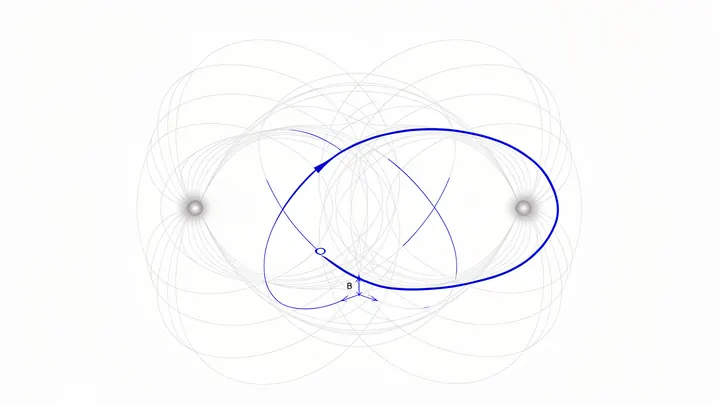
The three-body problem is the eternal stumbling block of celestial mechanics. Even Poincaré realized in the late 19th century that its chaos defies general analytical solutions. In this gravitational madness, islands of regularity appear only rarely — periodic orbits.
A child on a swing: too strong a push and they fly off. Roughly this is how powerful light tears electrons out of an atom. It would seem that the stronger the push, the more certain the destruction. But in the quantum world it is different: when the field strength crosses a certain threshold, the atom suddenly freezes.
Time crystals are quantum phases of matter that spontaneously oscillate, like a tuning fork with an infinitely decaying echo. If an ordinary spatial crystal repeats an atomic pattern in space, breaking translational symmetry, a time crystal exhibits periodicity in time, breaking time translation symmetry.
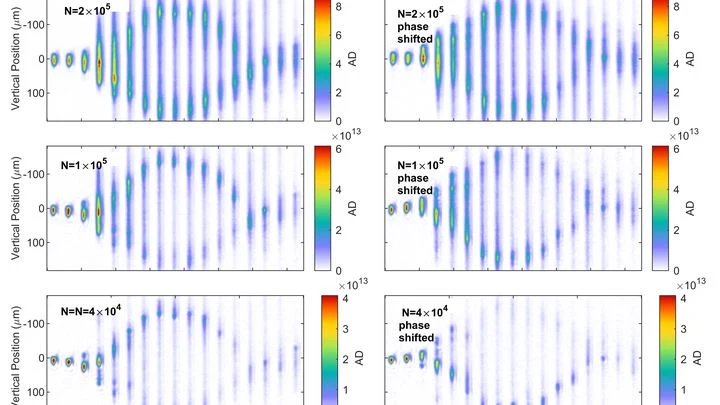
A ball on a slope with two pits usually rolls into the nearest one and comes to rest. But if the slope is slightly deformed and 'remembers' recent nudges, the ball can hang around halfway for a long time — in a narrow spot it doesn't want to leave. That's exactly the trick physicists played with light.
A crowd of people suddenly starts moving as one. In physics, this happens with atomic spins — tiny magnetic arrows. When many spins come together and interact through a shared medium, they form one big magnet, or a macrospin. This macrospin doesn't just point in one direction; it can get stuck in several positions, like an ice cube that refuses to melt even when it's warm.
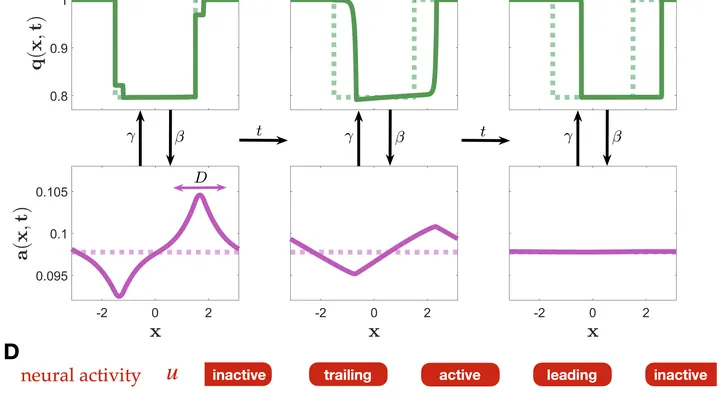
Holding a phone number in your head while you dial it: that's working memory. In the brain, a group of cells is responsible for this, sending signals to each other like people passing a bucket along a chain. But every transfer has a cost: it requires messenger substances that get used up.
In an orchestra where every musician plays the same note, the sound merges into a powerful unison. This is how a Bose–Einstein condensate is born: many boson particles at extremely low temperatures behave as a single entity.
A comet hurtling through space is a mountain of ice and dust that carries itself across the Solar System. If you mount small engines on such a mountain, it becomes a ship with its own fuel: gas from the interior can be vented through nozzles to change course.
In a tokamak, plasma is like a crowd on a narrow street: once someone starts running, everyone takes off at once. In a stellarator with a non-circular cross-section, the street is winding, with dead ends and pockets. The crowd can't gather into a single wave — people get stuck in different corners.
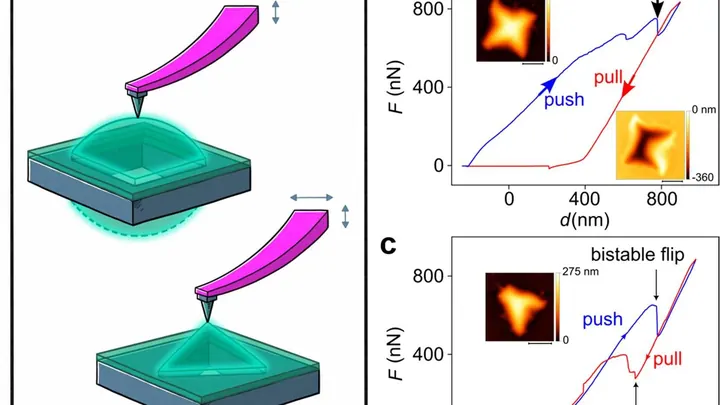
A thin film of metal oxide lies on a surface with a tiny pit. If you gently compress the film from the sides, it won't crumple — instead, it will bow downward into the pit or bulge upward like a hump. Both positions are stable, like a canning jar lid that is either concave or convex and doesn't flip back and forth on its own.
Time crystals are an exotic phase of matter that exhibits periodic motion not in space but in time, even while in its ground, unexcited state. This idea, reminiscent of a perpetual clock that never needs winding, was first proposed by Frank Wilczek.
Quantum computers use GKP states, dreamed up by Alexei Kitaev, John Preskill, and Daniel Gottesman. Their hallmark is built-in stabilizer checks that catch errors. For a long time, it was believed that a successful check guaranteed a nearly perfect state. Alas, it's an illusion.
In 1867, James Clerk Maxwell imagined a demon that sorts gas molecules and thereby violates the second law of thermodynamics. The demon needs to know the speeds of the particles. In the quantum world, a similar task arises: keep entanglement from growing like an avalanche, but you cannot observe the entire system.