Bistability is a property of a dynamical system that has two stable equilibriumstates, with an unstable threshold separating them. A bistable system can rest in either state indefinitely, but a sufficiently strong perturbation can flip it to the other state, where it remains until another perturbation pushes it back. This is the mathematical backbone of memory, switches, and many natural phenomena, from electronic flip-flops to ecological regime shifts.
History
The concept was formalized in the late 19th century by Henri Poincaré in his qualitative theory of dynamical systems, though bistable behaviors in mechanical and electrical devices were observed earlier.
How it works
Bistability arises from positive feedback: a change in the system's state reinforces itself, driving the system away from intermediate values and toward one of two attractors. Between the attractors lies an unstable equilibrium, a tipping point. A small disturbance near this threshold can send the system cascading into one stable state or the other, while disturbances below the threshold decay. The system's history (which state it occupied) matters, a phenomenon called hysteresis.
In practice
Bistability is the operating principle of every computer memory cell (SRAM, flash) and of optical switches that toggle between transparent and opaque states, as highlighted in the article 'Свет переключает материал между двумя состояниями'.
Fun fact
A bistable system can act as a one-bit memory: the two stable states encode 0 and 1, and the threshold ensures the stored value persists without power.
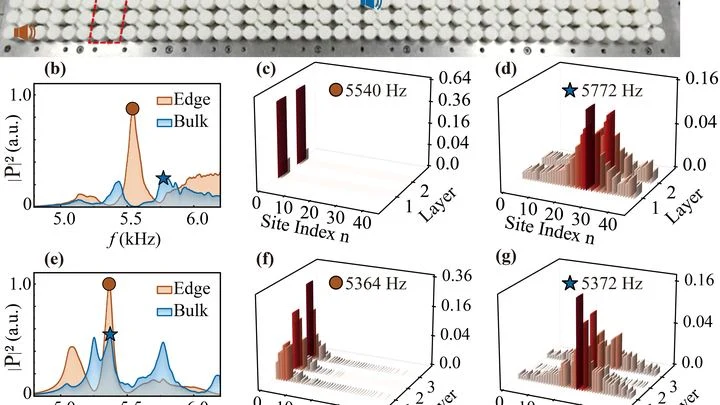
Imagine a book with latches on its pages: you can only flip a page if you know how to click its edge. That is roughly how the mechanical metamaterial we are about to discuss works. Each cell is a small mass inside a larger one, connected by an elastic beam. The beam can sit in two stable positions, like a switch.
A door lock with two different keys: one turns easily, the other demands noticeable effort. That is how two layers of hexagonal boron nitride behave when twisted relative to each other. This material consists of boron and nitrogen atoms arranged in a hexagonal lattice, and its layers can sit in different registries, like two identical grids shifted by different angles.
In an aquarium the size of a dining table, two schools of black neon tetras swim in adjacent compartments separated by a transparent wall. They cannot touch each other, but they see every movement. And here's the surprising part: when one school decides to turn left, the other does the same a moment later. It's like two pendulums hanging behind glass, starting to swing in rhythm.
Every winter, hospitals fill up, and by summer they seem to empty. Epidemics breathe like the tide. But why do waves of disease keep rolling in, even without new mutations? Mathematicians found an answer in a tug-of-war between two strains.
Within a single epidemic, two virus variants often coexist.
A forest does not live in a static world. Between winter and summer, day and night, conditions shift, and each fluctuation is like a rhythm that all its inhabitants must keep pace with. Yet until now, ecologists have mostly studied how communities of living beings persist in an unchanging environment, like testing a bridge's strength only in calm weather.
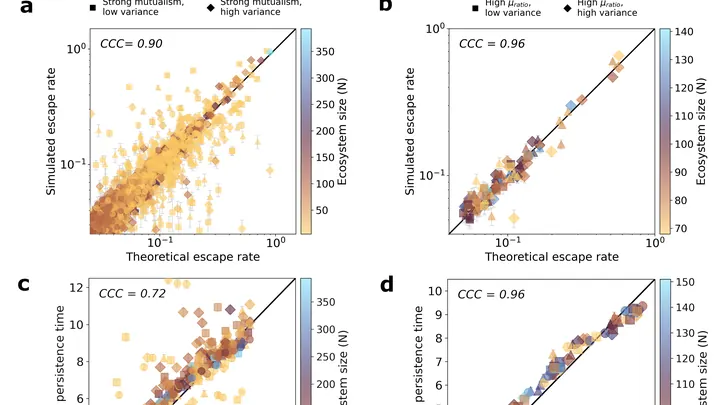
Rare species in a large community are like thin branches on a tree: a random gust can easily snap them. Even if conditions are stable, a small population simply lacks enough individuals to survive a bad season. In a new study, scientists added this factor to an ecosystem model and watched the community clean itself out.
A light switch clicks, and the light comes on. But imagine a switch that, with the same press, can either turn on the lamp or leave the room dark. It also remembers what it did last time, and sometimes it seems to flip a coin to decide whether to light up.
This kind of behavior was found in a crystal of black phosphorus — a semiconductor just a few atomic layers thick.
Two ropes glued along their length naturally twist into a double helix. That's how DNA works — except the glue is hydrogen bonds between bases, and the stiffness comes from the chains themselves.
Two gardeners haggle over water from a magical well. One proposes how many buckets to take, the other can agree or refuse. If the deal goes through, the water decreases; if not, the well gradually refills. This haggling repeats hundreds of times, and the gardeners' habits sometimes change randomly, as if they're trying new tactics.
In a room with a dead corner, sound doesn’t travel. On the wall there’s a smart mirror: it catches the sound and re-reflects it, making the hidden audible. That’s how a reflective surface works in wireless communication. But if the source is right in front of you, the mirror only creates an echo.
The railway overhead contact line resembles a galaxy: energy flows through it like gravity, with trains becoming planets. The more trains draw current simultaneously, the stronger the voltage fluctuations — gravitational waves ripple through the system, threatening blackouts.
The railway's electrical network is like an orchestra: trains are musicians whose systems respond differently to current. When their 'electric voices' fall out of tune, disorder arises — a cacophony that can escalate into dangerous voltage rocking.
A runner loses on both a smooth track and sticky sand. Seems hopeless. But if the surface underfoot starts changing every few seconds (track, then sand) the runner suddenly stops falling behind. He doesn't get faster; the environment just doesn't get a chance to 'crush' his weakness.
That's exactly what the authors found when studying a simple predator–prey model.
A runner on the middle of a track suddenly switches to a walk — not speeding up or slowing down, but maintaining a constant pace. Something similar may have happened to the universe itself shortly after the Big Bang.
In a world striving for chaos, rhythm sometimes arises. The Belousov–Zhabotinsky reaction has amazed for decades: in a test tube, color waves run on their own, as if a living organism breathing matter. Something similar lurks in crystals where iron atoms balance between two magnetic states — high-spin and low-spin.
Inside every cell, a complex network of genes determines what it will become — a nerve cell, a muscle cell, or part of the skin. This choice often resembles flipping a toggle switch: two stable positions, and the cell decides which way to tip. But cells have a feature rarely considered in such models: they divide.
Imagine two immiscible liquids, such as oil and water. Under normal conditions, they tend to separate, forming a clear interface. But introduce microscopic swimmers (bacteria, whose basis is carbon) and the picture changes dramatically.
Toss a handful of coins on a table: each one lands heads or tails on its own. Now imagine the coins start flipping over, nudging each other. That's roughly how neutrinos behave in a very dense environment.
A swing can rock strongly or barely move. Usually, if left alone, it stays in its chosen mode. But in the microworld, things are different: a tiny membrane, oscillating under the action of a laser beam, can spontaneously jump from one amplitude to another.
A person hunting for keys mentally runs through places where they might be. A bird that tucked hundreds of seeds into crevices in autumn retrieves them flawlessly in winter. How can a brain hold so many addresses when all birds have roughly the same number of neurons? The answer lies in geometry.
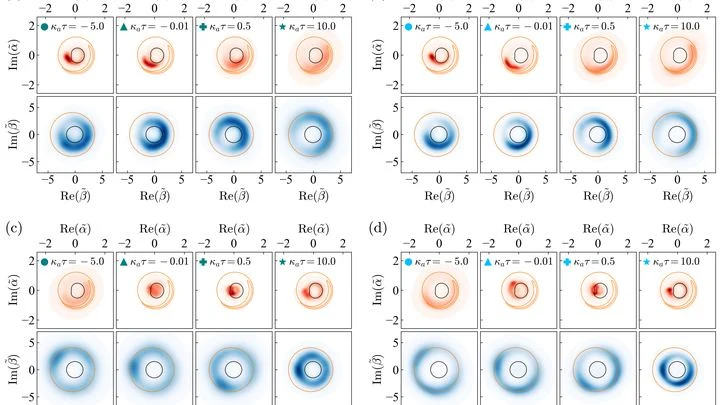
A ball on a slope with two pits usually rolls into the nearest one and comes to rest. But if the slope is slightly deformed and 'remembers' recent nudges, the ball can hang around halfway for a long time — in a narrow spot it doesn't want to leave. That's exactly the trick physicists played with light.
When hot soup cools, clumps form on the surface — similarly, as the early universe cooled, it gave birth to threadlike clumps of energy: cosmic strings. Some of them are like a stretched rubber band: as long as it's intact, it's stable. But if you nick the band, it snaps.
A person hears a ringing that isn't there. The doctor asks them to describe it — loudness, pitch, persistence. But it's subjective: one might say "like a mosquito," another "like steam from a kettle." We need a way to see tinnitus directly, in the brain itself.
In a big city after rain, water collects in the same low spots no matter where the first drops fall. An hour later, the pattern of puddles hardly depends on where the downpour started. That is equilibrium — the outcome a system reaches regardless of its start, once the details are forgotten.
A crowd of people suddenly starts moving as one. In physics, this happens with atomic spins — tiny magnetic arrows. When many spins come together and interact through a shared medium, they form one big magnet, or a macrospin. This macrospin doesn't just point in one direction; it can get stuck in several positions, like an ice cube that refuses to melt even when it's warm.
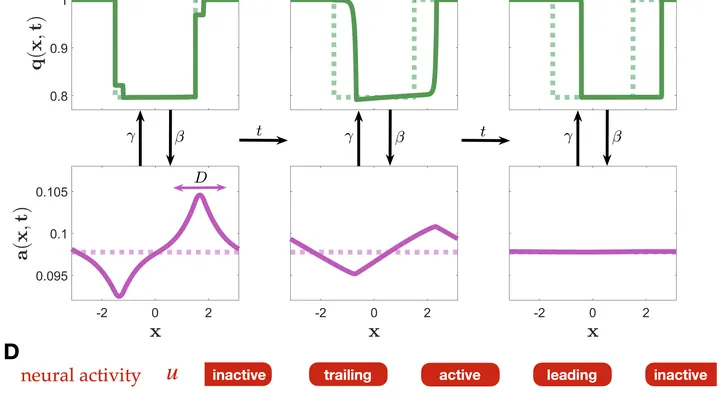
Holding a phone number in your head while you dial it: that's working memory. In the brain, a group of cells is responsible for this, sending signals to each other like people passing a bucket along a chain. But every transfer has a cost: it requires messenger substances that get used up.
A struck tuning fork fades: its vibrations leak into the air. But there are systems where the oscillation does not decay, even though there are plenty of free waves around, ready to carry energy away. Physicists call such 'captured' states bound states in the continuum (BIC).
A flat sheet with slits in a flow of water or air behaves like self-adjusting blinds. The pressure opens the gaps, and each strip of material tilts, turning into a miniature wing. Thus, even a sheet placed perpendicular to the flow generates not only drag but also significant lateral lift.
A semiconductor film just one atom thick is like a communal apartment: it houses negatively charged electrons and positively charged 'holes.' When light hits such a film, an electron and a hole can pair up into an exciton — a bound state of an electron and a hole, akin to a hydrogen atom.
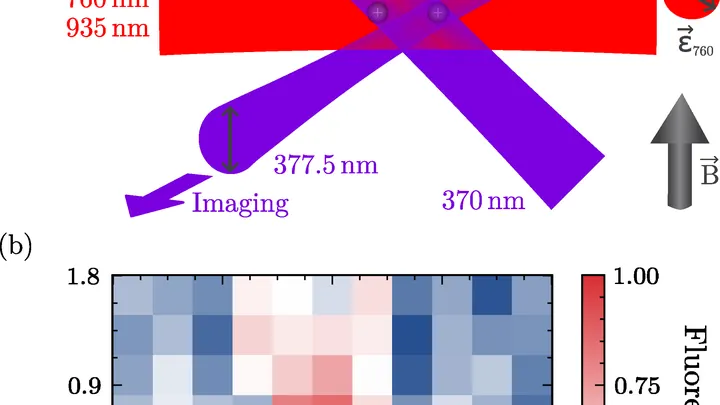
A glowing dot in a vacuum chamber refuses to go out, even though the light source has long been switched off. A single ytterbium ion, held by electric fields, is stuck in an excited state, as if the electron inside it has forgotten how to return to its usual place.
You can edit a cell perfectly, and it still turns out useless. The gene is fixed exactly as planned, yet the cell behaves unpredictably: it drifts, changes fate, loses safety. It's like fixing one gear in a watch, but the watch still runs wrong because the whole mechanism is out of sync.
Previously, a cell was viewed as a list of independent parts.
Quantum entanglement works like a leash: it ties particles together, but the length of this tether is strictly limited. In a chain of particles, heat plays the role of an impatient dog tugging at the leash — the hotter it gets, the shorter the distance over which the connection holds.
A stack of identical pancakes on a plate is just a stack. But if you arrange them with a certain order, something new suddenly appears: for example, a pattern that was not visible in each pancake individually. Physicists have performed a similar trick with thin layers of materials.
An ecosystem is like a swing that someone is subtly pushing. Previously, it was thought that the main concern was that the swing wouldn't swing too wildly. But the authors of this work showed that the greater danger is when the equilibrium point itself slides toward a place where the swing can no longer return.
Ordinary tiles form a repeating pattern. But atoms can do more: under certain conditions, they themselves lay out a complex mosaic where the pattern never repeats, like on antique tile panels.
In a plasma accelerator, particles are accelerated like surfers riding a wave created in the plasma. If the leading bunch and the trailing bunch are not aligned, an instability arises that shakes the trailing bunch. It's as if a surfer on a wave starts wobbling from side to side: their trajectory gets messed up, and they might fall off the wave.
A rubber band is stretched, and suddenly snaps. In the atomic world, a similar picture emerges: the string binding particles can break. In a new study, physicists took a chain of Rydberg atoms and tracked how such a string breaks.
Under weak tension, the string breaks completely, and the system splits into several independent pieces, as if a rubber band shattered into segments.
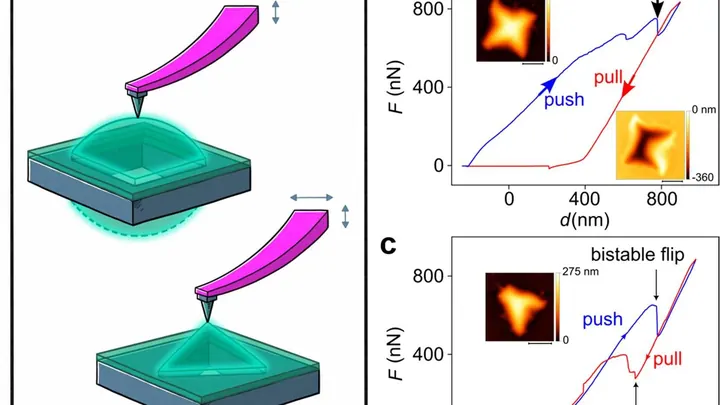
A thin film of metal oxide lies on a surface with a tiny pit. If you gently compress the film from the sides, it won't crumple — instead, it will bow downward into the pit or bulge upward like a hump. Both positions are stable, like a canning jar lid that is either concave or convex and doesn't flip back and forth on its own.
Water in a glass settles down once you stop stirring it. Oil in an engine dampens vibrations. It seems viscosity is always about damping. But in some flows, it's the opposite: add friction, and waves start to grow as if from nowhere.
Physicists have found a simple explanation.
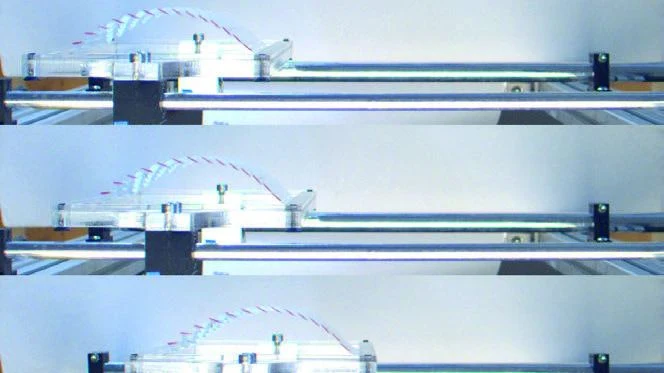
Snap the bottom of a soda can: it will dent inward and stay that way. Press again: it pops outward. That's bistability: a system with two stable states, like a light switch. An elastic arch is the simplest example. It can curve upward or downward, and to flip it, you need to apply force.