A Four-Partner Dance in Graphene express
In a superconductor, electrons move in pairs, like dance partners. Usually, through a junction between two superconductors, one pair passes at a time. But add a third contact, and the dance gets more complex: two pairs can move together, forming a foursome. It's this four-part resonance that has been seen for the first time in a graphene junction with three terminals.
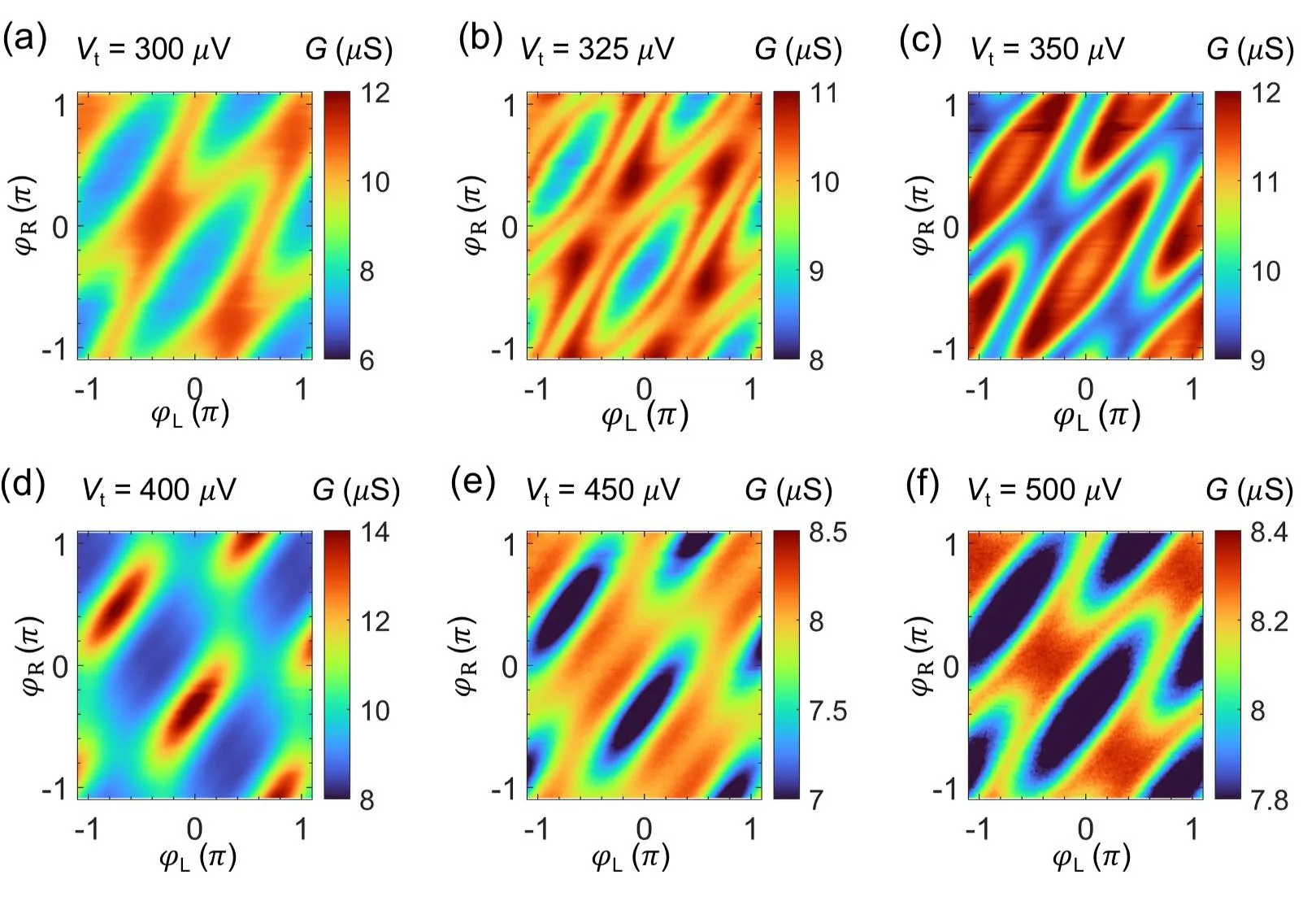
The scientists measured how the current changes as the phases at the contacts are varied. The phase is the position of the electron wave, like the phase of the moon. When two phases aligned in a special way, sharp dips appeared in the spectrum. These dips moved along closed paths around a torus — a donut shape formed by the two phases. Such winding points to a topological nature: the foursomes of pairs behave like a knot that cannot be untied without breaking.
This discovery shows that multi-contact superconducting devices can create states that are impossible in ordinary two-contact ones. In the future, such systems could help engineer new quantum materials and possibly topological qubits for quantum computers.
Original abstract
as written by the authors arXiv:2601.18036
Multiterminal Josephson junctions offer a powerful playground for exploring exotic superconducting and topological phenomena beyond the reach of conventional two-terminal devices. In this work, we present the direct spectroscopic observation of Cooper quartet resonances, a signature of correlated tunneling of two Cooper pairs across the device, in a graphene three-terminal Josephson junction (3TJJ). Using tunneling spectroscopy, we visualize how Andreev bound states (ABS) evolve across a two-dimensional superconducting phase space, controlled by the two independent phase differences in the 3TJJ. These measurements reveal sharp local minima in the differential conductance spectra locked in a specific phase condition of superconducting phase variables. The resulting quantized trajectories around the compact torus of the superconducting phase variables reveal an underlying topological winding in the multipair transport. To interpret our results, we develop a theoretical model that connects the observed quartet resonances to the coherent hybridization of multiple ABS branches, a hallmark of the rich pairing process enabled by multiterminal geometries. Our results highlight the potential of multiterminal superconducting devices to host engineered superconducting states and pave the way for new approaches to topological band structure design based on phase-controlled, higher-order superconducting transport.
The four-part resonance is like four people holding hands and spinning, their combined dance visible only to a specific tune (phase).
In the series 'The Expanse,' superconducting materials allow ships to withstand enormous G-forces — multi-contact junctions could be a step toward such technology.