A massless particle has zero rest mass and therefore always travels at the speed of light in vacuum. The most familiar example is the photon, the quantum of electromagnetic radiation. In condensed matter physics, quasiparticles in certain materials — such as electrons in graphene — behave as massless relativistic fermions, obeying the Dirac equation rather than the Schrödinger equation. This leads to extraordinary transport properties, including extremely high mobility and the ability to tunnel through barriers that would stop massive particles.
History
The concept of massless particles was established in the early 20th century with the development of special relativity and quantum mechanics. The photon was proposed by Einstein in 1905, and the Dirac equation (1928) predicted massless fermions, later realized in graphene's electronic structure (discovered experimentally in 2004 by Geim and Novoselov).
How it works
For a truly massless particle, the energy-momentum relation is E = pc, where p is momentum. This linear dispersion means the particle has no rest frame and cannot be slowed down. In graphene, electrons near the Dirac points have a linear energy-momentum relation, mimicking massless relativistic particles with an effective 'speed of light' of about 10^6 m/s. This behavior emerges from the honeycomb lattice structure and the quantum mechanical hopping of electrons between carbon atoms.
In practice
Massless particles are central to photonics, telecommunications, and solar cells. Graphene's massless electrons enable ultra-fast transistors, transparent conductors, and sensitive detectors.
Fun fact
In graphene, electrons behave as if they have zero mass, but they still carry charge — allowing them to pass through high potential barriers with perfect transmission, a phenomenon called Klein tunneling.
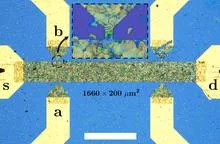
On the lab bench lies a piece of graphite grown from gas, like a deposit on the wall of a reactor. Usually, such material is not suitable for converting heat into electricity: inside it, electrons and holes run in opposite directions and cancel each other out.
The cosmological standard model is like a recipe for a cake where everything is strictly measured: dark matter is like flour without a single lump (zero pressure), and dark energy is like the perfect leavening agent (equation of state exactly minus one). But what if the flour is a bit damp and the leavening agent has lost its oomph?
At the heart of a dying star, as its core collapses into a neutron sphere, an invisible storm is born. Trillions of neutrinos, particles that barely interact with matter, race through the scorching plasma. There are so many of them that they begin to influence each other, changing their 'flavors' (electron, muon, tau) like chameleons.
In a tight row of atoms, spaced closer than the wavelength of light, a remarkable state hides. The excitation is distributed among all particles so that their radiation cancels itself out. This quantum 'silence' is an ideal vault for a photon: it can be stored there hundreds of times longer than usual.
Eight bright spots on the radio sky. They are all the same quasar HS 0810+2554, whose light passed through a gravitational lens — a massive foreground galaxy.
Ever since Fritz Zwicky noticed that galaxy clusters were moving too fast, and Vera Rubin measured the rotation of spiral arms, dark matter has remained cosmology's greatest mystery.
Spacetime is not empty: it shivers. After the Big Bang, the universe was filled with a hum of gravitational waves, like the low rumble of a giant bell. In this ripple, as it turns out, particles of dark matter, the invisible substance that holds galaxies together, can be born.
But the previous idea had a snag.
At the heart of a warp drive lies Einstein's idea that massive bodies curve spacetime — the very stage on which all cosmic events unfold. Picture a bubble of such curved spacetime. Inside it, the ship floats without any G-forces, like a passenger in an airplane cabin who doesn't feel the headwind.
A pebble falls into a pond, and ripples spread across the water. In the quantum world, the pond is not made of water but of many identical particles, and the pebble is also a particle, just a foreign one. Such a foreign particle is called a Fermi polaron.
A billiard game would be strange if the balls had no mass. They wouldn't collide but would pass through each other, ignoring obstacles. That's roughly what it looks like to imagine light as a stream of classical particles — tiny elastic bodies flying in straight lines. A new proof puts an end to that picture.
When an electric charge moves with acceleration, it emits electromagnetic radiation, i.e., light — a familiar phenomenon in physics. However, researchers have found that when moving along a specially chosen trajectory, the radiation acquires unusual properties.
In the quantum world, light and matter constantly exchange energy. Previously, they were described statically, like frozen poses. The new approach follows the dance itself: the transitions between states, like a continuous sequence of movements.
When light swings past a massive body like a black hole, its path warps — an effect predicted by Einstein. New research has taken into account that near such objects, clouds of hadrons often swirl — the very particles we know from protons and neutrons in atomic nuclei.
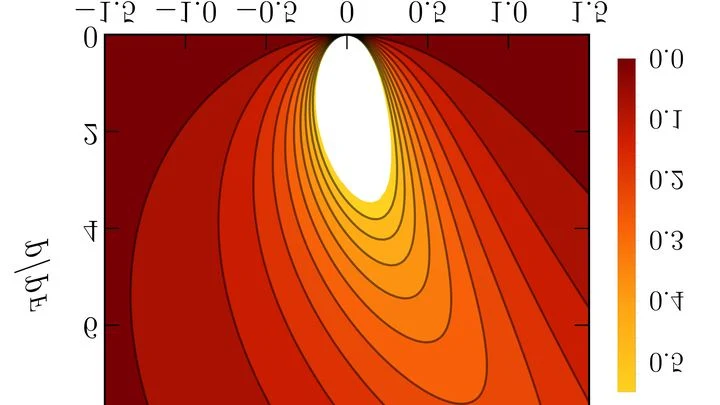
A sheet of graphene one atom thick is like a perfectly smooth tablecloth on which electron marbles roll. Place an electric barrier in their path, and usually they'll bounce back. But in graphene, it's different: under certain conditions, electrons pass through the barrier without even noticing it, as if the wall were made of mist.
For a long time, cosmologists could not peer beyond the starting point — the infinitely dense singularity of the Big Bang, where the equations of general relativity by Einstein lose their predictive power.
In the macroscopic world we know, any motion inevitably decays: friction, a dissipative process that scatters energy, intervenes. But quantum reality has surprises in store.
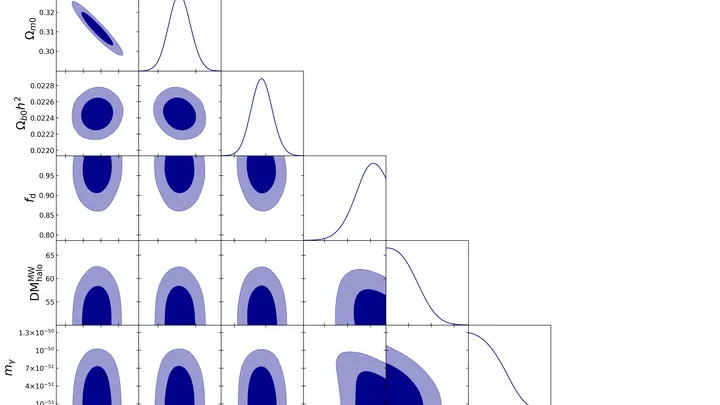
Fast radio bursts are brilliant cosmic flashes that, like a starting signal, set off a race of radio waves across the universe. Astronomers used them as a natural laboratory to test whether the photon, the quantum of light and the carrier particle of the electromagnetic interaction, has mass.