A charge qubit is a type of superconducting qubit, the basic unit of quantum information in a quantum computer, where the two logical states (|0⟩ and |1⟩) are distinguished by the number of Cooper pairs—pairs of electrons that move together in a superconductor—on a small island. The qubit is typically formed by a tiny superconducting island connected to a reservoir via a Josephson junction, which allows Cooper pairs to tunnel in and out.
History
The charge qubit was first proposed and demonstrated in the late 1990s, with key experiments by the NEC group led by Yasunobu Nakamura and Jaw-Shen Tsai in 1999, who showed coherent oscillations in a Cooper-pair box.
How it works
The charge qubit operates in the regime where the charging energy (the energy cost of adding an extra Cooper pair) dominates over the Josephson coupling energy. By applying a gate voltage, you can tune the system so that two adjacent charge states (say, n and n+1 Cooper pairs) are nearly degenerate. The Josephson junction then provides a tunneling term that couples these states, creating a two-level quantum system. The qubit's state is controlled by microwave pulses that drive transitions between the two charge states, and readout is done by measuring the charge or the associated current.
In practice
Charge qubits are used in experimental quantum computing, particularly in early superconducting quantum processors, though they have been largely superseded by transmon qubits, which are less sensitive to charge noise.
Fun fact
The charge qubit is so sensitive to stray electric fields that even a single electron moving nearby can cause decoherence, which is why it was later modified into the transmon design to reduce this sensitivity.
In a quiet room with no magnets anywhere, two electrons in a silicon trap still feel a faint trembling. It comes from the nuclei of silicon and germanium atoms, which spin randomly like the needles of broken compasses. This trembling was once considered noise, but now it has become a measuring instrument itself.
A courtroom interpreter must relay every word without being distracted by noise in the room. In the quantum world, a superconducting resonator plays that role, losing photons on schedule without straying into spurious effects.
In a narrow corridor, people walk in rows rather than as a crowd. The number of rows depends on the width of the passage. In graphene, this corridor is a quantum point contact — a constriction where electrons move ballistically without scattering.
A quantum computer isn't just a bunch of qubits: it's a whole city, where each resident is one of the machine's possible states. Residents get to know each other through weak interactions between qubits: if one state can transition to another, a thread of acquaintance is drawn between them.
At low temperatures, many materials become superconductors — current flows without resistance. But how exactly does this happen if electrons were initially trapped in an insulator? Half a century ago, Philip Anderson suggested that the answer lies in a special quantum dance of particles.
Drop by drop from a faucet, or a steady stream without a single splash. That's roughly what the two regimes of current in a superconducting contact look like. Only here, the role of water is played by Cooper pairs — bound electrons that move without resistance.
An empty resonator isn't truly empty. Even in an absolute vacuum, where not a single photon exists, quantum fluctuations persist. They resemble ripples on water in a dead calm: the surface appears smooth, but molecules keep jittering. Physicists have learned to turn this jitter into real waves.
In superconductors, electrons pair up and flow without resistance. Usually, these pairs are distributed uniformly, like water in a calm lake. But sometimes ripples appear in the material — pairs bunch up and thin out with a certain period. This state is called superconductivity with pair-density waves.
An optical trap holds an atom almost motionless, like a ball on a soft spring. But as soon as acceleration appears, say gravity, the equilibrium shifts. The atom moves within the standing light wave, and this changes the rate at which it exchanges energy with the field. The frequency of this exchange becomes a direct indicator of acceleration.
Honeycombs filled with electronic 'honey.' In the normal state, electrons move chaotically, but upon strong cooling they can pair up: this is how superconductivity emerges. The shape of these pairs, or pairing symmetry, determines the material's properties: some dance a waltz, others a foxtrot.
Superconductivity is often pictured as a frozen dance of electrons: they pair up and move without resistance, like figure skaters on perfect ice. But in high-temperature superconductors, that ice turns out to be not so smooth.
The old question of Maxwell’s demon, can an intelligent being circumvent the second law of thermodynamics and pump heat from cold to hot, gains new resonance in the quantum world.
In the crystal CsV3Sb5-xSnx, which becomes a superconductor at low temperatures, current does not flow as a uniform stream but along narrow, winding paths. A scanning microscope with a sensitive magnetic field sensor helped reveal these paths: it picks up the faintest currents, much like a sonar probes the seafloor.
In some materials, electric current can flow without any loss: this is superconductivity. But before becoming a superconductor, a substance often passes through a strange state: electrons already sense each other and form pairs, yet they cannot move in unison.
Using laser spectroscopy — a method akin to listening to the echo from a crystal — physicists examined the layered material. They found regions where electrons move freely (Fermi pockets) and noticed that each such region behaves in its own way.
Three guitar strings on the same instrument, but each tuning peg turns with a different resistance: one gives way immediately, another is stiff, and the third is completely stuck.
A swing can rock strongly or barely move. Usually, if left alone, it stays in its chosen mode. But in the microworld, things are different: a tiny membrane, oscillating under the action of a laser beam, can spontaneously jump from one amplitude to another.
Two simultaneous interpreters sit in the same booth. The first translates from English into Russian but swallows half the words. The second goes from Russian into French, and also loses half. If you put them together, you'd expect a mess: the losses would add up, and only a quarter of the meaning would reach the listener. But what if they start correcting each other?
Ordinary batteries lose charge like tea cools down. A quantum battery works differently: its heart is a tiny cavity with darting photons. If you illuminate it with special photon pairs, energy flows into a chain of qubit cells instantaneously — much like a swing gets a boost from strong pushes.
The dance floor is packed: everyone moves on their own, no one holds hands. Suddenly the music gets louder and more rhythmic — neighbors start grabbing each other, forming pairs that spin in sync. That's roughly what the experiment looked like in the lab, where a cloud of lithium atoms, cooled to near absolute zero, was made to suddenly strengthen its mutual attraction.
Before assembling a huge puzzle, you need to stamp out the pieces — otherwise the picture won't come together. In fusion-based quantum computers, the role of such pieces is played by tiny clumps of light — photonic resource states. They are collided and measured to gradually grow the computational fabric.
An ordinary battery in a phone stores energy in chemical bonds — slowly, with heat and wear. A quantum capacitor works differently: it charges not with matter but with rhythm. A swing that is pushed in time with its motion accumulates energy in the motion itself, without friction.
A stone falls into a pond — ripples spread across the water. In physics, a similar conservation law works for energy and momentum: what goes in comes out. But in curved spacetime, where gravity rules, conserved quantities are harder to define.
In a superconductor, electrons pair up like dancers holding hands. Usually, the distance between them, the pair size, depends on how fast they move and how strongly they are bound. But sometimes the dance floor almost disappears, and there's nowhere to move. This happens in materials with flat electronic bands: electrons nearly freeze, and the usual rules stop working.
Picture a packed bus where every passenger is an electron. In a superconductor, passengers pair up and move in sync, losing no energy. But in high-temperature superconductors like cuprates, this idyll only works when extra passengers are added. If you drop some off, the pairs start acting strangely.
In the world of superconductors, electrons don't like to be alone. They typically pair up into Cooper pairs and move without resistance, like figure skaters holding hands. But you can make them dance in fours. The authors of this work propose a scheme where Cooper quartets, groups of four electrons exchanging partners in a rapid rhythm, are born.
Four musicians play in harmony only if they hold hands. In the quantum world, such a chain is formed by four electrons in four neighboring quantum dots — tiny traps for charge. This is the basis of the SAGE qubit (from "singlet-based always-on exchange").
The crystal of the uranium compound UTe2 resembles a layered cake where electrons flow without resistance. But if you examine its surface under a microscope, you see ripples, like waves on water from a thrown stone.
In quantum batteries, charging can be accelerated by shuffling the steps in time, like a deck of cards. Instead of a smooth energy climb, you get abrupt efficiency explosions, like microscopic supernovae inside atoms.
In a superconducting resonator, light doesn't just bounce around: it embraces the qubit so tightly that their joint dance can no longer be described by old textbooks. The researchers took an indium arsenide nanowire, turned it into a superconducting qubit, and placed it inside a microwave resonator.
An ordinary superconducting qubit is like a swing that any gust of wind can set rocking. The slightest change in electric charge nearby, and the quantum state is already spoiled.
A quantum computer is like an orchestra, where each qubit is a musician playing their part. But every now and then, a cosmic ray bursts into the hall, and the violinist flinches, losing the rhythm. These particles from deep space pierce the chip, knock out extra electrons, and spoil the delicate quantum music.
A quantum computer is like an orchestra where every musician must hit their note without going flat. But superconducting qubits share a common ailment: random charges accumulate on their electrodes, and the 'note' drifts. Engineers call this charge offset drift, and usually battle it for years.
A quantum computer based on electron spins is like a row of tiny spinning tops. Each top spins either clockwise or counterclockwise: that's a qubit. To find out the result of a computation, you typically stop the top and see which way it fell. But if you have many tops, each one needs its own "eye"—an extra helper qubit.
The quantum Hall effect has long been suspected of superfluidity — the ability to flow without friction. Imagine a cook following a recipe: for each unit of magnetic flux, he must add exactly a certain number of electrons.
A drop of metal on a semiconductor is like an island in the sea. For an electron to reach that island, it must pay a "toll": overcome a barrier that arises because the island is tiny, and each extra charge significantly changes its energy. This phenomenon is called Coulomb blockade. It underpins single-electron transistors, where current flows one electron at a time.
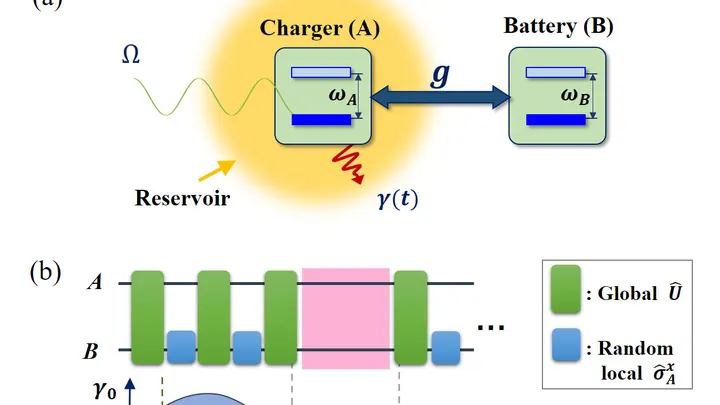
A quantum battery is a device that stores energy in the quantum states of particles. In the new work, the battery was modeled as a pair of qubits — the tiniest carriers of information that can be in a "zero" state, a "one" state, or a mixture of both.
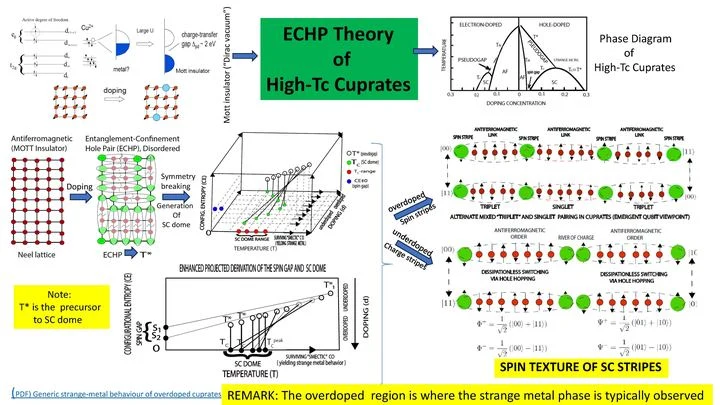
Inside some materials, electric current flows with zero resistance. These are superconductors, and they only work when it's very cold. Copper oxides are special: they stay superconducting at somewhat higher temperatures, but why has been a puzzle for forty years.