Light Fringes Betray a Photon’s Spin
On the wall: light and dark fringes. That’s what light looks like when it cancels itself out.
Way back in the 17th century, Christiaan Huygens suggested that light is a wave.
The wave-like behavior of particles that leads to constructive and destructive patterns.Quantum interference is the phenomenon where particles like electrons, photons, or atoms behave as waves, and their probability amplitudes add together — sometimes reinforcing (constructive interference) and sometimes canceling (destructive interference). This is not just a mathematical trick; it produces observable patterns like the alternating bright and dark fringes in the double-slit experiment. It lies at the heart of quantum mechanics, explaining everything from the stability of atoms to the operation of modern quantum devices.
The concept emerged from Thomas Young's double-slit experiment with light in 1801, but its full quantum significance was realized by Louis de Broglie (1924) and Erwin Schrödinger (1926) who applied wave behavior to matter.
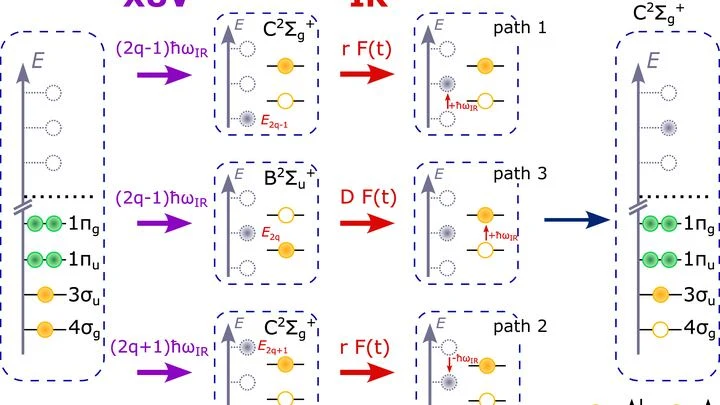
Each possible path a particle can take is assigned a complex number (amplitude). When multiple paths lead to the same final state, these amplitudes are summed. The magnitude squared of the total gives the probability. If the phases of the amplitudes align, they add up; if they oppose, they cancel. This is why electrons in an atom don't spiral into the nucleus — certain orbits have destructive interference for all other paths.
Used in quantum computing for qubit manipulation, in interferometric sensors for gravitational wave detection (LIGO), and in electron microscopy to enhance resolution.
In the double-slit experiment, even single particles fired one at a time build up an interference pattern, meaning each particle interferes with itself.