The Josephson current is a supercurrent that flows between two superconductors separated by a thin insulating barrier (a Josephson junction) without any applied voltage. This phenomenon arises from quantum tunneling of Cooper pairs — bound pairs of electrons that carry supercurrents — across the barrier. It is the fundamental building block of superconducting electronics, including the most sensitive magnetometers in existence.
History
Brian Josephson predicted the effect in 1962 while a graduate student at Cambridge, based on theoretical considerations of superconductivity. His prediction was experimentally confirmed within a year by Philip Anderson and John Rowell at Bell Labs, and Josephson received the Nobel Prize in Physics in 1973.
How it works
In a superconductor, electrons form Cooper pairs that condense into a single quantum state described by a macroscopic wavefunction. When two superconductors are brought close together with a thin barrier, the wavefunctions overlap, allowing Cooper pairs to tunnel through. The current depends on the phase difference between the two wavefunctions: I = I_c sin(φ), where I_c is the critical current. If a voltage V is applied, the phase evolves in time, producing an alternating current with frequency 2eV/h — the AC Josephson effect. Without voltage, a steady DC current flows, which is the Josephson current.
In practice
Josephson junctions are used in superconducting quantum interference devices (SQUIDs) for measuring tiny magnetic fields, in voltage standards that define the volt, and as qubits in superconducting quantum computers.
Fun fact
The frequency of the AC Josephson effect is exactly 483.6 GHz per millivolt, a relation so precise that it is now used to define the international standard for voltage.
You don't build a road by demolishing neighboring houses: first you lay the asphalt, then you grind away the excess, leaving a smooth surface. That's roughly what physicists in Heidelberg did when they took on the production of Josephson junctions, tiny sandwiches of superconductor and insulator through which current flows without resistance.
A tiny black hole flies through a hydrogen cloud and stretches atoms like taffy. That is what a superconductor looks like when it traps a persistent current: a material in which electricity flows without losses turns into a miniature permanent magnet.
A courtroom interpreter must relay every word without being distracted by noise in the room. In the quantum world, a superconducting resonator plays that role, losing photons on schedule without straying into spurious effects.
A superconducting quantum interferometer is a device that senses magnetic fields billions of times weaker than the needle of an ordinary compass. Inside it, there is a narrow bridge where superconductivity briefly breaks.
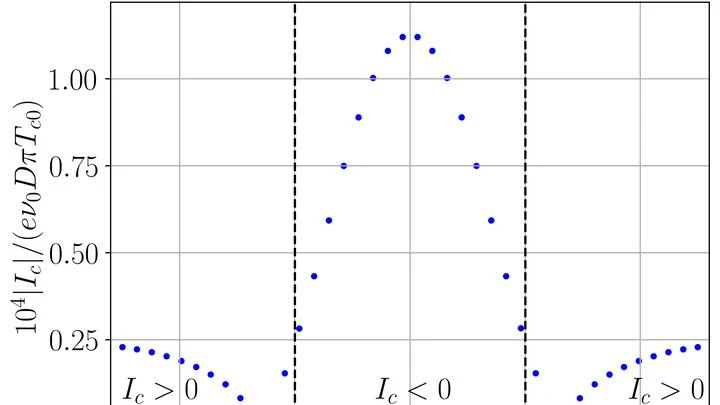
A water pipe: the wider it is, the more water flows through. In superconducting contacts — Josephson junctions (bridges through which current flows without resistance)—it's usually the same: the better the material conducts in its normal state, the larger the superconducting current that flows through it.
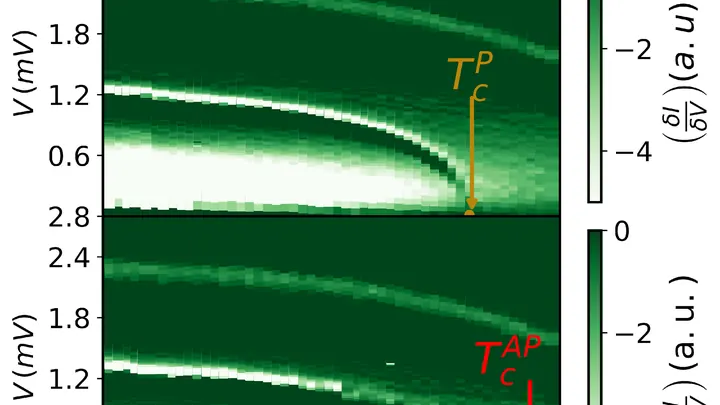
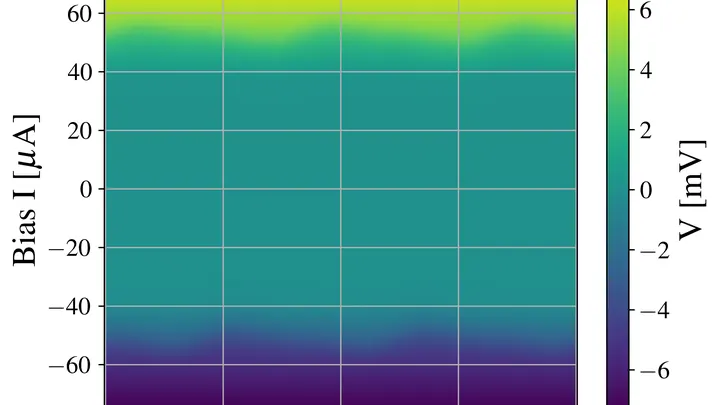
The Josephson junction is a bridge made of superconductor, separated by an ultra-thin insulating layer. Current flows through it even without voltage. But when the current becomes too large, the bridge starts to oscillate, and even steps, Shapiro steps, appear on the voltage graph. Between these steps hide invisible gaps where the system behaves strangely.
Drop by drop from a faucet, or a steady stream without a single splash. That's roughly what the two regimes of current in a superconducting contact look like. Only here, the role of water is played by Cooper pairs — bound electrons that move without resistance.
Ordinary electric current heats up wires — anyone who has touched a phone charger knows that. But there's another kind of current: instead of electrons rushing in a crowd in one direction, they spin in sync, like figure skaters in a pairs routine. This coordinated rotation is called a spin current, and it produces almost no heat.
A thin film of a special crystal (for instance, molybdenum disulfide) sits on a microscope stage. The temperature is just above the point where the material becomes a superconductor.
In the quantum world, there is its own dance. Two superconducting toroids, each comfortably holding its quantized magnetic flux, whirl in a synchronous waltz. Between them is a vacuum, not a single field line, yet they mirror each other’s moves without fail.
In a superconducting ring shaped like a washer, current sometimes flows more easily in one direction than the other. This property is called the diode effect. Usually, its direction is rigidly set by the material's structure. But in new work, physicists showed that it can be switched, and the switch is the number of magnetic vortices trapped in the ring.
The classical Mpemba paradox — hot water freezes faster than cold — has teased scientists for centuries. Only recently has nonequilibrium statistical mechanics explained it: it’s all about boundary conditions; the system seems to seek an excuse to “hit the wall” and speed up cooling.
Superconductivity is often pictured as a frozen dance of electrons: they pair up and move without resistance, like figure skaters on perfect ice. But in high-temperature superconductors, that ice turns out to be not so smooth.
In the crystal CsV3Sb5-xSnx, which becomes a superconductor at low temperatures, current does not flow as a uniform stream but along narrow, winding paths. A scanning microscope with a sensitive magnetic field sensor helped reveal these paths: it picks up the faintest currents, much like a sonar probes the seafloor.
A switch that knows which way to let current flow. That's how a Josephson diode works — a superconducting bridge where current goes willingly in one direction but meets resistance in the other. In the new study, such a bridge was made from graphene — a sheet of carbon just one atom thick.
The universe is like a layered cake, and our layer (stars, planets, and people) is just one of many. In a neighboring layer, which physicists call the hidden sector, processes are boiling away. This work describes one such process: a first-order phase transition, where matter abruptly changes state, like water turning into ice.
A supersolid is matter that is both crystalline and fluid. It is created from atoms cooled almost to absolute zero. In new work, physicists obtained such a substance as a triangular lattice of droplets. Each droplet oscillates in its own rhythm.
In a water supply system, water sometimes flows not as a continuous stream but in separate identical portions, as if the tap opens and closes, letting through exactly one drop each time. This is roughly how electric current behaves in superconducting contacts called Josephson junctions.
A swing can rock strongly or barely move. Usually, if left alone, it stays in its chosen mode. But in the microworld, things are different: a tiny membrane, oscillating under the action of a laser beam, can spontaneously jump from one amplitude to another.
The atom is like a conductor, and the light in the resonator is the orchestra. Their energy exchange, known as the Jaynes–Cummings interaction (part of the Standard Model), lets the atom use “baton” strokes to change the rhythm and timbre of the oscillations.
A bridge of aluminum just a few atoms thick is the heart of many quantum devices. Current flows through such a bridge without resistance, and it can be controlled with a magnetic field. These bridges are called Josephson junctions, after the British physicist who described their behavior.
An ordinary flash drive in your pocket gets warm even when it's just sitting there. Now imagine memory that, in the cold, uses almost nothing, like a thermos that never cools down. A superconductor carries current without loss at liquid-helium temperatures, but it couldn't store data. The new cell changes that.
A superfluid gas behaves like a frictionless liquid. Two clouds of such gas are connected by a narrow bridge, and a stream of particles flows through it. This resembles the Josephson effect in superconductors, but here the particles are neutral atoms instead of electrons.
When you flip a switch, the light doesn't come on immediately — electrons in the wires need time to 'get going' and move together. In ordinary metals and semiconductors, current builds up gradually, like water in a hose when you first open the tap.
In the world of superconductors, electrons don't like to be alone. They typically pair up into Cooper pairs and move without resistance, like figure skaters holding hands. But you can make them dance in fours. The authors of this work propose a scheme where Cooper quartets, groups of four electrons exchanging partners in a rapid rhythm, are born.
Two superconducting banks are connected by a bridge of magnetic material. Inside the bridge lies a domain wall: a narrow boundary where the magnetization rotates, like a column of soldiers changing their marching direction.
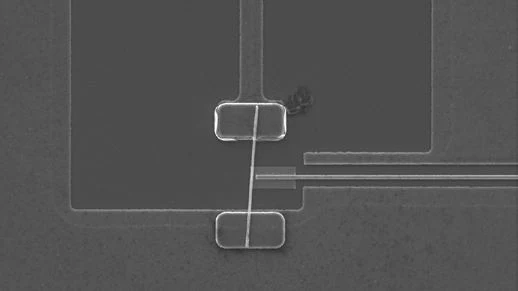
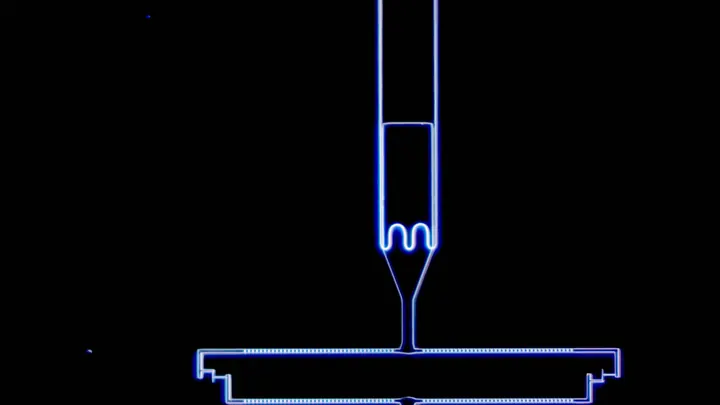
A quantum chip is like a layered cake: superconducting metal, a thin insulator layer, and more metal. Previously, layers were applied through a polymer mask, like a stencil for paint. The polymer left invisible droplets on the surface that degraded superconductivity and compromised cleanliness.
Now, the mask is gone.
Two identical cars roll off the same assembly line. Body, wheels, steering — everything matches. Only one has a regular gasoline engine, while the other has a hybrid engine that can be tuned to the road. And the hybrid stalls after a couple of kilometers, while the gasoline one runs for tens.
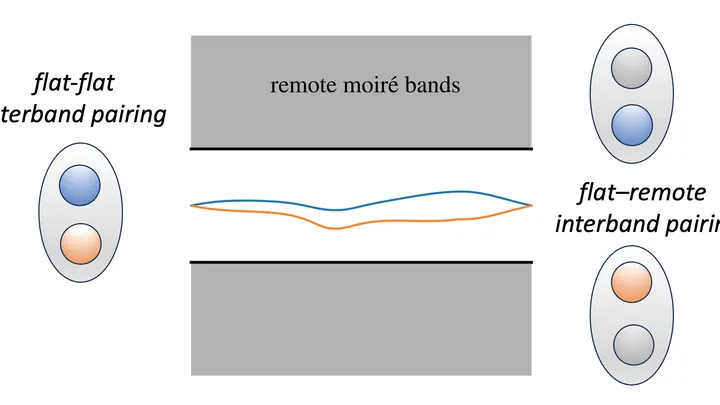
A sheet of graphene one atom thick is twisted at a small angle, and it starts behaving like a layered pie with layers slightly rotated relative to each other. At a certain twist angle, this material becomes a superconductor: electrons begin to move in pairs, like dancers in a waltz, without losing energy. But what exactly happens inside has remained a mystery.
Superconducting circuits often rely on Josephson junctions — places where current flows without resistance through a thin barrier. Typically, this barrier is an oxide layer, but its properties are hard to control at the nanoscale. In this new work, the barrier is a thin layer of niobium or titanium nitride sandwiched between niobium layers.
A sheet of graphene one atom thick is like a perfectly smooth tablecloth on which electron marbles roll. Place an electric barrier in their path, and usually they'll bounce back. But in graphene, it's different: under certain conditions, electrons pass through the barrier without even noticing it, as if the wall were made of mist.
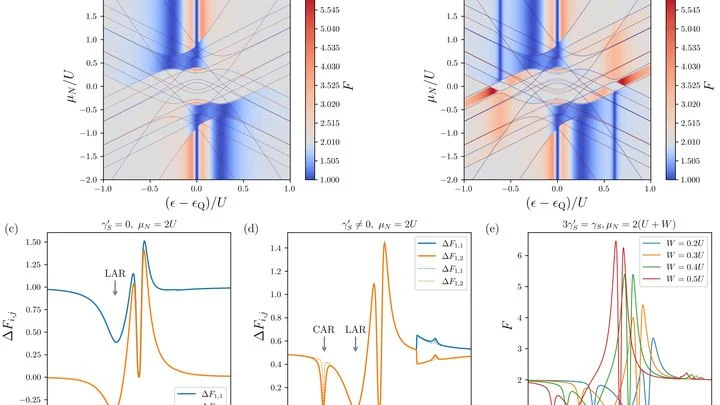
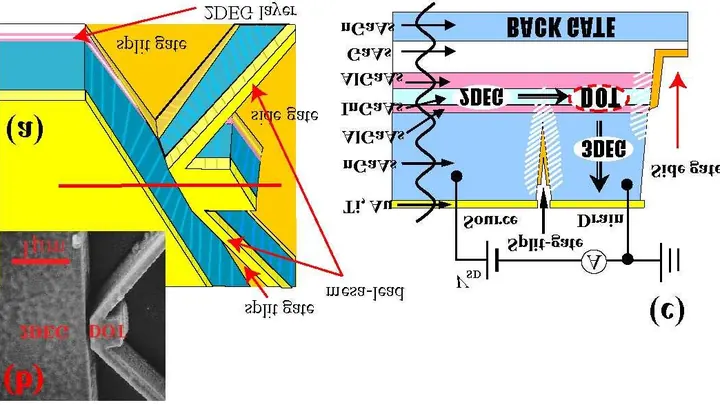
A quantum dot is like a tiny island where one or a few electrons can settle. In this new work, such an island was connected to two 'seas' of electrons: one flat like a pancake, the other bulky like an ocean. Electrons can hop from the island to the seas and back, and this hop depends on the shape of the electron's wave on the island.
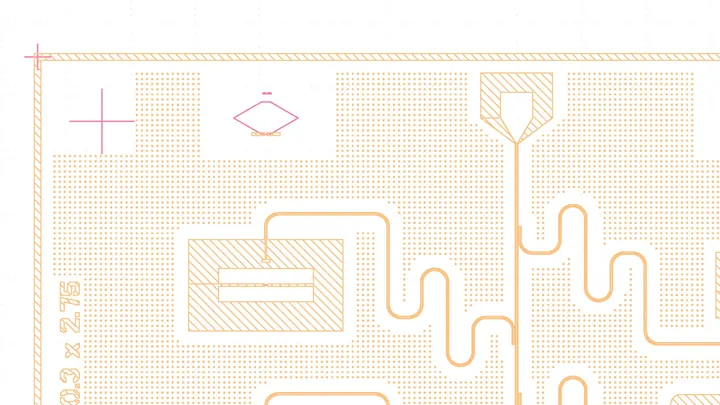
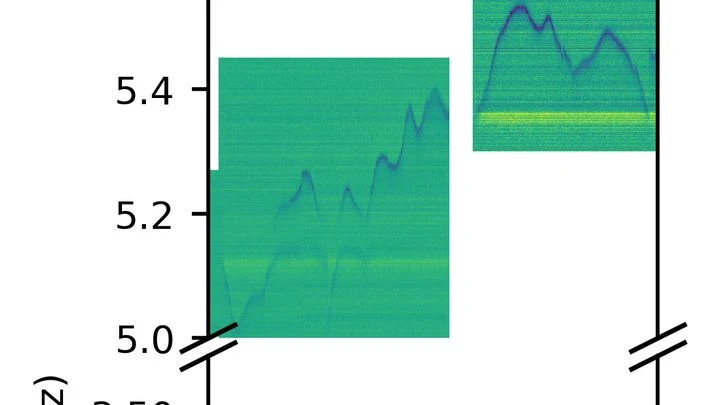
In a superconducting resonator, light doesn't just bounce around: it embraces the qubit so tightly that their joint dance can no longer be described by old textbooks. The researchers took an indium arsenide nanowire, turned it into a superconducting qubit, and placed it inside a microwave resonator.
An ordinary superconducting qubit is like a swing that any gust of wind can set rocking. The slightest change in electric charge nearby, and the quantum state is already spoiled.
A quantum computer is like an orchestra where every musician must hit their note without going flat. But superconducting qubits share a common ailment: random charges accumulate on their electrodes, and the 'note' drifts. Engineers call this charge offset drift, and usually battle it for years.
A superconducting contact is like a narrow bridge between two shores, carrying current without friction. Place such a bridge near a massive star, and it will feel time flowing slower near the star's surface. Clocks on the shores tick at different rates, and the current begins to oscillate differently.
But if the star rotates slowly, the picture gets more complicated.
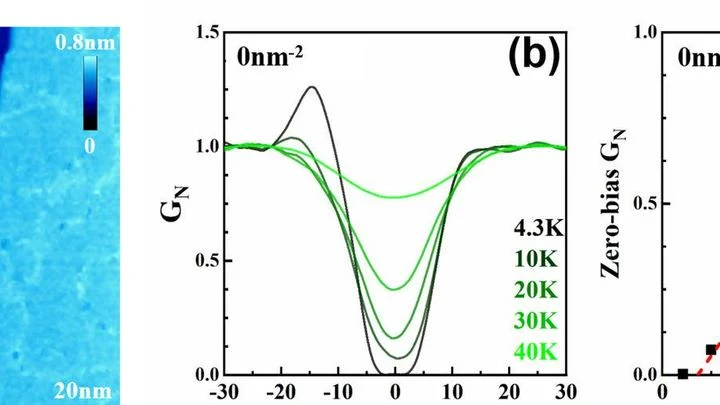
A superconductor carries current without loss, like a perfectly smooth road where cars glide with no friction. But what if you scatter rocks and potholes across that road? Scientists decided to find out by adding disorder to a superconducting material just one atom thick.
A qubit, the computational unit of a quantum computer, lives for fractions of a millisecond before forgetting its state. One culprit is a tiny contact inside it: two layers of aluminum sandwiching a layer of aluminum oxide just a couple of nanometers thick.