Aluminum oxide (Al₂O₃) is a wide-bandgap dielectric material that, in its amorphous form, serves as the insulating barrier in Josephson junctions—the core building block of superconducting qubits. In these junctions, two superconducting electrodes are separated by a thin (~1–2 nm) layer of aluminum oxide, through which Cooper pairs tunnel quantum mechanically. The properties of this oxide layer—its thickness, uniformity, and atomic structure—directly determine the qubit's energy levels, coherence times, and noise characteristics. The provided titles highlight its role: the thickness of aluminum is linked to qubit noise, and the internal structure of the junction contact is probed to understand what limits performance.
History
The use of aluminum oxide as a tunnel barrier in Josephson junctions dates back to the 1960s, following Josephson's prediction (1962) and the first fabrication of superconducting tunnel junctions. The material was adopted because aluminum forms a stable, self-limiting native oxide that is easy to grow and provides a uniform barrier. The systematic study of its role in qubit decoherence began in the 2000s with the rise of superconducting quantum computing.
How it works
Aluminum oxide is formed by oxidizing a thin aluminum film, typically by exposing it to oxygen or via plasma oxidation. The resulting amorphous Al₂O₃ is a good insulator with a high dielectric constant (~9) and a large bandgap (~8.8 eV), preventing leakage of electrons while allowing quantum tunneling of Cooper pairs. The thickness is controlled to a few nanometers; too thick and tunneling is suppressed, too thin and pinholes cause shorts. The atomic structure is disordered, and the dangling bonds or trapped charges create TLS defects that couple to the qubit, causing energy loss and dephasing. Researchers use techniques like transmission electron microscopy and noise spectroscopy to characterize these defects.
In practice
Aluminum oxide is used in every superconducting qubit (transmon, fluxonium, etc.) as the Josephson junction barrier, and also in solar cells as a surface passivation layer, in memristors, and as a protective coating in microelectronics.
Fun fact
The thickness of the aluminum oxide barrier in a Josephson junction is only about 1–2 nanometers—roughly 5–10 atoms across—yet it must be uniform to within a single atomic layer for the qubit to work reliably.
You don't build a road by demolishing neighboring houses: first you lay the asphalt, then you grind away the excess, leaving a smooth surface. That's roughly what physicists in Heidelberg did when they took on the production of Josephson junctions, tiny sandwiches of superconductor and insulator through which current flows without resistance.
A stack of pages that has been flipped through many times remembers it: some sheets lie flat, others stick up, and creases remain here and there. Layered materials behave much the same way when ions enter them.
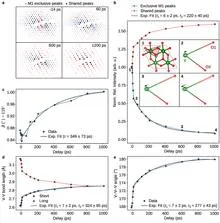
The camera captures not a race but a dance of atoms. In vanadium dioxide, the transition from an insulating to a metallic state occurs within trillionths of a second, yet until now no one had seen exactly how the vanadium and oxygen atoms move. Now, ultrafast electron diffraction has captured this route frame by frame.
A transparent film of bismuth tungstate sits on a substrate and does not conduct electricity. Three minutes in a cloud of nitrogen plasma, and it turns black, with resistance dropping by a factor of a billion.
A courtroom interpreter must relay every word without being distracted by noise in the room. In the quantum world, a superconducting resonator plays that role, losing photons on schedule without straying into spurious effects.
A superconducting quantum interferometer is a device that senses magnetic fields billions of times weaker than the needle of an ordinary compass. Inside it, there is a narrow bridge where superconductivity briefly breaks.
The thinner the ferroelectric film, the stronger the depolarizing field — a dictate of classical physics. Imagine a pencil balancing on a fingertip: the shorter it is, the harder to keep it upright. Nanoscale polarization likewise strives to vanish.
A quantum computer is like an orchestra where every musician must play their part without missing a beat. The musicians are qubits — carriers of quantum information. For the orchestra to sound harmonious, you need qubits that are reliable, controllable, and not too sensitive to noise.
A switch that knows which way to let current flow. That's how a Josephson diode works — a superconducting bridge where current goes willingly in one direction but meets resistance in the other. In the new study, such a bridge was made from graphene — a sheet of carbon just one atom thick.
Electrons in a conductor are like a chaotic crowd: colliding, they lose energy, and resistance arises. In a superconductor, however, they move in unison, like partners in a well-coordinated dance, without touching each other. This state has reduced энтропией — meaning disorder.
Such behavior is rare for gold and copper.
A bridge of aluminum just a few atoms thick is the heart of many quantum devices. Current flows through such a bridge without resistance, and it can be controlled with a magnetic field. These bridges are called Josephson junctions, after the British physicist who described their behavior.
An optical tweezer is a laser beam that holds an atom in place, much like fingers holding a pea. Arrays of these tweezers form the basis of future quantum computers. But there's a catch: not every tweezer catches an atom. Typically, only half of the traps get filled, and for molecules, even fewer. Empty spots break the whole setup.
A memristor is a resistor with a memory: after the current is turned off, it retains its resistance. Inside, a thin film of metal oxide is sandwiched between two metal electrodes. When a strong current is first passed through the device, conductive filaments of oxygen vacancies form in the oxide, and the resistance drops sharply.
Two superconducting banks are connected by a bridge of magnetic material. Inside the bridge lies a domain wall: a narrow boundary where the magnetization rotates, like a column of soldiers changing their marching direction.
A quantum chip is like a layered cake: superconducting metal, a thin insulator layer, and more metal. Previously, layers were applied through a polymer mask, like a stencil for paint. The polymer left invisible droplets on the surface that degraded superconductivity and compromised cleanliness.
Now, the mask is gone.
A freshly polished niobium surface shines like a mirror. But within minutes, a dull oxide film, invisible to the eye, forms on it. For a superconducting qubit, this film is like sand in an hourglass: it causes the quantum state to decay prematurely.
Two identical cars roll off the same assembly line. Body, wheels, steering — everything matches. Only one has a regular gasoline engine, while the other has a hybrid engine that can be tuned to the road. And the hybrid stalls after a couple of kilometers, while the gasoline one runs for tens.
Two sheets of graphene — carbon film one atom thick — without a twist resemble a harbor clogged with shoals: lithium ions either run aground or rush past without stopping. But a 9.43° twist lays out a perfect fairway. The ion ships dock securely to carbon 'piers' and immediately cast off without losing speed.
A sheet of graphene one atom thick is like a flexible metal mesh through which electrons zip almost unimpeded. Stack two such sheets with a slight twist, and the material's properties change dramatically: it can become an insulator that blocks current.
A conventional graphite anode in a sodium battery is like a cramped garage that barely fits a large truck. Sodium is larger than lithium and doesn't fit well between graphite layers, so batteries quickly lose capacity.
Superconducting circuits often rely on Josephson junctions — places where current flows without resistance through a thin barrier. Typically, this barrier is an oxide layer, but its properties are hard to control at the nanoscale. In this new work, the barrier is a thin layer of niobium or titanium nitride sandwiched between niobium layers.
A quantum computer is like an orchestra, where each qubit is a musician playing their part. But every now and then, a cosmic ray bursts into the hall, and the violinist flinches, losing the rhythm. These particles from deep space pierce the chip, knock out extra electrons, and spoil the delicate quantum music.
A quantum computer is like an orchestra where every musician must hit their note without going flat. But superconducting qubits share a common ailment: random charges accumulate on their electrodes, and the 'note' drifts. Engineers call this charge offset drift, and usually battle it for years.
When two different materials are pressed together and then pulled apart, a spark jumps between them. Anyone who has pulled off a wool sweater in the dark or gotten a shock from a doorknob knows the feeling. For a long time, it was thought that charges simply hop from one surface to another due to differences in material properties.
In a metal crystal, atoms line up in neat rows like bricks in a wall. Knock out a single brick, and you're left with a void — what scientists call a vacancy. Under irradiation, these voids multiply and start merging into large holes, sapping the metal's strength. It's like holes in a brick wall joining up into a gaping breach.
A quantum computer is like an orchestra where every musician must come in exactly on the beat. The faintest rustle in the hall throws off the violinist, and the melody falls apart. In silicon chips, that rustle is electrical noise: random fluctuations of charge inside the material. They make quantum bits err.
A qubit, the computational unit of a quantum computer, lives for fractions of a millisecond before forgetting its state. One culprit is a tiny contact inside it: two layers of aluminum sandwiching a layer of aluminum oxide just a couple of nanometers thick.
A thin film of indium arsenide on an insulating substrate behaves like a double-walled thermos: the electrons inside barely give off heat to the surrounding crystal. In an ordinary metal, electrons quickly exchange energy with atomic vibrations, so their temperature is always close to that of the sample.
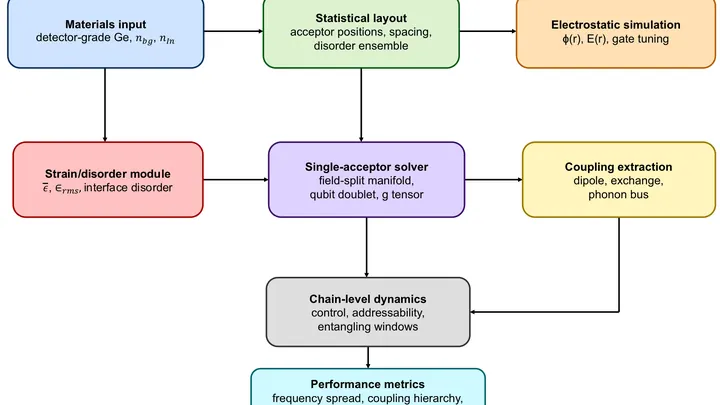
A quantum bit is like a spinning top that must keep spinning steadily for a long time. In germanium, researchers have learned to set such tops spinning, but the floor around them is always trembling: electrical noise knocks the spin off course.
A quantum computer is like an orchestra where every musician must play their own note precisely. But the hall is filled with invisible noise — defects in superconducting contacts that throw qubits off rhythm. These defects are called two-level systems. They are like cracks in glass: tiny, yet capable of ruining the whole picture.
Lithium in a battery sometimes behaves like ivy on a building facade: instead of a uniform layer, it sprouts thin, sharp tendrils. These needles can pierce the separator inside the battery and cause a short circuit. So engineers are looking for ways to make lithium grow calmly.
One trick they've found is to put a thin silver film under the lithium.
A quantum computer is like an orchestra where every musician must play in perfect harmony. If even one instrument is off-key, the melody falls apart. Superconducting qubits play the role of these musicians, and their "off-key" is the loss of quantum coherence.
A quantum computer is built from many qubits, like an orchestra from musicians. But each instrument sounds a bit different. In superconducting qubits, the role of the string is played by a thin sandwich of aluminum and aluminum oxide: the Josephson junction.
A superconducting qubit is a tiny electrical circuit that behaves like an artificial atom. In its normal state, current flows through it without resistance, and the energy levels are evenly spaced, like steps on a staircase. But if a single electron gets stuck in the circuit, everything changes.
In a superconductor, electrons move in pairs, like dance partners. Usually, through a junction between two superconductors, one pair passes at a time. But add a third contact, and the dance gets more complex: two pairs can move together, forming a foursome. It's this four-part resonance that has been seen for the first time in a graphene junction with three terminals.
A tiny lithium niobate comb vibrates at a frequency of 300 million times per second. Each tooth is carved from a crystal plate as thin as a human hair, with metal electrodes deposited on its sidewalls. The sound wave bounces inside the tooth like an echo in a narrow stone canyon, unable to escape.
A crystal one atom thick is like a sheet of paper you can write on with electricity. Such a material promises to become the foundation for tiny, fast microchips. But before putting it into production, you need to know exactly what it's made of. And that's where the usual formula falls apart.