Solar Flare: Two Peaks, One Magnetic Ribbon express
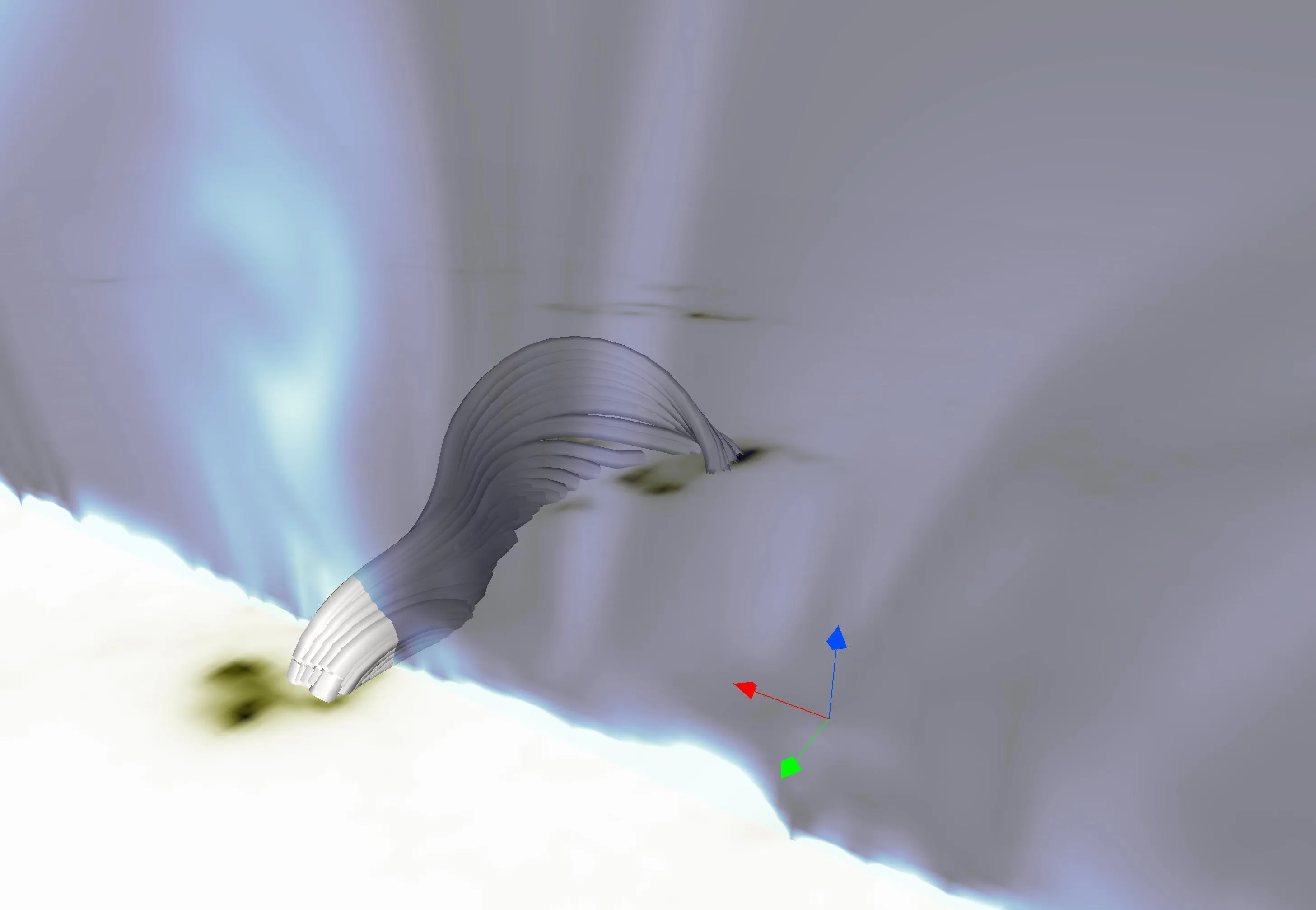
On October 1, 2024, a class X7.1 flare erupted on the Sun — one of the most powerful. Two spacecraft, HXI and STIX, watched it from different angles, like two eyes, and together with a computer model helped reconstruct the three-dimensional picture.
At the flare's peak, the X-ray emission flickered twice, and each time bright spots on the Sun's surface appeared in different places. This meant that magnetic fields were tearing and reconnecting not at a single point, but along a long, curved boundary, like a crack running across ice. The model showed that both peaks were born in the same magnetic ribbon, just in different parts of it.
The second spacecraft, STIX, also spotted a vertical column of hot gas rising from the surface. Its center shifted between the two peaks, as if energy were flowing through an invisible pipe. This is a first step toward understanding how flares accelerate particles to near-light speeds.
Original abstract
as written by the authors arXiv:2601.23046
We investigated the three-dimensional (3D) magnetic structures and dynamics responsible for particle acceleration in an X7.1-class flare that occurred on October 1, 2024, in NOAA active region 13842. We combined stereoscopic hard X-ray (HXR) observations from the Advanced Space-based Solar Observatory/Hard X-ray Imager (HXI) and the Solar Orbiter/Spectrometer Telescope for Imaging X-rays (STIX) with a 3D magnetohydrodynamic (MHD) simulation constrained by observed photospheric magnetic fields. During the two main peaks of the impulsive phase, HXR footpoints appeared at different locations, indicating a migration of the primary reconnection site in the corona. Our data-constrained MHD simulation successfully reproduced the reconnected field lines linking the observed conjugate HXR footpoints. Furthermore, the simulation shows that these primary reconnections occur along a single quasi-separatrix layer (QSL) system. Therefore, the two main peaks of HXR can be interpreted as episodic energy release within the single QSL system. This study demonstrates that the data-constrained MHD model provides a realistic 3D magnetic context for interpreting HXR emission. Notably, STIX observations revealed a vertically distributed thermal HXR source, extending from the footpoints to the looptop, with its centroid migrating between the two peaks. This marks a first step toward understanding the particle acceleration processes in solar flares.
The energy of a single X-class flare is comparable to billions of atomic bombs, yet the Sun releases it in just a few minutes.