X-ray emission is high-energy electromagnetic radiation produced when extremely hot astrophysical plasmas (millions of degrees) or accreting objects convert gravitational or magnetic energy into photons. Unlike visible light, X-rays are emitted by matter in extreme conditions: stellar coronae, supernova remnants, accretion disks around black holes and neutron stars, and magnetars. Because Earth's atmosphere blocks X-rays, these signals must be observed from space, making them a key window into the most violent and energetic processes in the universe.
History
X-rays were discovered in 1895 by Wilhelm Röntgen, but cosmic X-ray emission was first detected in 1962 by Riccardo Giacconi and colleagues using a sounding rocket, which found Scorpius X-1 and the diffuse X-ray background.
How it works
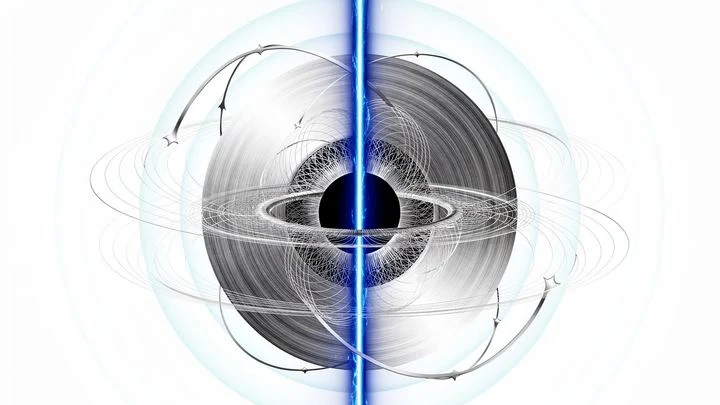
X-rays are generated when electrons are accelerated or decelerated rapidly, or when they transition between deep atomic energy levels in highly ionized atoms. In hot plasmas, thermal bremsstrahlung (free-free emission) dominates: electrons are deflected by ions and radiate X-rays. In accreting objects, gravitational potential energy is released as matter spirals inward, heating the gas to X-ray temperatures. In magnetars, the decay of an ultra-strong magnetic field powers X-ray emission, and the radiation can become polarized as it passes through a magnetized vacuum.
In practice
X-ray astronomy is used to study black holes, neutron stars, supernova remnants, and galaxy clusters, and X-ray polarimetry (as in the magnetar measurement) probes extreme magnetic fields and vacuum effects.
Fun fact
The first cosmic X-ray source, Scorpius X-1, is a neutron star accreting matter from a companion star, and it is one of the brightest X-ray sources in the sky despite being about 9,000 light-years away.
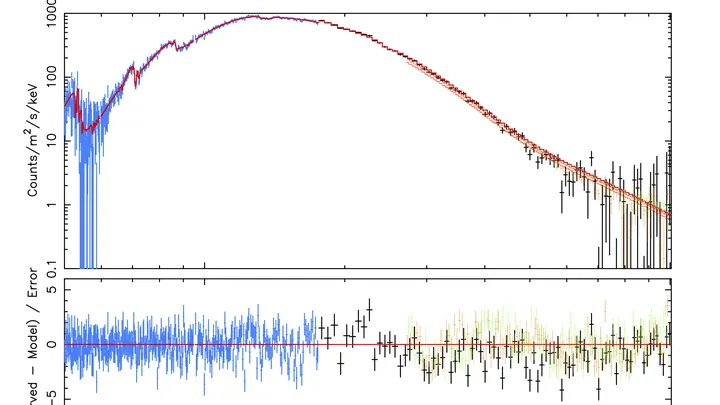
For years, silence reigned in the heart of galaxy 1ES 1927+654: the accreting gas merely whispered in X-rays, leaking slow winds. But in 2022–2025, the picture changed dramatically. Spectra taken by XMM-Newton and Swift lit up with emission lines — a narrow peak at 0.56 keV, likely from OVII oxygen, a broader feature near 1 keV, and a powerful iron band in the 6–7 keV region.
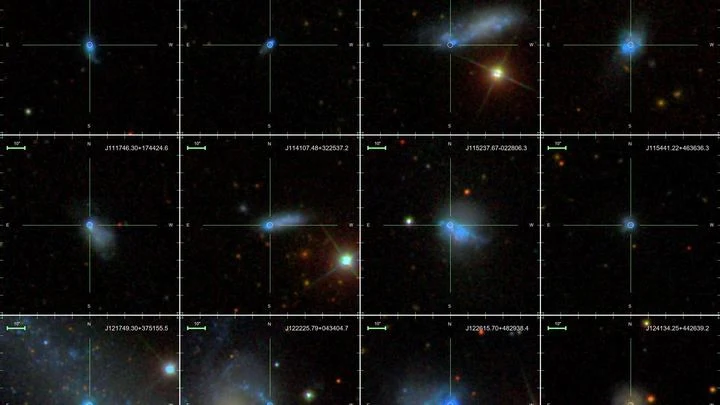
A dim lightbulb suddenly starts illuminating patterns on the wall that were invisible to the eye. That's roughly how astronomers look at distant dwarf galaxies — tiny stellar islands poor in heavy elements. In some of them, a faint violet glow of ionized helium has been spotted (a specific spectral line He II 4686 Å).
An ordinary camera flash lingers for hundredths of a second, but for atoms, that's an eternity. Inside molecules, electrons jump in attoseconds: billionths of a billionth of a second. To capture that, you need a light pulse shorter than the event itself.
Physicists take an electron beam in a linear accelerator and compress it so that individual bunches become thinner than a hair — in time.
When a massive star dies, a supernova explosion occurs, so powerful that a single flash outshines an entire galaxy. In this fire, billions of axions are born — invisible particles that leave almost no trace. Every second, trillions of these tiny things fly right through each of us, completely unnoticed.
Every galaxy is wrapped in an invisible shell of hot gas, like steam rising from a pot of boiling water. This gas barely glows in X-rays, making it notoriously difficult to measure. Yet it holds the memory of stellar explosions and the galaxy's growth.
The new method uses light from a galaxy's bright center.
The black hole MAXI J1810-222 behaves like a giant vacuum cleaner with a reverse valve: it pulls in matter, but some of it gets spat back out into space. This "backflow"—a stellar wind — had been spotted by astronomers before, but only as a blurry smudge in X-rays.
The black hole in V4641 Sagittarii behaves like a vacuum cleaner running at full power, but neighbors only see a faint indicator light. The LHAASO and HAWC telescopes caught gamma rays from it with energies up to 0.8 PeV — millions of times more energetic than hospital X-rays.
A giant cosmic funnel sucks in gas from its surroundings. But not all of that gas falls in — some is spat back out, like splashes from boiling water. That's exactly what the ultraluminous X-ray source NGC 5204 X-1 does: a compact object (likely a black hole) feeds so voraciously that the excess escapes in powerful jets.
The solar flare of June 3, 2012 behaved like an orchestra where, after the main performance, a second soloist unexpectedly steps in. First, instruments recorded a sharp burst of gamma-ray emission with energies above 100 megaelectronvolts — as if billions of tiny bullets struck the detectors at once. Then, after a brief pause, the emission intensified again and persisted for more than eight minutes.
In the binary system 4U 1624-49, a neutron star pulls gas from its companion star. This gas spirals into a glowing disk, like water in a funnel. And from the edge of this funnel, a hot stream tears away — hydrogen and other elements fly off at speeds up to 320 kilometers per second.
Neutron stars are ultra-dense remnants of supernovae the size of a city. In the 1930s, Fritz Zwicky hypothesized their existence, and later Jocelyn Bell Burnell discovered pulsars — rapidly rotating neutron stars.
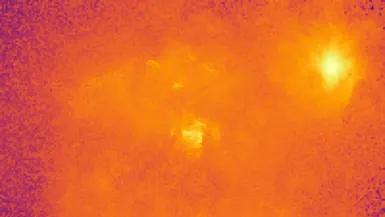
Twenty years ago, an X-ray image of the Arches cluster resembled a photo of a person in thick fog: the cluster itself was drowned in the glow of a neighboring cloud. The cloud acted like a mirror, reflecting hard radiation from the vicinity of the black hole, and that reflection swamped the faint signal from the stars.
On the night of March 9–10, 2024, a cloud of plasma ejected by the Sun raced away from the star. It had already passed a distance of five solar radii when a ground-based array of 352 antennas in California's Owens Valley caught a brief radio signal from it.