Hard X-rays are high-energy X-rays with photon energies typically ranging from about 10 keV to several hundred keV. Unlike lower-energy 'soft' X-rays, hard X-rays have greater penetrating power and can pass through many materials, making them valuable for probing dense objects. In astrophysics, hard X-rays are often produced in extreme environments such as solar flares, where particles are accelerated to high energies, or in the vicinity of neutron stars and black holes.
History
The distinction between soft and hard X-rays was established in the early 20th century as X-ray sources with different energies were studied. The term 'hard X-ray' became common in the mid-20th century with the development of detectors capable of measuring higher-energy photons.
How it works
Hard X-rays are generated when high-energy electrons interact with matter via processes like bremsstrahlung (braking radiation) or inverse Compton scattering. In solar flares, for example, electrons accelerated by magnetic reconnection events collide with the dense solar atmosphere, producing hard X-ray emission. Because hard X-rays can penetrate deep into materials, they are also used in medical imaging and industrial inspection to reveal internal structures.
In practice
Hard X-rays are used in astronomy to study high-energy phenomena like solar flares and accreting black holes, and in medicine for radiation therapy and diagnostic imaging, as well as in security scanning and materials science.
Fun fact
Hard X-rays from solar flares can penetrate the Earth's atmosphere only to a limited extent, so they are primarily observed by space-based telescopes like NASA's RHESSI or the Fermi Gamma-ray Space Telescope.
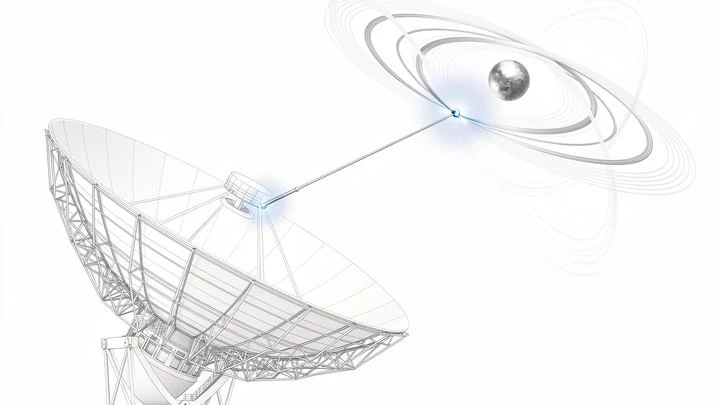
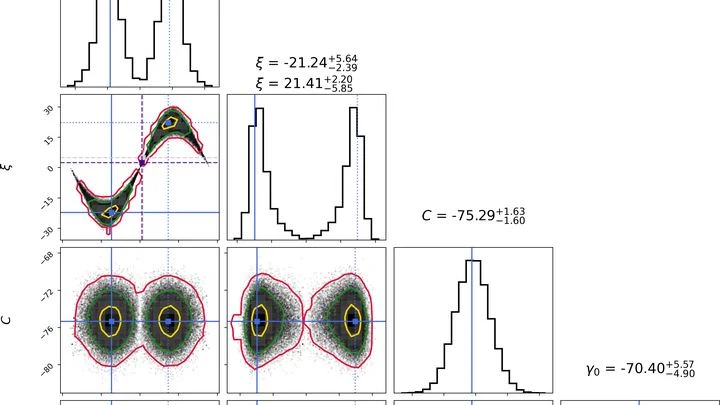
In the basement of the laboratory, an 8 tesla magnet hums. Inside it, like a bell in a bell tower, hangs a hollow copper cylinder tuned to a single note. If an axion, a dark matter particle, flies by, the cylinder responds with a faint ring. The trouble is that ordinary copper muffles this ring: at high frequencies, current flows only through a thin skin of the metal, and losses grow.
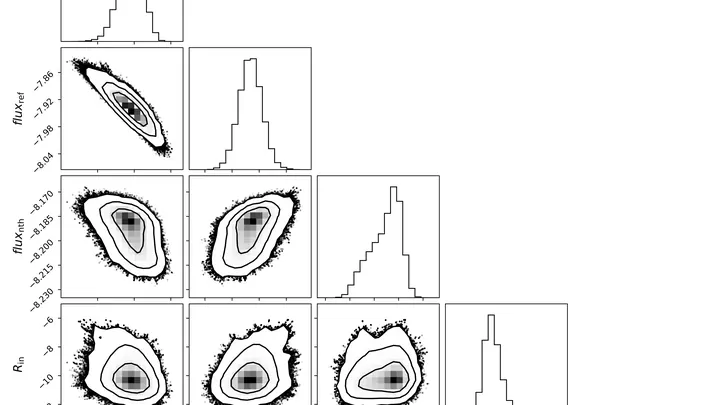
The XMM-Newton X-ray telescope stared at galaxy Mrk 1044 for two straight hours. Inside it, a black hole is surrounded by a swirling disk of superheated gas. This gas glows in X-rays, and its light flickers — brighter, then dimmer.
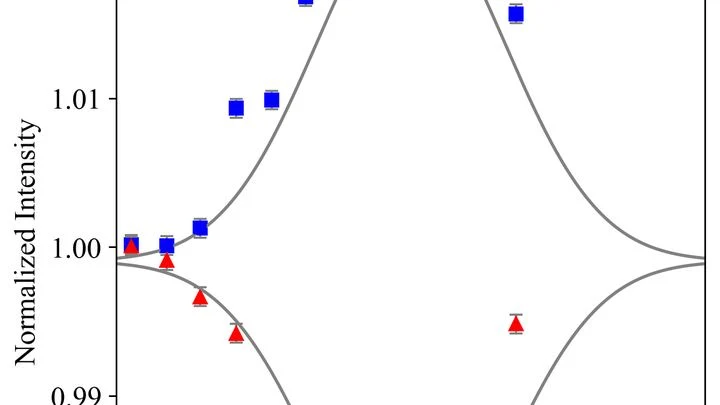
For the first half hour, the flickering of soft and hard X-rays was in step.
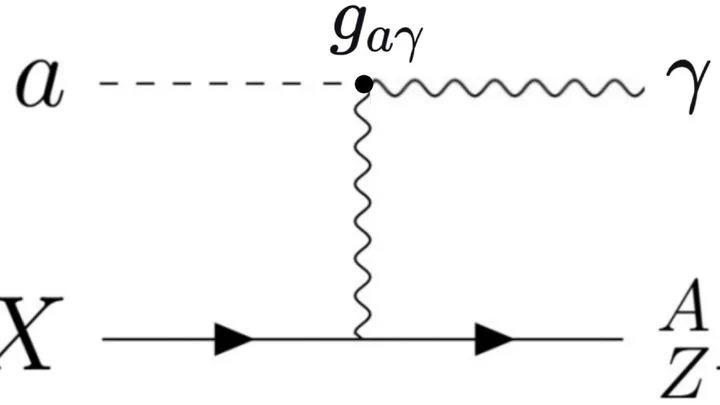
Inside the Sun, reactions can produce light, almost undetectable particles called axions. One such reaction yields axions with an energy of 5.49 MeV, as if each one carried the energy of a tennis ball moving at 100 km/h. These particles pass freely through Earth, but occasionally they might collide with a xenon atom.
A black hole paired with a star works like a pump: it pulls gas from its companion, swirls it into a glowing disk, and occasionally ejects some of that matter in two narrow jets. In 2021, the system 4U 1543-475 put on such a show.
A cosmic "caliper" will soon measure a neutron star to within a hundred meters. For an object a couple dozen kilometers across, that's like measuring the thickness of a human hair from a kilometer away.
A neutron star is the remnant of an exploded supernova.
Some 123 parsecs from Earth, in the constellation Corona Australis, drifts the neutron star RX J1856.5-3754. Its diameter is about 12 kilometers, smaller than Moscow's Ring Road, but its surface temperature reaches 460 000 kelvin. The star emits a slow, almost inaudible exhalation.
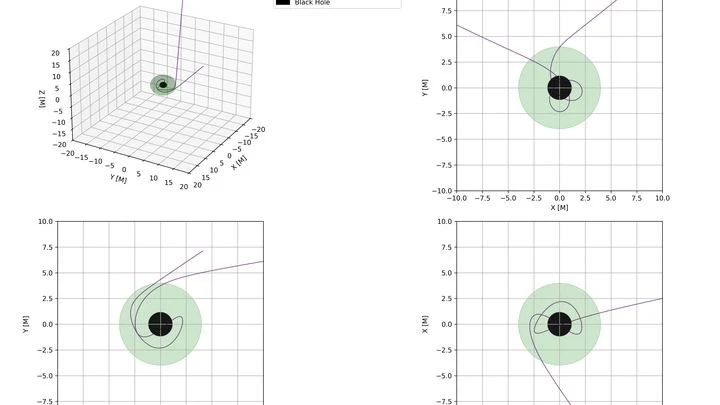
A cosmic ray approaches a black hole almost tangentially. Instead of falling straight in, it lingers on an unstable orbit, like an acrobat balancing on a tightrope over an abyss. After a few loops, the light finally escapes toward a distant observer. Such rays produce multiple images of the same source, known as higher-order images.
Solar flares are powerful explosions on the Sun that can knock out satellites and blackout cities. Predicting them is complicated by the tangled magnetic fields in sunspots.
A powerful spotlight flickers on and off. Light reflects off surrounding clouds, and by measuring the delay of the reflected signal, you can figure out how far away the clouds are. That's roughly how astronomers study the hot corona — a scorching cloud of plasma above the black hole at the center of an active galaxy.
But there's a catch.
The story began with a puzzle: in the 1930s, Fritz Zwicky noticed that clusters of galaxies behave as if an enormous invisible mass is hidden within them. Half a century later, Vera Rubin confirmed that stars on the outskirts of galaxies rotate too fast to be held by visible matter alone.
Light passing by a black hole falls into a gravitational trap: its trajectory curves and the particle bounces along a nearly closed orbit, like a pinball.
The beacon flares up and then nearly goes out, even though the lamp inside burns steadily. That is exactly what astronomers saw when they pointed their telescopes at the galaxy I Zwicky 1. At its center sits a supermassive black hole that devours gas and dust so greedily that a scorching disk forms around it, shining brighter than an entire galaxy.
A giant cauldron that barely smolders most of the time, but occasionally spits out showers of sparks. That is roughly how the supermassive black hole at the center of our galaxy — Sagittarius A*—behaves. It weighs four million times as much as the Sun and lies 26,000 light-years away.
Dark matter has eluded direct observation so far, even though its gravity holds galaxies together. One hypothesis: it’s made of axions — ultra-light particles predicted by theory.
If you shrank an ordinary black hole to the size of a grain of sand, it would shine like a tiny star and quickly vanish in a flash. That's Stephen Hawking's prediction: the event horizon acts like a hot surface emitting particles.
An X-ray beam is a stream of tiny packets of energy, photons. Ordinary detectors count them but don't distinguish shades: two photons with close energies look the same to them. The new device works like a sensitive thermometer: it catches each photon and measures how much it warms a thin film. From the warming, you can tell exactly how much energy the photon brought.
The black hole GRS 1915+105 usually hides behind a dense gas curtain: its X-ray emission is heavily absorbed on its way to us. But in April 2023, it suddenly flared: the X-ray flux jumped nearly tenfold.
An ordinary camera flash lingers for hundredths of a second, but for atoms, that's an eternity. Inside molecules, electrons jump in attoseconds: billionths of a billionth of a second. To capture that, you need a light pulse shorter than the event itself.
Physicists take an electron beam in a linear accelerator and compress it so that individual bunches become thinner than a hair — in time.
On the outskirts of galaxy M83, also known as the Southern Pinwheel, a river of ancient stars drifts through the void. It stretches 81 kiloparsecs — roughly 264,000 light-years, two and a half times the diameter of our Milky Way.
The night sky looks still, but sometimes one of the stars suddenly begins to brighten. That's what happened with the system AT 2019wey: it was spotted by the TESS telescope, which usually hunts for planets around other stars, but happened to be imaging that patch of sky every half hour.
Ordinary light is like a crowd in a square: each photon moves on its own, bumping into others and scattering. But in some media, photons start running together like a pack of dogs: they bunch up. Scientists have built a random fiber laser where light particles gather into especially dense clusters.
A film as thin as a spider's web, made of five metals, took the hit from a laser. Inside, the pressure soared to 55 gigapascals — imagine a hundred elephants balanced on your thumbnail. The alloy withstood it, compressing for a fraction of a nanosecond without breaking.
One gigapascal is a thousand megapascals.
Cosmic rays are not light but charged particles bombarding Earth from all directions. Most of them are protons (hydrogen nuclei), but heavier nuclei also show up: helium, nitrogen, iron.
The black hole GS 1354-64 in the constellation Musca woke up in 2025 and began greedily pulling matter from its companion star. The orbiting X-ray telescope IXPE caught it at a rare moment: the outburst had already subsided, but the system had not yet settled down.
When matter accumulates on the surface of a neutron star, the ultra-dense remnant of a dead star, an explosion occurs, akin to a giant thermonuclear bomb. In this inferno, nuclei of elements not found on Earth are born within seconds. To understand which ones, their masses must be known with great precision.
A solar flare is like a short circuit in a giant neon sign. Inside the Sun, magnetic fields twist into loops, like rubber bands, and when they reconnect, energy bursts into space. Part of it goes into hard X-rays, produced by particles accelerated to nearly the speed of light.
In the dark chamber of the detector, argon waits. When an invisible particle (say, a dark matter candidate) flies through, it gives the argon nucleus a gentle shove. The nucleus is knocked out of place, and charges are born around it. Exactly how many charges is no trivial question: physicists use that number to tell what kind of visitor dropped by.
A thin crystal of hexagonal boron nitride is a relative of graphite, but transparent and insulating. Occasionally, single defects appear in its lattice: a boron or nitrogen atom is missing, leaving a trap for electrons. Such a trap can absorb light and re-emit it, like a tiny flashlight.
An ordinary free-electron laser is like a musical instrument with a single string: it can play only one note until you change its design. To get a different wavelength, you have to retune magnets or accelerate electrons harder. That's expensive and bulky.
The solar corona, the Sun's outer atmosphere, stretches millions of kilometers, yet it's visible only during a total eclipse or with specialized instruments. Typically, we gauge the corona's density by how it scatters white light, but that method relies on simplifications that can skew the results.
A solar flare is like thunder on a clear day: a short but powerful burst of energy. The MeerKAT radio telescope in South Africa caught one such M1.3-class flare and examined it with unprecedented clarity. Ordinary instruments see either bright details or faint ones, but not both at once.
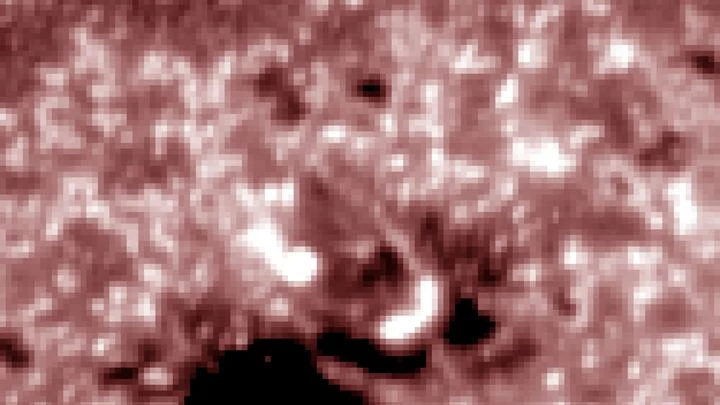
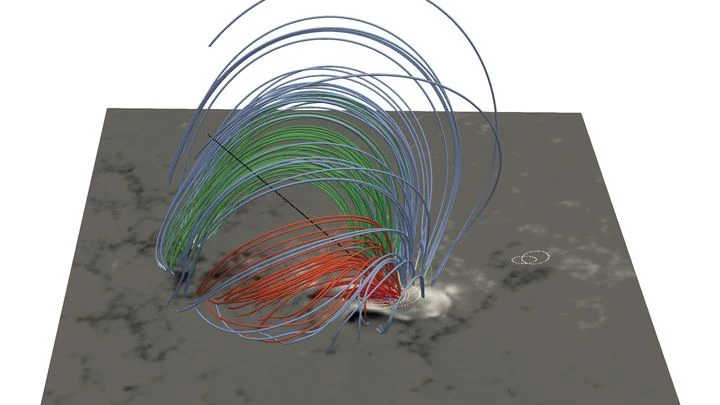
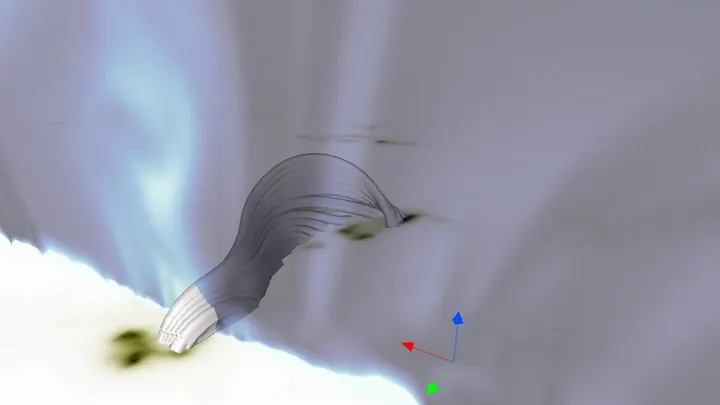
On October 1, 2024, a class X7.1 flare erupted on the Sun — one of the most powerful. Two spacecraft, HXI and STIX, watched it from different angles, like two eyes, and together with a computer model helped reconstruct the three-dimensional picture.
A flashlight shines through fog, and its light changes color slightly. From that change, you can tell what the fog is made of. That's how astronomers study cold gas around X-ray sources: iron atoms in the gas absorb and re-emit X-rays at a very specific energy, like a fingerprint. But there's a catch: if you strip a few electrons from the atom, the line shifts.
Neutron stars are ultra-dense remnants of supernovae the size of a city. In the 1930s, Fritz Zwicky hypothesized their existence, and later Jocelyn Bell Burnell discovered pulsars — rapidly rotating neutron stars.
In the binary system Cyg X-2, a neutron star pulls matter from a normal companion star. The infalling gas spirals in, heats up to millions of degrees, and shines brightly in X-rays. Astronomers pointed two space telescopes, IXPE and NuSTAR, at this object and, for the first time, measured in detail how polarized that light is.
In a dark room, two flashlights shine on a wall. Usually, their beams simply add up, and the spot becomes brighter. But if the flashlights emit light in special packets, photons, then under certain conditions they can behave differently. Instead of independently hitting different spots, two photons 'agree' and only come out together, as a pair, from a single output.
An X-ray telescope points at a neighboring galaxy, and sees a point that wasn't there yesterday. A month later, it blazes hundreds of times brighter than the Sun, and a year after that, it fades again. Such points are called ultraluminous X-ray sources, and each one is a close pair: an ordinary star and a black hole or neutron star, whirling around each other.
Cosmic rays are elementary particles carrying colossal energy that pierce the intergalactic void. When two such particles smash head-on, the energy density at the point of impact could be enough to collapse into a black hole the size of an atomic nucleus.
Every second, dozens of particles from space fly through each of us. Most are light protons, but there are also heavier atomic nuclei: carbon, oxygen, iron. They are born in stellar explosions and travel to Earth for millions of years. Their energy can be staggering: a single particle can carry as much as a tennis ball on a serve.