Solar Flare: Two Peaks, One Magnetic Ribbon express
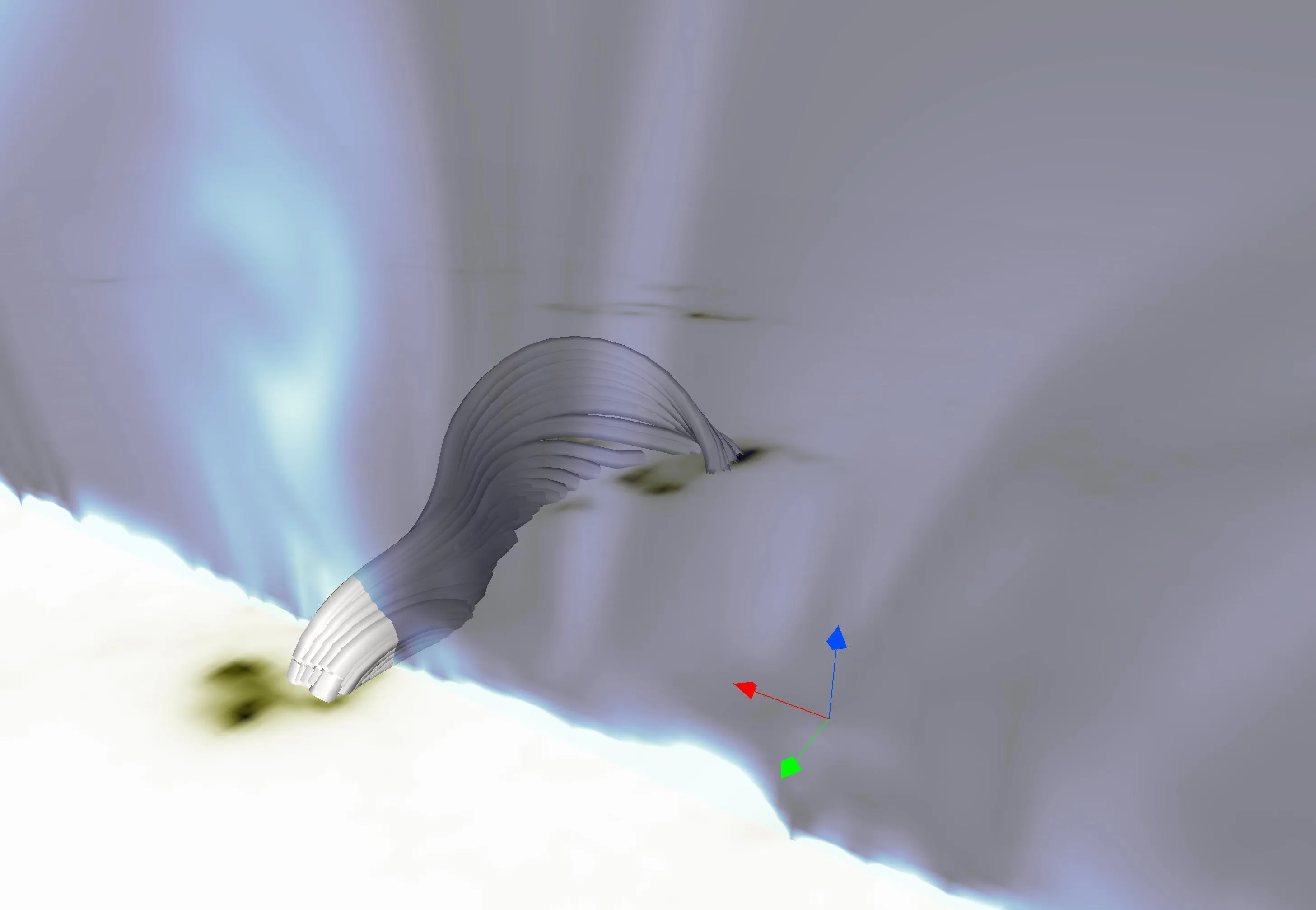
On October 1, 2024, a class X7.1 flare erupted on the Sun — one of the most powerful. Two spacecraft, HXI and STIX, watched it from different angles, like two eyes, and together with a computer model helped reconstruct the three-dimensional picture.
At the flare's peak, the X-ray emission flickered twice, and each time bright spots on the Sun's surface appeared in different places. This meant that magnetic fields were tearing and reconnecting not at a single point, but along a long, curved boundary, like a crack running across ice. The model showed that both peaks were born in the same magnetic ribbon, just in different parts of it.
The second spacecraft, STIX, also spotted a vertical column of hot gas rising from the surface. Its center shifted between the two peaks, as if energy were flowing through an invisible pipe. This is a first step toward understanding how flares accelerate particles to near-light speeds.
The energy of a single X-class flare is comparable to billions of atomic bombs, yet the Sun releases it in just a few minutes.