Quantum Stops for Qubits express
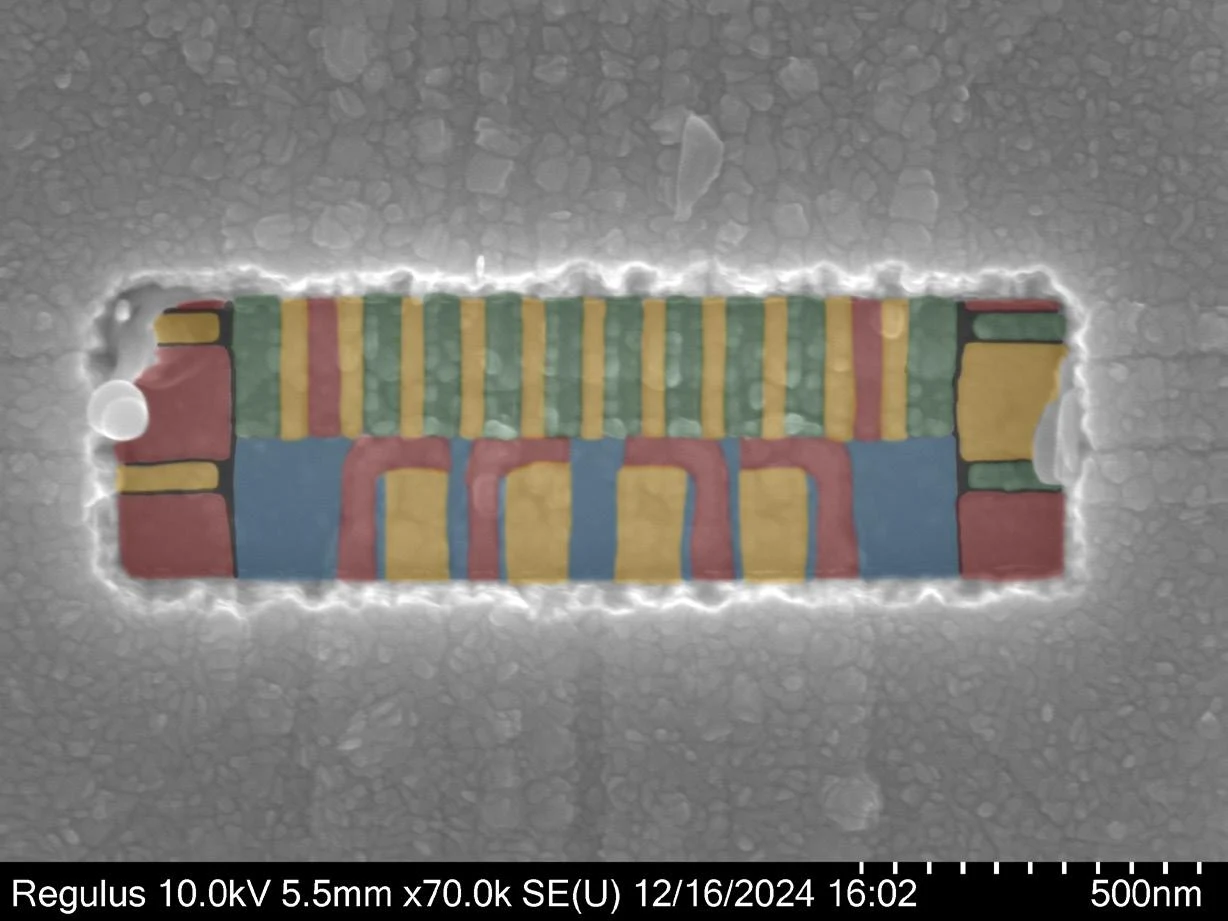
On a silicon chip that resembles a neighborhood, qubits, electrons with spin, live in separate 'houses.' Previously, neighbors could only chat over the fence, but now a road has been laid between them: along it, a qubit can ride to any of the four stops. The road is a bus that carries the electron without losing its quantum state.
At a stop, qubits meet and perform operations: one twists the other's spin like a key in a lock. To learn the result, you don't have to look at the charge — the spin is measured directly, without destroying it. This way, a processor of five qubits was assembled and wired into the desired circuit: a square with parity checks along both horizontal and vertical lines. It's like traffic lights at an intersection monitoring for traffic errors.
Such entanglement is a record for silicon spins. Previously, more than three was impossible. Now we can build quantum error-correcting codes: if one qubit stumbles, the others will notice and fix it. The road between stops is ready, the traffic lights work — all that's left is to teach the city self-repair.
Original abstract
as written by the authors arXiv:2601.23267
Recent advances in coherent spin shuttling have made sparse semiconductor spin qubit arrays an appealing solid-state platform to realize quantum processors. The dynamic and long-range connectivity enabled by shuttling is also essential for many quantum error-correction (QEC) schemes. Here, we demonstrate a silicon spin-qubit device that comprises a shuttling bus for coherently transporting qubits that can interact at four isolated locations we call bus stops. We dynamically populate the array and tune all single- and two-qubit operations using shuttling and quantum non-demolition (QND) spin measurements, without access to charge sensing in most of the device. We achieve universal control of the effective five-qubit processor and select the connectivity required to form a surface-code stabilizer plaquette that supports X- and Z-type parity checks up to weight-four. We use the parity checks to generate multi-qubit entanglement between all qubit combinations in the array and report the genuine entanglement of a five-qubit Greenberger-Horne-Zeilinger (GHZ) state, constituting the largest such state ever constructed with gate-defined semiconductor spins. This work opens immediate opportunities to pursue QEC experiments with spin qubits, and the protocols developed here lay the groundwork for the modular calibration and operation of sparse spin qubit arrays.
The electron is carried along the bus at about 10 meters per second — faster than a person can run, but slower than a cyclist rides.
The idea of shuttling qubits along a bus echoes the quantum teleportation from 'Star Trek,' only instead of distant planets, it's neighboring stops on a chip.