Quantum connection, in the context of entanglement, refers to the quality or strength of the quantum correlation between entangled particles, often quantified by the purity of the entangled state. Purity is a measure of how close a quantum state is to being a pure state (as opposed to a mixed state). For a maximally entangled state, the reduced density matrix of each particle is maximally mixed, giving a purity of 1/d, where d is the dimension of the Hilbert space. A higher purity of the overall state indicates a stronger, more reliable quantum connection, which is essential for quantum information processing.
The quality of the quantum connection is typically measured by the fidelity of the entangled state to a maximally entangled state (like a Bell state). This is done by performing quantum statetomography to reconstruct the density matrix and then computing the fidelity. Alternatively, one can measure the concurrence or entanglement of formation, which are monotonic functions of the purity. A pure entangled state has maximal entanglement, while any mixture or decoherence reduces the purity and thus the quality of the connection.
In practice
Quantum connection quality is crucial for quantum key distribution, quantum teleportation, and quantum computing, where high-fidelity entanglement is required for error-free operations. It is also used in quantum networking to assess the reliability of entanglement distribution over long distances.
Fun fact
In a perfect Bell state, the purity of each qubit is exactly 0.5, meaning each qubit is completely random on its own, yet the pair is perfectly correlated—this is the essence of quantum connection.
Quantum matter rarely treats us to the spectacle of self-motion. Where the classical world teems with starling murmurations, fish schools, and bustling bacteria, quantum thermodynamics long remained serene.
The quantum world is full of surprises. In a Kerr parametric oscillator, a device where light is trapped in a ring and driven by an external field, researchers recently noticed something strange: pairs of energy levels merge in an embrace. Physicists have dubbed this a "spectral kiss" spectroscopy.
Three dancers move as one: each feels all the others, and the overall harmony cannot be reduced to individual interactions. This is roughly how three particles behave, born from an electron and positron collision at the speed of light. They are a top quark, its antiparticle, and a Z boson.
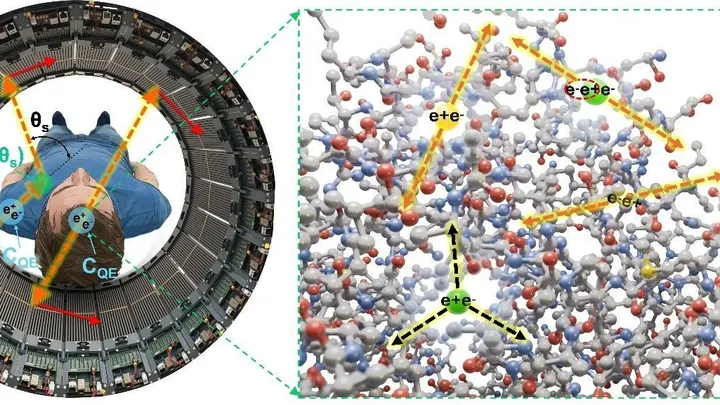
Two photons fly out from a single point in a patient's chest. They are twins: alter one, and you instantly know about the other. This connection is called quantum entanglement. In a PET scan, these pairs are born inside the body when an injected radioactive substance meets electrons in the tissues.
The degree of entanglement is not constant.
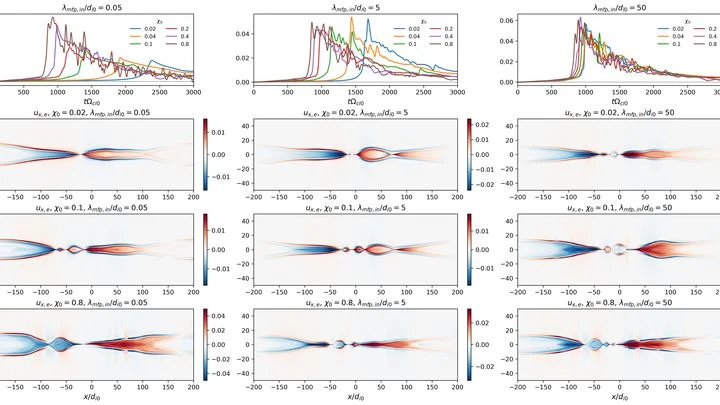
In plasma where some atoms remain neutral, magnetic field lines can rearrange at different speeds. This is like two rubber bands that are initially stuck together, then suddenly snap apart and contract, releasing energy.
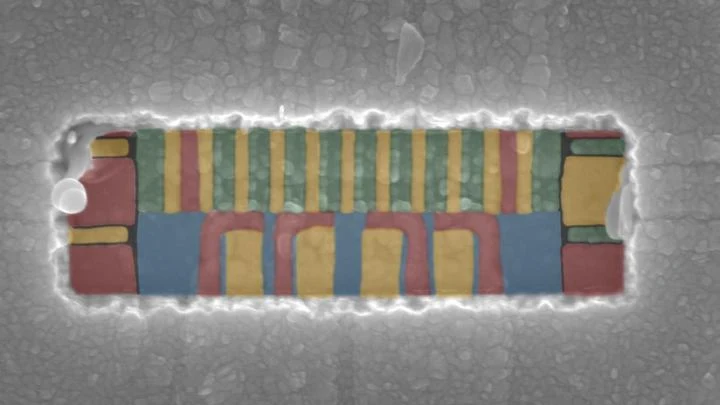
On a silicon chip that resembles a neighborhood, qubits, electrons with spin, live in separate 'houses.' Previously, neighbors could only chat over the fence, but now a road has been laid between them: along it, a qubit can ride to any of the four stops. The road is a bus that carries the electron without losing its quantum state.
A neutron star is the ultra-dense remnant of a supernova explosion, whose existence was predicted by Fritz Zwicky back in the 1930s. Later, Jocelyn Bell Burnell detected them as pulsars — rotating sources of strictly periodic radio signals.
The atomic nucleus is not just a bag of protons and neutrons. It is a quantum system where particles are bound by invisible threads of entanglement. When two protons or neutrons interact, their states become intertwined so that describing one without the other is impossible.
Picture an orchestra of 120 musicians playing in perfect unison — one false note and the harmony crumbles. That's the metaphor for a record-breaking quantum ensemble. Physicists have for the first time entangled 120 superconducting qubits, the building blocks of future computers.
In 1989, John Wheeler proposed a bold idea: "it from bit," meaning everything that exists arises from information. For a long time, this remained a beautiful metaphor, but now physicists have found a concrete mechanism that turns bits into particles.