Rough Walls Make Qubits Unpredictable express
A quantum computer is built from many qubits, like an orchestra from musicians. But each instrument sounds a bit different. In superconducting qubits, the role of the string is played by a thin sandwich of aluminum and aluminum oxide: the Josephson junction. Pairs of electrons tunnel through it, and how easily they do so determines the qubit's "pitch."
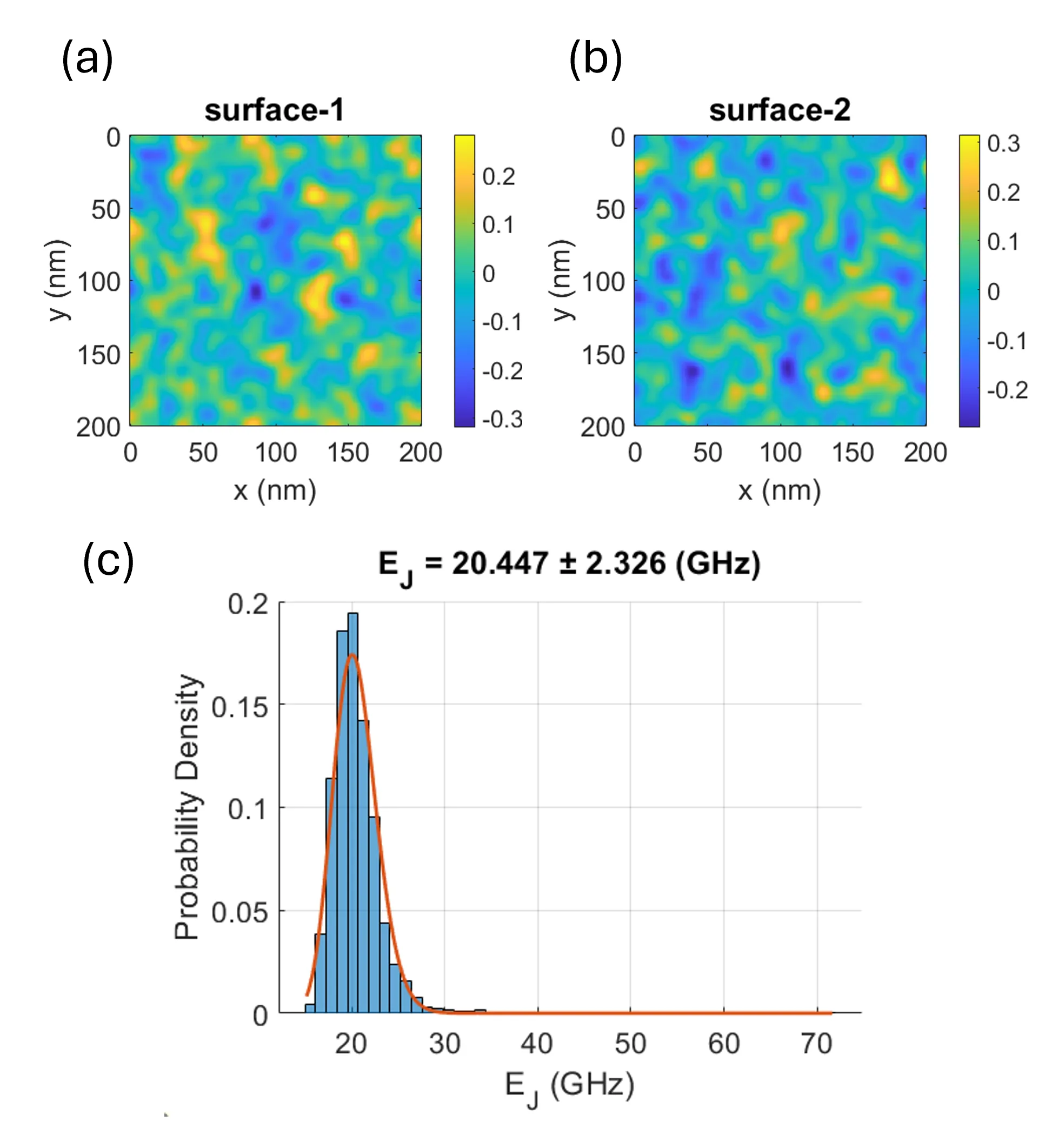
The problem is that the boundaries between layers are never perfectly smooth. Roughness is like ripples on sand after the wind: there is an average height of the bumps (σ) and a distance between them (ξ). The researchers simulated 5000 such junctions with different ripples and calculated how the Josephson energy: that very "pitch"—changes.
The higher the bumps (larger σ), the higher the average energy, but the spread also grows. The distance between bumps (ξ) has a different effect: with larger ξ, the average energy drops slightly, but the spread still increases. This means that even with identical fabrication technology, qubits will inevitably differ.
Now engineers have a simple picture: to make qubits more alike, they need to control not only the thickness of the layers but also the roughness of their interfaces. Otherwise, the orchestra will play out of tune.
Original abstract
as written by the authors arXiv:2602.03037
As quantum processors scale to large qubit numbers, device-to-device variability emerges as a critical challenge. Superconducting qubits are commonly realized using Al/AlO$$_{\text{x}}$$/Al Josephson junctions operating in the tunneling regime, where even minor variations in device geometry can lead to substantial performance fluctuations. In this work, we develop a quantitative model for the variability of the Josephson energy $$E_{J}$$ induced by interface roughness at the Al/AlO$$_{\text{x}}$$ interfaces. The roughness is modeled as a Gaussian random field characterized by two parameters: the root-mean-square roughness amplitude $$\sigma $$ and the transverse correlation length $$\xi $$. These parameters are extracted from the literature and molecular dynamics simulations. Quantum transport is treated using the Ambegaokar--Baratoff relation combined with a local thickness approximation. Numerical simulations over $$5,000$$ Josephson junctions show that $$E_{J}$$ follows a log-normal distribution. The mean value of $$E_{J}$$ increases with $$\sigma $$ and decreases slightly with $$\xi $$, while the variance of $$E_{J}$$ increases with both $$\sigma $$ and $$\xi $$. These results paint a quantitative and intuitive picture of Josephson energy variability induced by surface roughness, with direct relevance for junction design.
The log-normal distribution appears often in nature: it describes particle sizes in fragmentation, incomes in economics, and even the time people spend on a website.
In the series "Devs," a quantum computer fails due to qubit instability, and the characters search for a way to synchronize them, like piano tuners.