Scientist

Peter Higgs

1929–2024 · particle physics, theoretical physics
British theoretical physicist who predicted the existence of the elementary particle — the Higgs boson, responsible for the mechanism of spontaneous electroweak symmetry breaking. The experimental discovery of the boson at the Large Hadron Collider in 2012 confirmed his theory.

Biography

Studied at King's College London. Worked at the University of Edinburgh. Nobel Prize in Physics (2013) jointly with François Englert.

Key discoveries

💡 Peter Higgs disliked the boson being called the 'God particle'; he preferred the technical name.
"He stated that the Higgs boson is part of the mechanism that gives other particles mass, and its existence proves that our understanding of the nature of symmetries is correct."
Concepts
Higgs bosonLarge Hadron ColliderQuantum FieldStandard Model
Laws
Klein-Gordon equation
Scientists
Satyendra Nath BoseEmilio Gino SegrèPaul DiracRichard FeynmanJ. J. ThomsonWerner HeisenbergMarie CurieEnrico Fermi

Related articles

q-bio.QM2026-01-101 minarXiv:2601.06360express
Prostate Cancer: A Look at the Tumor's Surroundings
A glass of water and a glass of jelly look the same but behave differently. So it is with prostate tissue: on a standard slide under a microscope, you can see both the tumor glands and the supporting connective tissue around them. Previously, pathologists focused only on the glands, treating the support as mere background.
HEP Experiment2026-01-242 minarXiv:2601.17576express
Hunting Long-Lived Particles in the Heart of the LHC
In the CMS detector at the Large Hadron Collider, protons smash together with enormous energy, producing a shower of particles. Most of them decay almost instantly, right at the collision point.
Medical Physics2026-02-042 minarXiv:2602.04461express
Light instead of radiation: seeing an organ without a needle
Radioactive tracers are like a courier with a beacon: you inject it into the body, and it highlights the target organ on the scan. But this courier comes with strict rules: you can't send it often, it quickly 'gets tired,' and it costs a lot. Doctors have long dreamed of a way to see an organ without radiation.
Medical Physics2026-02-091 minarXiv:2602.08918express
The Living Lens: How MRI Sees Muscles in Motion
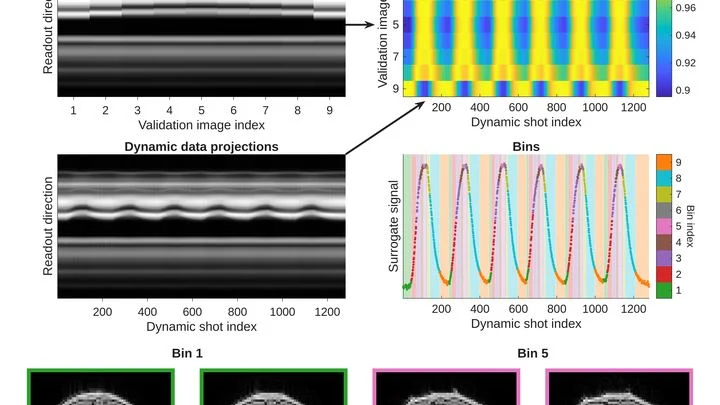
A photographer snaps a runner: to avoid a blurry shot, a short shutter speed is needed. An MRI scanner is like that photographer, but its 'shutter speed' is long — by the time it captures, the muscle has already changed. That's why dynamic MRI (a series of volumetric frames in motion) is a tough challenge: data are scarce, and motion doesn't wait.
HEP Experiment2026-02-101 minarXiv:2602.09354express
Higgs Under the Microscope: How Its Decays Are Caught
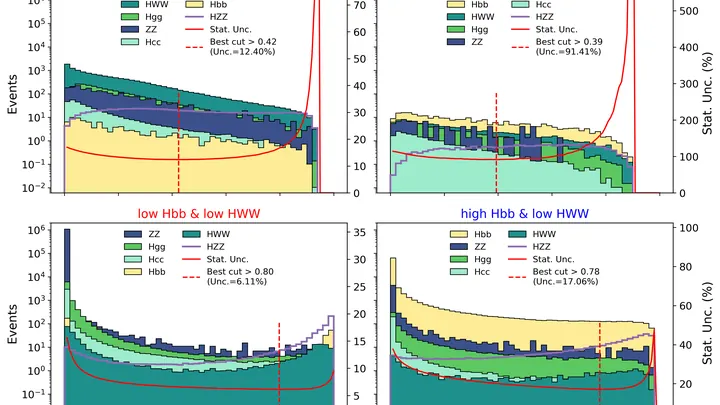
The Higgs boson lives an unimaginably short life — less than a billionth of a second. It cannot be caught directly, so physicists look at what remains after its decay: jets of particles, muons, neutrinos. But some information is lost if you consider only the explicit decay traces rather than the whole event.
HEP Experiment2026-02-191 minarXiv:2602.17165express
Eight collisions that revealed a new process
In the ATLAS detector at the Large Hadron Collider, protons collide billions of times per second. From this stream, physicists fished out eight events in which the collision produced two Z particles and one photon.
q-bio.OT2026-03-011 minarXiv:2603.01054express
How a Bladder Turns into a Pear
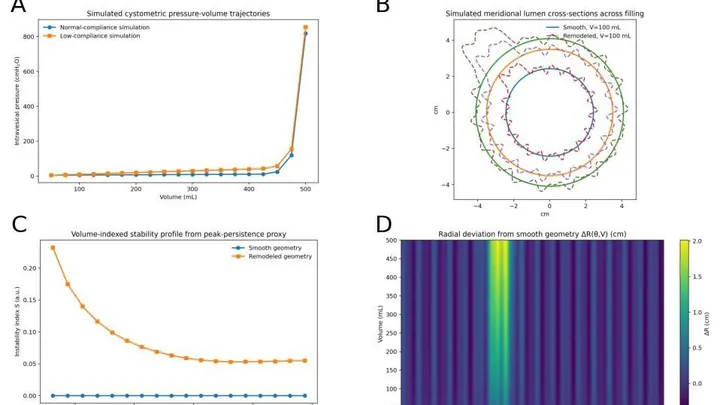
The bladder is like a balloon: as it fills, the wall stretches and the shape changes. Doctors usually monitor the pressure inside and how much fluid has entered, but they rarely look at the geometry itself — how the surface curves. Yet irregularities can appear before the usual metrics deteriorate.
Medical Physics2026-03-041 minarXiv:2603.04233express
A Heart Without Pauses: Movie of Every Beat
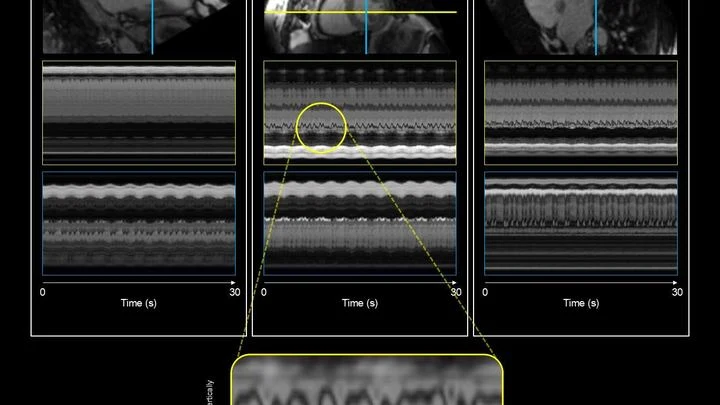
The heart beats irregularly. Standard MRI pretends all beats are the same: it stacks them on top of each other, like a photographer shooting a dancer with a long exposure. The result is a blurry smudge — pretty, but useless if you need to see each individual movement. The new approach films the heart like a video: frame by frame, with no gaps.
An MRI That Fits in a Backpack
A standard MRI machine is a huge magnet that you can't move, plus a powerful computer that turns signals from the body into a picture. In recent years, portable scanners with weaker fields have appeared: they are light, cheap, and can work in a field hospital or an ambulance.
HEP Experiment2026-03-091 minarXiv:2603.08315express
Hunting for Vanishing Tracks
In the ATLAS detector at the Large Hadron Collider, particles leave tracks like skiers in the snow. Some tracks break off after a couple of centimeters: that's what a particle would look like if it were born, flew a little way, and then decayed into something invisible.
Medical Physics2026-03-101 minarXiv:2603.09898express
A Scanner That Sees Through Tumors
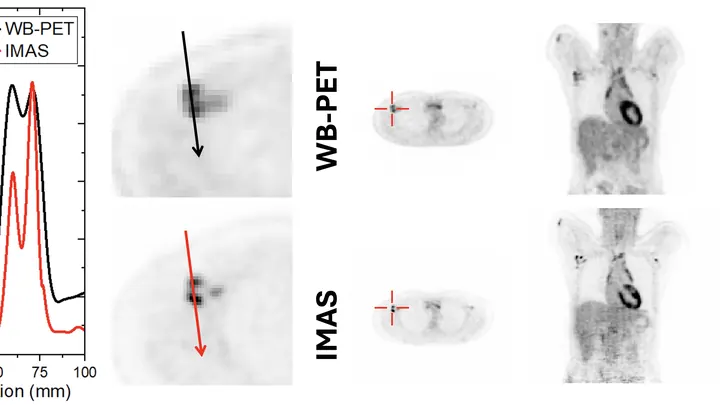
A standard PET scanner is like a camera with a narrow lens: to capture the whole body, you have to move it back and forth and take many shots. The new IMAS tomograph is a wide-angle camera that covers 71 centimeters of the body at once. The patient lies still, and the machine collects an image from head to thighs in a single pass.
HEP Experiment2026-03-131 minarXiv:2603.12961express
Proton Collisions Put Matter's Foundations to the Test
In an underground ring 27 kilometers in circumference, protons are accelerated to nearly the speed of light and smashed head-on. At the collision point, conditions briefly recreate those of the first trillionth of a second after the birth of the universe.
Medical Physics2026-03-191 minarXiv:2603.19368express
The Shadow of Cancer on a Clean Scan
PET/CT is like a map where cancer cells light up as bright spots. But what if the map is blank and the disease is still hiding somewhere? In 132 men with recurrent prostate cancer, doctors found no glowing lesions, but they decided to study the texture of the scan itself, like an experienced tracker noticing bent grass where an animal has passed.
HEP Experiment2026-03-202 minarXiv:2603.19963express
Weighing the W boson in a jet
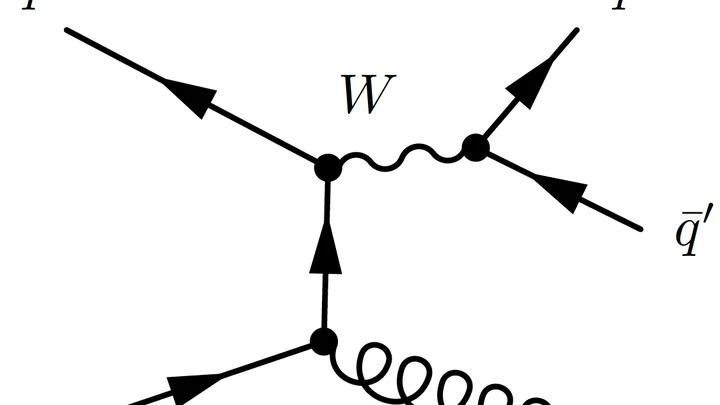
When a W boson, the particle that carries the weak force, decays into a quark and an antiquark, these two fragments fly off in nearly the same direction at the collider's immense speeds.
HEP Experiment2026-03-201 minarXiv:2603.20117express
How Physicists Hunt for Cracks in the Universe's Symmetry
In the ATLAS detector at the Large Hadron Collider, protons collide with enormous energy, and among the debris, a Higgs boson is sometimes born — the particle that gives mass to other particles.
Medical Physics2026-03-231 minarXiv:2603.22092express
The Placenta Under the Microscope: How Oxygen Travels to the Fetus
The placenta is like a bustling market where oxygen passes from mother to child. If the stalls are neatly arranged and goods are delivered quickly, everyone gets enough. But when the aisles get clogged, traffic jams start: some places are crowded, others empty.
Medical Physics2026-03-241 minarXiv:2603.22666express
Tracking Prostate Cancer Metastases in Scans
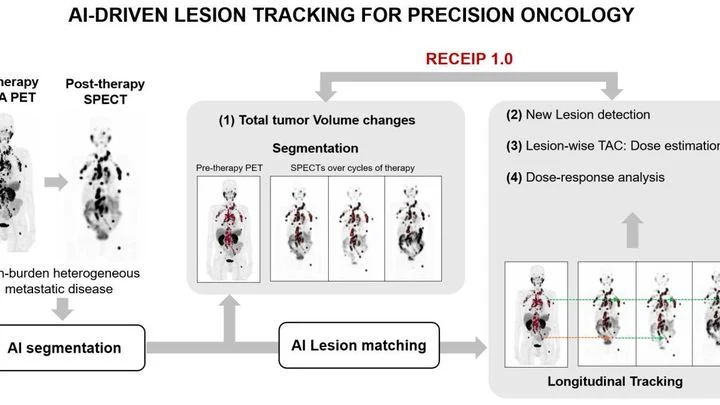
When treating prostate cancer, doctors often see not one tumor but many lesions in bones and lymph nodes. Each lesion can respond to therapy differently: one shrinks, another stays the same, a third grows. Previously, the disease was assessed as a whole, like judging the weather by the average temperature over a year.
q-bio.BM2026-03-241 minarXiv:2603.23775express
Diagnostics in the Palm of Your Hand: Electricity Instead of Optics
In a hospital, blood from a finger prick usually goes to the lab, and the result comes back the next day. The new method promises to cut that wait to a few minutes. Instead of catching light reflected off a sample, it reads the electrical voltage that arises at the boundary between two media, like the faint tingle you feel when you touch a battery with wet fingers.
Medical Physics2026-04-021 minarXiv:2604.01710express
Quiet MRI Machines Just Got Louder
A weak magnet in an MRI machine is like a dim bulb in a dark room: you get a picture, but details drown in grain. These scanners operate at fields below 0.1 tesla (a typical hospital machine runs at 3 tesla, 30 times stronger), yet they're lightweight, inexpensive, and don't require a special room. The catch: noise eats away at quality.
HEP Experiment2026-04-102 minarXiv:2604.09809express
Neural Network Learns to Spot Higgs Boson Decays
At the Large Hadron Collider, protons collide, and from the flash dozens of particles are born. Among them may be traces of rare processes — for example, the decay of a Standard Model Higgs boson into two W bosons. But these particles fly apart so quickly that their tracks merge into a single wide jet.
Medical Physics2026-04-112 minarXiv:2604.10227express
Dose Under Control
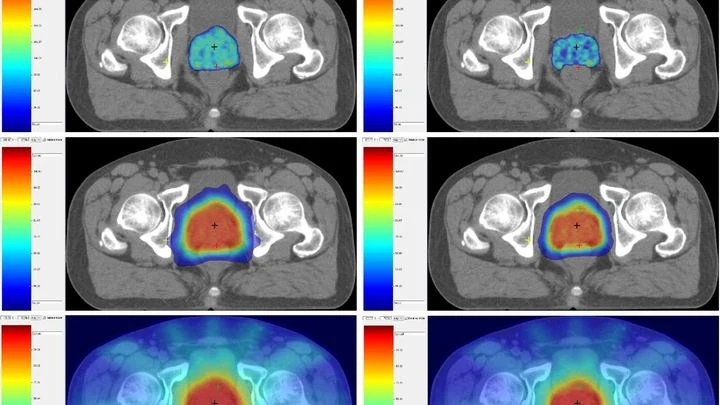
When a doctor irradiates a tumor, they try to spare nearby healthy organs. In the past, the standard approach was to give many small doses of radiation, like watering a lawn with a fine-spray watering can. Now, hypofractionation is increasingly used: fewer sessions, but larger doses, like a high-pressure hose. The question is how to tell whether the neighboring garden beds got overwatered.
HEP Experiment2026-04-191 minarXiv:2604.17514express
Muon Collider: Peering into the Heart of Mass
The Higgs boson is like a conductor that gives mass to all other particles. Without it, electrons would be massless and atoms would fall apart. But how does the conductor interact with itself? That is the key question a future muon collider aims to answer.
HEP Experiment2026-04-292 minarXiv:2604.27044express
Hunting for Higgs Pairs in Four Jets
At the Large Hadron Collider, protons collide billions of times per second, and only once in a trillion collisions does a pair of Standard Model Higgs bosons (the particles responsible for the mass of everything) emerge. In the CMS experiment, physicists hunted for exactly such events.
Medical Physics2026-05-092 minarXiv:2605.08957express
Gradient Coil for the Breast: MRI Without Contrast
A flashlight spreads light in a broad beam, while a laser cuts a narrow path and picks out the finest details. In magnetic resonance imaging (MRI), the gradient, a rapid change in the magnetic field along the body, plays the role of that laser.
Medical Physics2026-05-091 minarXiv:2605.09091express
How MRI is learning to tell water in muscles from water in blood vessels
To peek inside a muscle, it is illuminated with radio waves in a strong magnetic field: that's how MRI works. Water in cells and water in blood respond differently, but a standard scanner doesn't tell them apart: it produces an averaged image where the signal from capillaries is superimposed on the signal from muscle fibers.
HEP Phenomenology2026-05-162 minarXiv:2605.16756express
Spotting the Elusive Boson with a Laser and a Point Cloud
Two blindingly bright beams smash head-on. At the point of impact, a particle is born for an instant — the very one responsible for the mass of everything in the universe. That's the Higgs boson. Usually, it's produced by accelerating protons or electrons, but here the projectiles are particles of light themselves — photons.
Medical Physics2026-05-242 minarXiv:2605.24815express
How to Make MRI See a Beating Heart
A photographer shoots a runner with a long exposure and gets a blurry silhouette. That's roughly how a standard MRI scanner "sees" moving organs: the heart contracts, the lungs breathe, and the image smears. To avoid this, patients are asked to freeze and hold their breath. But for a child or someone short of breath, that's nearly impossible. The method called GRASP tackles the problem differently.
HEP Phenomenology2026-05-242 minarXiv:2605.25015express
How Hidden Nonlocality Explains the Mass of Everything
An orchestra without a conductor. Each musician hears not only their neighbor but also echoes from across the stage. That's roughly how the idea of a nonlocal Higgs field works: a particle 'feels' what's happening not at a single point but across an entire region of space.
HEP Phenomenology2026-05-302 minarXiv:2606.00695express
Heavy Higgs Twin Hides in Four Jets
Deep inside the detector at the Large Hadron Collider, protons collide, and for a fleeting moment something heavy is born. It instantly shatters into two Higgs bosons — particles that, like nesting dolls, each hide two pairs of b-quarks.
Mesoscale2026-05-312 minarXiv:2606.01029express
A Loop That Travels on Its Own and Dictates Energy
A quantum particle traveling around a closed ring leaves two distinct 'records' along its path. The first is like a fingerprint on a doorknob: it remains unchanged no matter how many times you turn the knob, and it only tells you about the shape and material.
Medical Physics2026-06-062 minarXiv:2606.08065express
Breathing vs. Snapshot
As a person breathes, the liver glides smoothly up and down. When treating a tumor with radiation, this motion must be accounted for: the beam must hit the target, not healthy tissue. Usually, breathing is "captured" using special computed tomography (CT), taking a series of frames over one breath cycle.
Image Processing2026-07-131 minarXiv:2607.11385express
How Cleaning MRI Scans Helps Find Prostate Cancer
Prostate MRI scans often look like photos taken through a dirty window: noise, blurred edges, curvature from field imperfections. Scientists checked what happens if you 'wash' that window: remove the excess, correct the distortions, and accurately align different types of scans.
HEP Experiment2026-07-252 minarXiv:2607.23352express
The Higgs Boson Beyond the Peak
The Higgs boson is like a tuning fork that rings at a strictly defined note. But physicists have learned to hear it even when the note is off — in the so-called 'off-shell' region. It was there, in the data from the CMS detector, that answers were hiding about what the Higgs mechanism is really made of.
HEP Theory2026-07-262 minarXiv:2607.23616express
How a Tiny Addition to the Higgs Field Extends the Life of Energy Clumps
A tightly stretched string keeps vibrating after being plucked. In particle physics, there is a similar object — the oscillon. It is a clump of energy that pulses like a heart without spreading out in space. Such structures arise in the Higgs field — the very field responsible for particle masses.
HEP Phenomenology2026-08-042 minarXiv:2608.03936express
Higgs Plays at Half Strength
In proton collisions at the Large Hadron Collider, sometimes not one but two Higgs bosons are produced. The rate of such events is a direct imprint of how the Higgs field interacts with itself. In the Standard Model, this coupling is rigidly fixed, but extended theories allow deviations.
Applied Physics2026-08-101 minarXiv:2608.10225express
A Quiet Amplifier for a Weak Signal
The coil in an MRI picks up radio signals from hydrogen atoms, like an antenna catching a distant radio station. But the signal is weak, and if the amplifier itself is noisy, the image comes out grainy.