Rough Walls Make Qubits Unpredictable express
A quantum computer is built from many qubits, like an orchestra from musicians. But each instrument sounds a bit different. In superconducting qubits, the role of the string is played by a thin sandwich of aluminum and aluminum oxide: the Josephson junction. Pairs of electrons tunnel through it, and how easily they do so determines the qubit's "pitch."
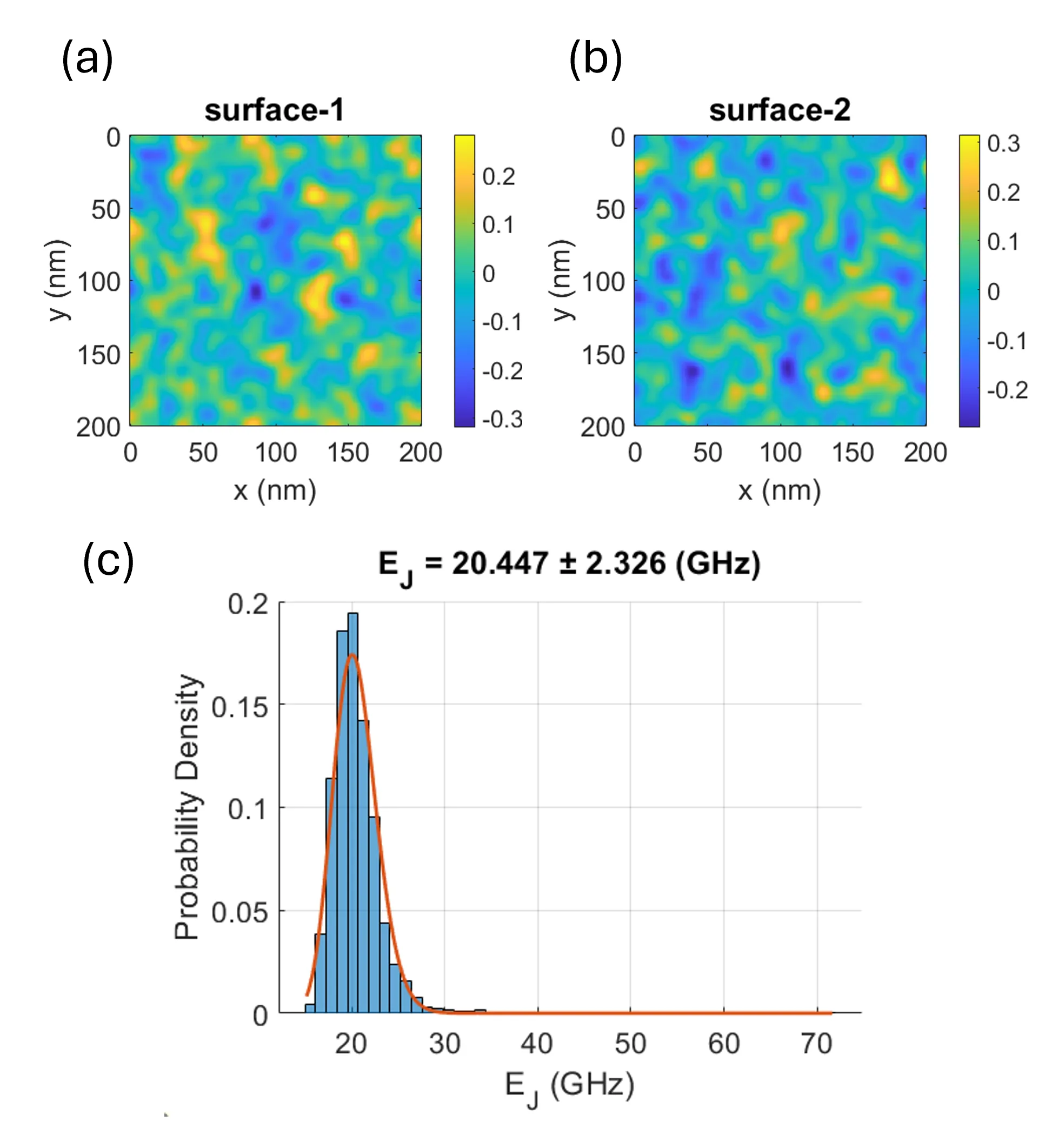
The problem is that the boundaries between layers are never perfectly smooth. Roughness is like ripples on sand after the wind: there is an average height of the bumps (σ) and a distance between them (ξ). The researchers simulated 5000 such junctions with different ripples and calculated how the Josephson energy: that very "pitch"—changes.
The higher the bumps (larger σ), the higher the average energy, but the spread also grows. The distance between bumps (ξ) has a different effect: with larger ξ, the average energy drops slightly, but the spread still increases. This means that even with identical fabrication technology, qubits will inevitably differ.
Now engineers have a simple picture: to make qubits more alike, they need to control not only the thickness of the layers but also the roughness of their interfaces. Otherwise, the orchestra will play out of tune.
The log-normal distribution appears often in nature: it describes particle sizes in fragmentation, incomes in economics, and even the time people spend on a website.
In the series "Devs," a quantum computer fails due to qubit instability, and the characters search for a way to synchronize them, like piano tuners.