property

surface roughness

A measure of the texture of a surface, quantified by the deviations in the direction of the normal vector from its ideal form.
18 related articles

Description

Surface roughness quantifies the deviations of a real surface's normal vector from its ideal, perfectly smooth form. It is a statistical measure of the microscopic peaks and valleys that exist on all physical surfaces, typically characterized by parameters like Ra (average roughness) or RMS (root mean square). Roughness affects how surfaces interact with light, fluids, and each other, and is critical in fields from tribology to optics.

History

The systematic study of surface roughness began in the 1930s with the development of profilometry. The concept gained quantitative rigor with the advent of fractal geometry in the 1980s, which showed that many natural surfaces are self-affine across scales.

How it works

Roughness is measured by profilometers or atomic force microscopes that trace the surface height profile. The data is analyzed statistically: Ra is the mean absolute deviation from the average height, while RMS is the standard deviation. The scale of roughness matters — features from nanometers to millimeters influence different phenomena, such as wetting, adhesion, and scattering.

In practice

Surface roughness is engineered in manufacturing to control friction, wear, and sealing; in optics it determines scattering losses; and in microfluidics it affects flow resistance and mixing.

Fun fact

A surface that appears perfectly smooth to the naked eye can have roughness variations of just a few nanometers, yet those variations can scatter enough light to ruin a precision mirror's performance.

Concept graph →

Related articles · 19

Instrumentation2026-08-191 minarXiv:2608.19176express
Bumps That Help Light Through
When light hits ordinary plastic, some of it reflects, like a glare on a window. To eliminate this glare, a special coating made of tiny structures is applied to the surface, which cancels out the reflection.
Geophysics2026-07-262 minarXiv:2607.23736express
Why the Fault Decides Whether an Earthquake Happens
Two pieces of sandpaper are pressed tightly together. As you start to slide them, they first catch on the rough spots, then suddenly slip. A fault in the Earth behaves much the same way during an earthquake. But there's a crucial detail: how far do you need to push the edges before the grip gives way? This distance is called the critical slip distance.
Signal Processing2026-07-152 minarXiv:2607.13583express
An Orchestra of Imperfect Elements: How Manufacturing Irregularities Paradoxically Boost the Radio Signal
Imagine a smart antenna panel, a phased array, that steers radio waves traveling at the speed of light. It works like an orchestra: hundreds of tiny emitters, like musical instruments, shift their phase (the moment they 'join' the overall sound) on command via a variable voltage.
Image Processing2026-07-152 minarXiv:2607.14195express
Arterial Tortuosity: A Mathematical Diagnosis in the Language of Curvature
Imagine a kinked garden hose: water meets resistance, and pressure drops. A similar process occurs in arteries when they lose their straight geometry. Vascular tortuosity is not just a cosmetic defect but a factor that disrupts hemodynamics and poses a threat of ischemic stroke.
Medical Physics2026-07-102 minarXiv:2607.09401express
When Vessel Walls Distort the Picture
In the brain's white matter, the signal travels along axons — long neuronal processes wrapped in an insulating myelin sheath. Water fills the space inside axons and outside, in the narrow gaps between fibers.
math.DG2026-07-013 minarXiv:2607.00949
The Veronese Fingerprint
A geometer runs a finger along an invisible surface, and by how the geodesics bend, lifts its fingerprint. That fingerprint can be the maximum normal curvature κ(F): the largest curvature among all geodesics passing through a point of the immersed manifold.
Galaxies2026-06-053 minarXiv:2606.07741
Cosmic Latte: Why X-rays Are Three Times Brighter Than Hydrogen
In astrophysics, some numbers seem random yet recur with the persistence of a spell. One such number is the ratio of X-ray brightness to H-alpha hydrogen emission in turbulent gas tails. From galactic winds to ‘jellyfish’ slicing through clusters, this ratio steadily holds at around three.
Exoplanets2026-03-221 minarXiv:2603.21413express
The Sun as a Training Ground for Finding Earth's Twins
Scientists search for planets around distant stars by detecting a slight wobble in the star's motion: the planet tugs on the star, making its light shift slightly toward the blue and then toward the red. But stars have their own ripples — dark spots and bright faculae on their surfaces. These also shift the light, making it hard to tell them apart from a planet.
Fluid Dynamics2026-03-191 minarXiv:2603.18491express
A Rough Cornea Tears the Tear Film
The tear film on the eye is an ultrathin layer of fluid that protects the cornea and keeps vision sharp. It’s usually pictured as a perfectly smooth surface, but the real cornea, even a healthy one, is covered in microscopic bumps.
q-bio.BM2026-02-111 minarXiv:2602.10644express
A Tissue Map from Blurry Images
Our body's tissue is like a city: different neighborhoods are home to different cells, each with its own job. To understand how this city is organized, biologists take images showing which genes are active at each spot. But sharp images are expensive, and cheap ones come out blurry, like a photo of a city from high above, where individual buildings are hard to make out.
Quantum Physics2026-02-031 minarXiv:2602.03037express
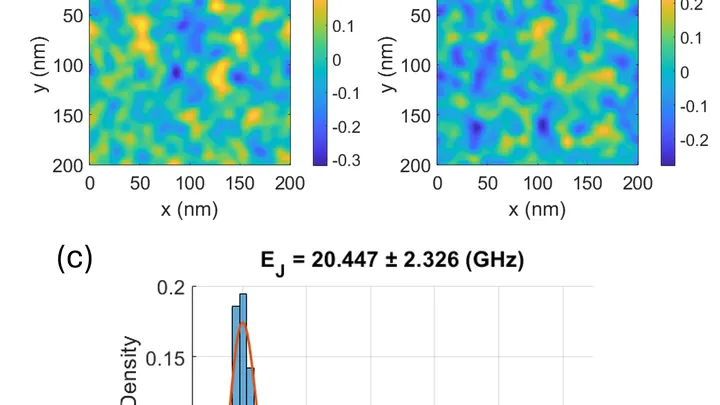
Rough Walls Make Qubits Unpredictable
A quantum computer is built from many qubits, like an orchestra from musicians. But each instrument sounds a bit different. In superconducting qubits, the role of the string is played by a thin sandwich of aluminum and aluminum oxide: the Josephson junction.
Fluid Dynamics2026-02-032 minarXiv:2602.03617express
Roughness That Decides a Flight's Fate
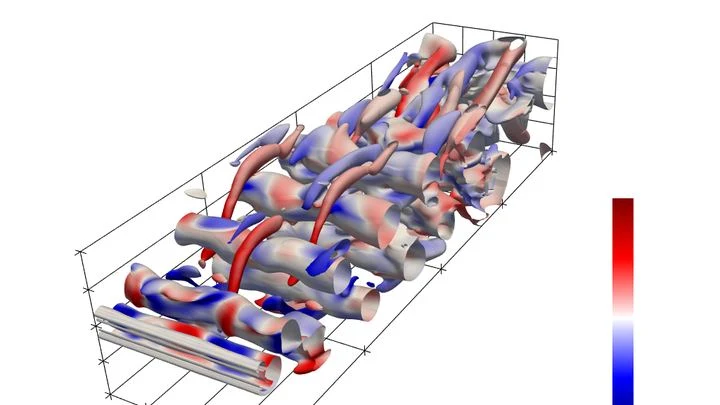
A blunt cylinder flying at six times the speed of sound isn't the most elegant object, but it's the star of a new simulation. The surface of such a vehicle is never perfectly smooth: during atmospheric entry, the heat shield ablates, leaving bumps and pits.
Fluid Dynamics2026-01-241 minarXiv:2601.17341express
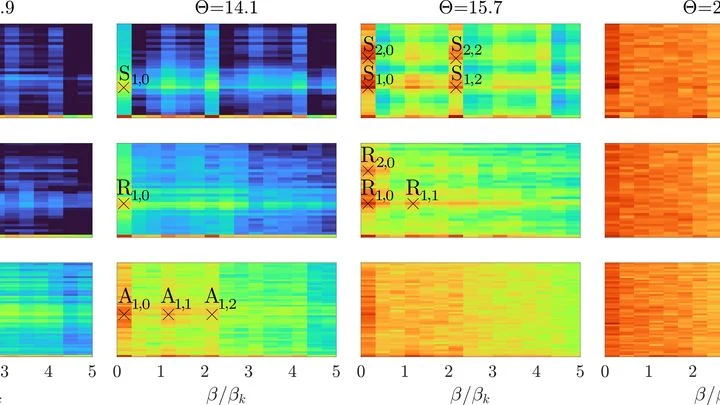
A Thin Plate Wakes Turbulence Early
A thin plate stands across a flow of water or air. Behind it, a wake forms — a region where the flow becomes tangled and mixed. Usually, such a wake becomes turbulent when the flow speed is high enough, quantified by the Reynolds number.
Materials2026-01-241 minarXiv:2601.17487express
How a Film of Molecules Smooths Itself Out
If you dump a handful of coins on a table, the surface becomes bumpy. But add more coins, and they spread out into a flat layer on their own. Something similar happens when you deposit ultra-thin films of individual molecules onto a substrate. At first, islands appear on the surface — molecules cluster together like people in a queue. The film gets rougher and rougher.
A Drop Squeezed by Flow Tells Its Story
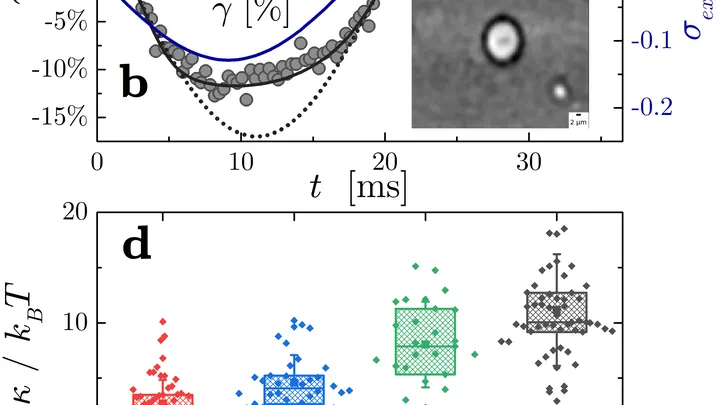
A microscopic gel bead or a tiny oil droplet squeezes through a narrow channel whose walls rhythmically contract and relax. The particle flattens and then recovers its shape, and by how quickly it does so, you can infer its internal elasticity and viscosity.
Cosmology2026-01-062 minarXiv:2601.02886express
The Universe Stops Being Uniform at a Scale of 138 Megaparsecs
Galaxies in the Universe are not scattered randomly: neighboring ones move in the same direction, like a school of fish, while distant ones each go their own way. Where the boundary between 'together' and 'apart' lies has been unclear until now.
Materials2026-01-011 minarXiv:2601.00190express
Friction Vanishes Before Your Eyes
Two pieces of graphite rub against each other, and the resistance vanishes as if an invisible film of oil separated them. Previously, this was only seen under a microscope, on tiny contact patches.
How a Sheet of Paper Decides to Wrinkle or Fold
A thin rubber film lies on a table. Someone grabs it by the middle and slowly pulls upward. The film doesn't just rise: it arches into a dome, then wrinkles run along the dome's edge, like pleats on a skirt. Pull higher — the wrinkles gather into large folds that cross the entire film. And if you start lowering it, the folds don't disappear but collapse into new shapes.
How Ripples on Water Steer the Planet's Winds
The planet's winds are not free-flowing currents but rather obedient jets that can be nudged from an unexpected direction. The ocean surface, covered with waves, acts like a tuning knob: change its roughness, and giant air rivers shift by hundreds of kilometers.