Electron mobility is a fundamental property of materials that quantifies how fast an electron can drift through a substance when an electric field is applied. It is defined as the ratio of the electron's drift velocity to the electric field strength, typically measured in cm²/(V·s). High mobility means electrons move quickly and with little scattering, which is crucial for electronic devices like transistors, where faster switching and lower power consumption are desired. Mobility is influenced by the material's crystal structure, temperature, impurities, and defects.
History
The concept of electron mobility was developed in the early 20th century alongside the Drude model (1900) and later refined by Arnold Sommerfeld and others with quantum mechanics. The Hall effect, discovered in 1879, provided a practical way to measure mobility.
How it works
When an electric field is applied, electrons accelerate but constantly collide with lattice vibrations (phonons), impurities, and other electrons. These collisions scatter the electrons, limiting their net velocity. Mobility is essentially a measure of how effectively the electrons can avoid scattering. In a perfect crystal at absolute zero, mobility would be infinite, but in reality, it is finite. The mobility is determined by the average time between collisions (the relaxation time) and the effective mass of the electron: higher relaxation time and lower effective mass lead to higher mobility.
In practice
Electron mobility is a key parameter in designing high-speed transistors, solar cells, and light-emitting diodes. Materials like gallium arsenide (GaAs) are prized for their high electron mobility, enabling faster electronics than silicon.
Fun fact
Graphene has one of the highest known electron mobilities at room temperature, exceeding 200,000 cm²/(V·s), which is more than 100 times that of silicon.
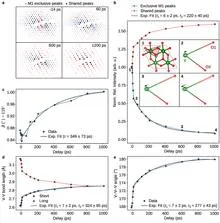
The camera captures not a race but a dance of atoms. In vanadium dioxide, the transition from an insulating to a metallic state occurs within trillionths of a second, yet until now no one had seen exactly how the vanadium and oxygen atoms move. Now, ultrafast electron diffraction has captured this route frame by frame.
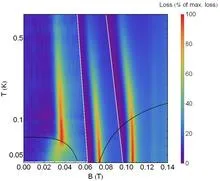
Tuning a radio receiver to a station that changes frequency as you cross a phase boundary: that is how you might picture the challenge facing the researchers. In the metal YbRh2Si2, electrons behave as "heavy" particles: their effective mass is hundreds of times that of a free electron.
An electron flying through a gas is like a swimmer trying to cross a crowded pool. Each collision with an atom changes its course and speed. In dense argon gas, there are so many collisions that a simple description no longer works.
Physicists measured electron mobility — how easily electrons drift under an electric field.
Water in a stream doesn't flow in a uniform sheet; it carves winding paths where the current runs faster. Electrons in a Hall thruster, a device that pushes a spacecraft with a jet of plasma, behave much the same way.
Inside the thruster, a magnetic field confines electrons, which ionize the gas and produce thrust.
A solid electrolyte is like a sponge for lithium ions. In a regular lithium battery, ions float in a liquid, like fish in an aquarium. In a solid-state battery, they have to squeeze through the crystal lattice, like through narrow corridors.
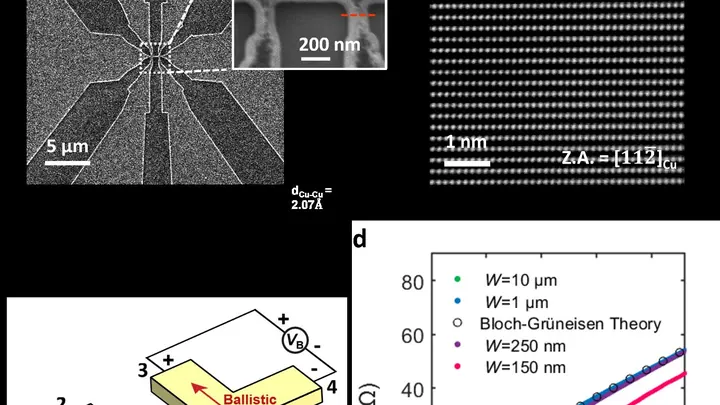
An electron in a metal is usually like a person in rush hour: it constantly bumps into others and loses its way. But if you remove the obstacles, it can fly in a straight line, like a car on an empty night highway. This kind of motion is called ballistic — from the word "ballista," an ancient catapult that hurled a stone without interference.
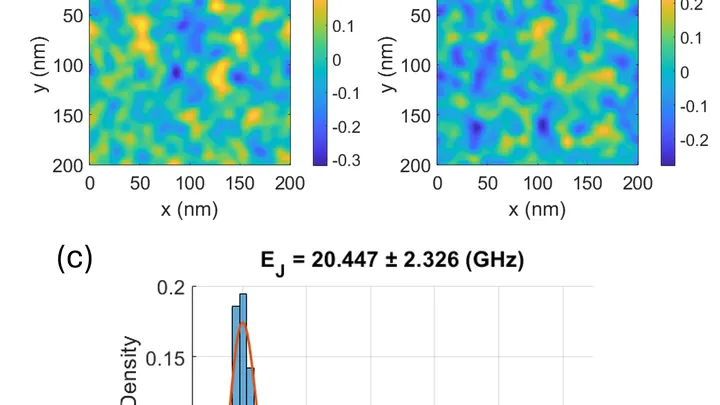
A quantum computer is built from many qubits, like an orchestra from musicians. But each instrument sounds a bit different. In superconducting qubits, the role of the string is played by a thin sandwich of aluminum and aluminum oxide: the Josephson junction.
Toss a handful of pebbles into a stream: some settle on the bottom, others get swept around. That's roughly how waves behave in a disordered medium — light in frosted glass, sound in porous material. Usually, disorder slows things down: the wave gets stuck, spreads out, loses direction. But in a new study, physicists built an acoustic lattice where things work differently.
Imagine a superhighway where cars zoom along with barely a slowdown: that's what a layer of ultraclean semiconductor looks like, where electrons travel vast distances without a single collision. Scientists have built a transistor in which electrons run twice as fast as in any similar device before.
Diamond is not just a gemstone. This crystal can conduct electricity when free charge carriers, electrons and holes, appear in it. But how fast do they move? In scientific papers, numbers vary by tens of times. One lab reports a mobility of 1000 cm²/(V·s), another 4000.
In disordered materials, such as organic semiconductors or inks made from two-dimensional materials, electrons don't move smoothly like water through a pipe. Instead, they hop from one spot to another, like a ball bouncing across a rough surface. This kind of motion is called hopping transport.
Thirty nanometers is the distance over which a phonon sprinter hasn't yet had time to accelerate. In thin aluminum nitride films, thermal resistance remains almost unchanged up to this thickness: heat transport proceeds in the ballistic regime, where phonons (quanta of crystal lattice vibrations) fly…