The joule (symbol J) is the SI unit of energy, work, and heat. It is defined as the energy transferred when a force of one newton acts over a distance of one meter, or equivalently, the energy dissipated as heat when an electric current of one ampere passes through a resistance of one ohm for one second. In thermodynamics and materials science, it is the standard measure for quantifying heat absorbed per unit mass, often expressed in joules per kilogram (J/kg) for specific heat or latent heat.
History
Named after James Prescott Joule, who in the 1840s demonstrated the mechanical equivalent of heat through his famous paddle-wheel experiments, establishing that mechanical work and heat are interconvertible forms of energy. The unit was formally adopted by the International System of Units (SI) in 1948.
How it works
The joule ties mechanical and thermal energy to a single, consistent scale. One joule is a relatively small amount of energy — roughly the energy needed to lift a small apple one meter against Earth's gravity. When a material absorbs heat, the energy in joules increases its internal energy, raising temperature or causing phase changes, and the ratio of joules to mass (and temperature change) defines material properties like specific heat capacity.
In practice
Used universally in physics, engineering, and chemistry to specify energy content, heat transfer, and work — from food energy labels (kilojoules) to the thermal properties of building materials.
Fun fact
A single joule is roughly the energy released when a mosquito hits a windshield at highway speed.
Systems:SIThe SI derived unit of energy, defined as the work done when a force of one newton moves an object one metre.
Hot water after a shower, warm air from ventilation, the heated walls of an engine — all this is heat below 100°C. Usually, it dissipates without doing any useful work. Now it can be captured and turned into electricity.
Inside the new device is a wire made of a nickel-titanium alloy. This material remembers its shape: when heated, it contracts; when cooled, it returns to its original shape.
Gas passing through a narrow valve can heat up or cool down: this is the Joule–Thomson effect, which powers refrigerators and air liquefiers. It turns out black holes can do the same.
A thin semiconductor layer at low temperatures behaves like a pot of honey: electrons flow not as individual particles but as a thick liquid. If you run an alternating current through such a layer, the resistance responds with a smooth curve.
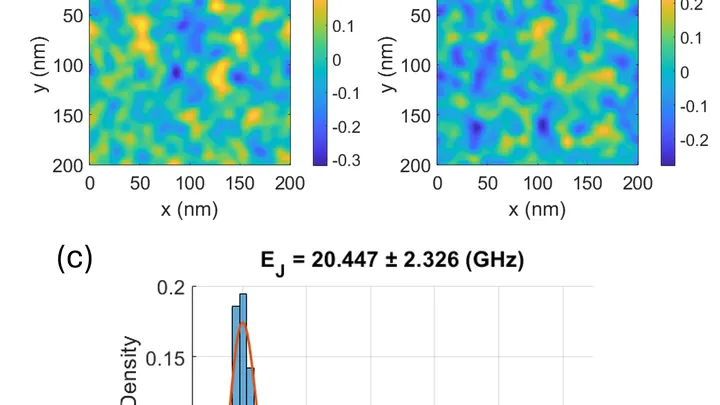
A quantum computer is built from many qubits, like an orchestra from musicians. But each instrument sounds a bit different. In superconducting qubits, the role of the string is played by a thin sandwich of aluminum and aluminum oxide: the Josephson junction.
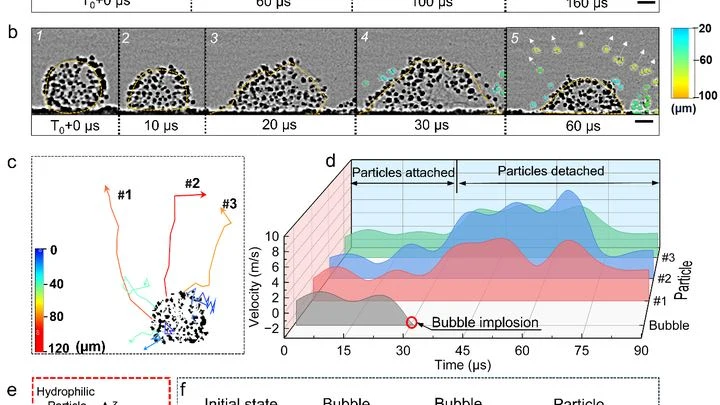
In a glass of water, ultrasound creates tiny bubbles. They grow and shrink, and sometimes they collapse sharply, like a popping soap bubble, but thousands of times faster. Near these bubbles float small particles — for example, nickel spheres the size of dust motes.
Run a current through a wire, and the wire heats up. Anyone who has ever touched a phone charger knows this. Physicists call this heating Joule heating, after James Joule, who in the mid-19th century measured how much heat electricity produces. Since then, the formula has been simple: the greater the resistance and the current, the hotter the wire.
Measured dipole moment of tantalum-181: 3.39 × 10⁻³² e·cm — like spotting a one-atom shift across the entire Solar System. An ordinary atomic nucleus is perfectly balanced, like a spinning top. In tantalum, that balance is broken: the positive and negative charges are slightly offset from each other.