A Laser Comb for Sound in a Crystal express
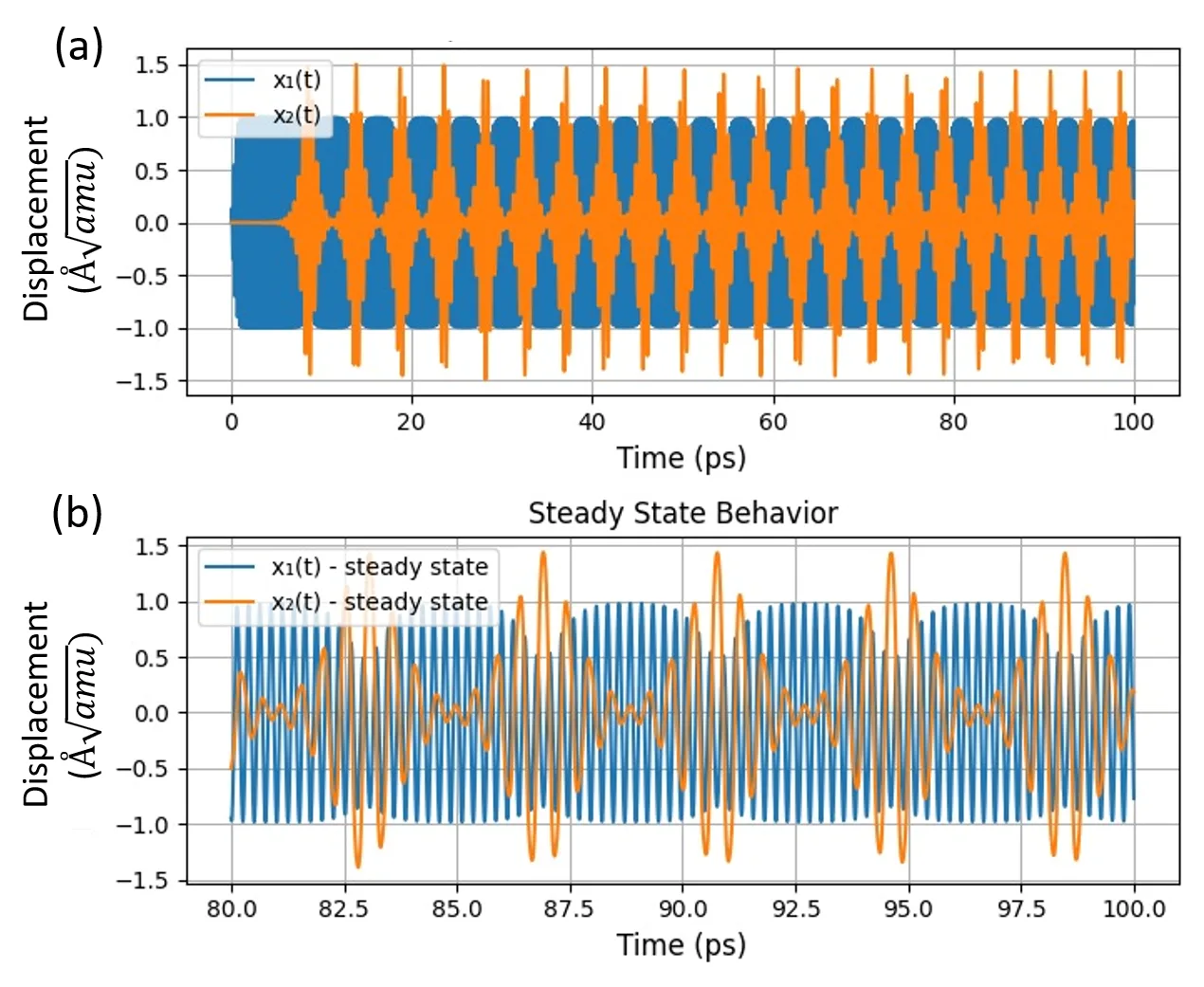
A short laser pulse hits a crystal, and instead of a single sound, the crystal responds with a whole ladder of frequencies, each separated by the same interval. This is how a phononic frequency comb is born, a phenomenon that physicists are exploring in a material with an unusual internal structure.
In the hexagonal InMnO3 crystal, the atoms are arranged so that one type of vibration resembles the Higgs boson: it gives 'mass' to other vibrations while remaining optically active. Nearby lives a second type: a soft, nearly massless mode, similar to ripples on the surface of water. A terahertz pulse with a high electric field rocks the first mode, which then pushes the second through internal couplings. The result is nonlinear mixing: the vibrations don't just add up; they generate new frequencies.
The authors built a numerical model of the coupled equations of motion for the atoms and tracked how the crystal's response changes with different pulse parameters. It turns out that the comb appears only above a threshold: a weak pulse produces just the original vibration, while a strong enough one immediately yields a whole set of lines. The spacing between lines and their number can be tuned by the duration and amplitude of the pulse, but if the power is too high or the damping too weak, the structure breaks down.
The practical appeal is that phononic combs could become compact sources of stable frequencies for spectroscopy, telecommunications, and precision clocks. Instead of bulky laser systems — a tiny crystal excited by a short pulse.
Original abstract
as written by the authors arXiv:2602.07462
We investigate the generation of phononic frequency combs arising from nonlinear coupling between Higgs-like and Goldstone-like phonon modes in hexagonal InMnO3. The Higgs-like mode, an infrared-active optical phonon, is resonantly driven by a short, high-electric field terahertz pulse, while the optically inactive Goldstone-like mode is indirectly excited through intrinsic nonlinear mode coupling. Using a nonlinear phononics model, we numerically solve the coupled equations of motion governing the lattice dynamics and analyze the resulting time- and frequency-domain responses. By systematically varying key drive and material parameters-including electric field amplitude, pulse width, driving frequency, and mode damping-we identify the conditions under which stable phononic frequency combs emerge. Our results reveal clear threshold behaviors for comb formation, tunability of comb spacing and spectral bandwidth through external control parameters, and a breakdown of coherent comb structure at high drive strengths or weak damping. These findings demonstrate how nonlinear Higgs-Goldstone interactions enable controllable phononic frequency comb generation and provide insight into ultrafast lattice dynamics in symmetry-broken materials.
The term 'Higgs mode' for crystal vibrations came by analogy with the Higgs boson: in both cases, a particle or vibration gives mass to others while remaining special itself.
In Greg Egan's novel 'Schild's Ladder', physicists use exotic fields to manipulate spacetime; controlling phononic modes is a first step toward 'tuning' matter at the quantum level.