Acetonitrile Clocks: Precision Without Interference express
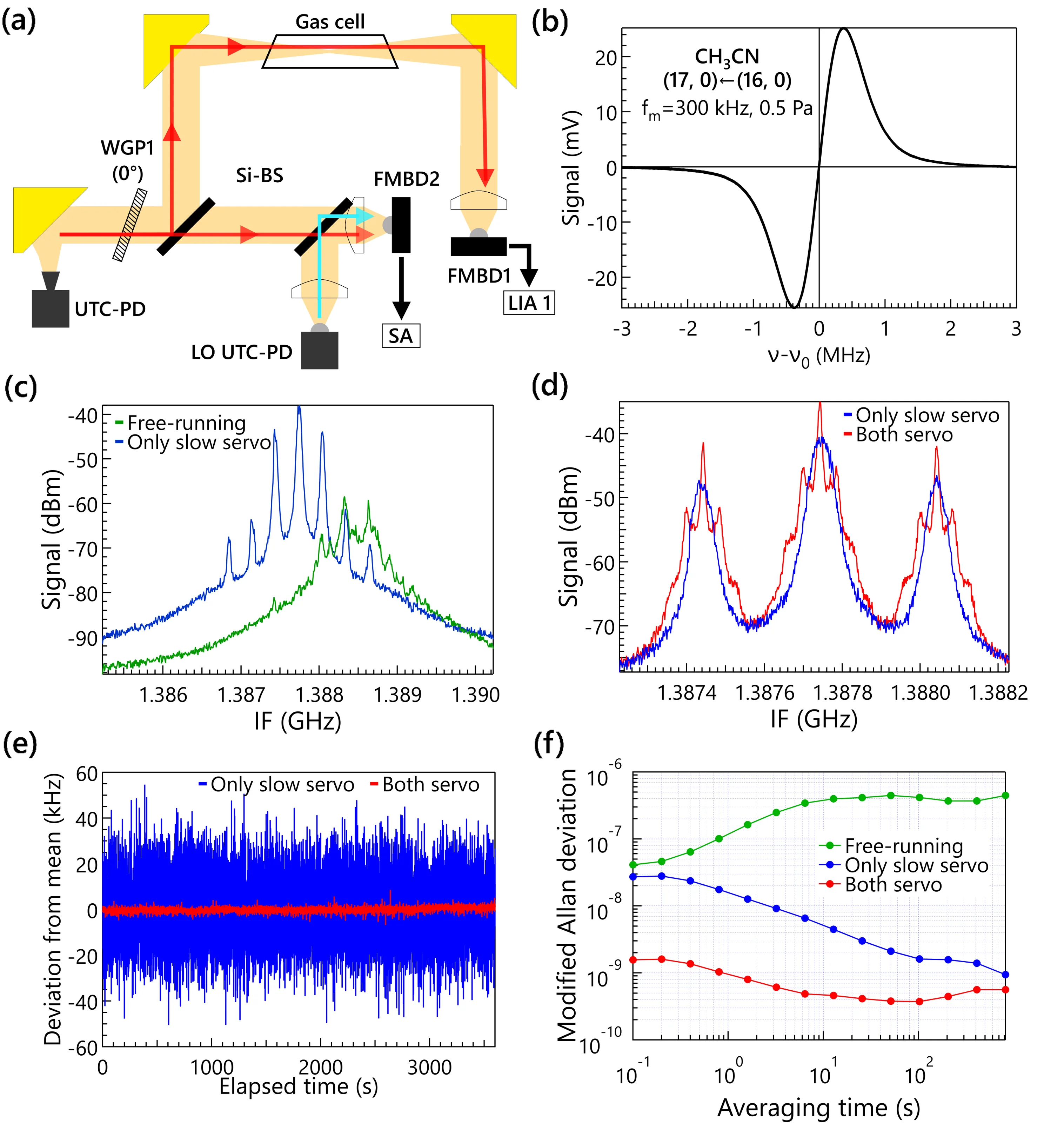
Light passing through a gas leaves narrow dark lines on the spectrum — the fingerprints of absorption. Acetonitrile molecules, like tiny antennas, respond only to strictly defined frequencies. But when there are many such lines and they are closely spaced, the signals overlap, like voices in a noisy room. As a result, clocks based on these molecules start to drift.
Scientists used a clever trick: they made the signal sound like three notes played simultaneously, but with slightly different pitches. This "chord" helped isolate the desired line and suppress neighboring ones. The result was a clean signal that can stabilize frequency to within one part per billion per second.
Such precision is enough to detect time drift in navigation systems or to perform ultra-sensitive measurements. Moreover, the method allowed observation of an effect previously lost in the noise — the so-called Lamb dips. These are narrow peaks in the spectrum arising because molecules moving toward and away from the light interact differently with the wave.
Clocks that are not thrown off by interference are a step toward portable frequency standards. They could find a place in satellites, laboratories, and even telecommunications equipment, where every billionth of a second matters.
Original abstract
as written by the authors arXiv:2602.07737
We demonstrate a distortion-free terahertz frequency stabilization technique using a "synthetic FM triplet" to overcome modulation sideband interference associated with high-density spectral lines in molecular clocks. By applying this method to the rotational transitions of acetonitrile (CH$$_3$$CN), we successfully generated clean derivative waveforms free from inter-line interference, achieving a fractional frequency instability of $$1 \times 10^{-9}$$ at an averaging time of $$1~\mathrm{s}$$. Furthermore, we report the observation of Lamb-dips using this high-fidelity approach. Our results establish acetonitrile as a promising candidate for high-agility molecular clocks and provide a robust solution for precision spectroscopy of molecules with complex hyperfine structures.
Acetonitrile is the same substance found in some nail polish removers, but in gaseous form its molecules rotate with the precision of a clockwork mechanism.
In the series "The Expanse," ships synchronize time via atomic clocks to jump through the ring gates; molecular clocks could make such synchronization even more reliable.