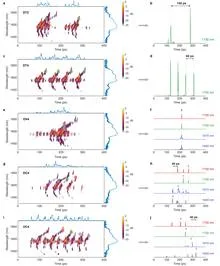
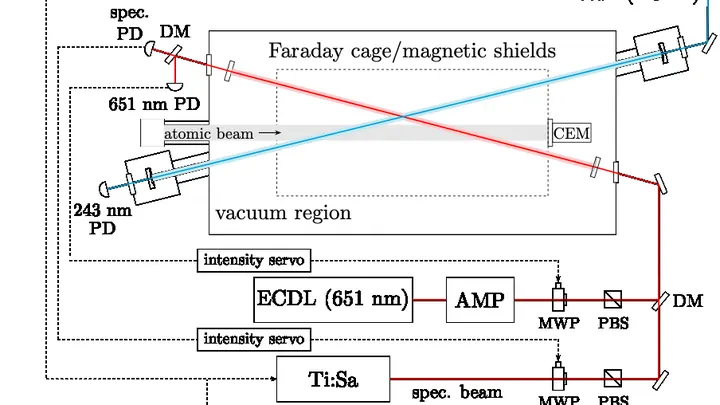
Spectral line measurement refers to the precise determination of the frequencies of light emitted or absorbed by atoms and ions when their electrons transition between energy levels. These measurements are fundamental to atomic physics, providing a direct window into the structure of matter and the constants that govern it. Using synchrotron radiation—bright, tunable light from particle accelerators—and ion traps, which hold charged particles in place, scientists can achieve extraordinary accuracy, often to parts per trillion.
History
The technique of precise spectral line measurement evolved from early spectroscopy in the 19th century, but the combination of ion traps and synchrotron radiation became prominent in the late 20th century, with major advances in the 2000s.
How it works
In an ion trap, a single ion is confined electromagnetically and cooled to near absolute zero, minimizing Doppler shifts and other disturbances. Synchrotron radiation is then used to excite the ion, and the emitted light is analyzed with high-resolution spectroscopy. By comparing the measured frequency to theoretical predictions, researchers can test quantum electrodynamics and determine fundamental constants like the Rydberg constant or the fine-structure constant.
In practice
These measurements underpin optical atomic clocks, which are used in GPS satellites, telecommunications, and tests of fundamental physics, as well as in defining the second.
Fun fact
The most precise spectral line measurements have achieved uncertainties of about 10^-18, meaning a clock based on such a transition would not lose or gain a second over the age of the universe.
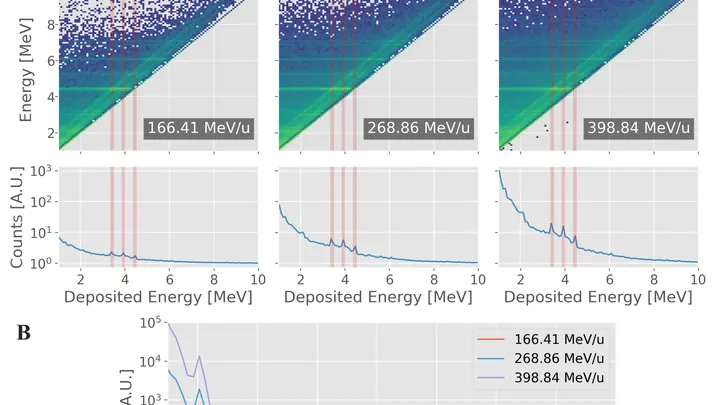
An aluminum sphere the size of a large globe sits in a neutron beam and answers each hit with a precise note. Inside the sphere there is nothing but nitrogen and eleven tiny steel balls, each the size of a pinhead. When a neutron enters the sphere, it knocks a particle out of a nitrogen atom, and that jolt turns into an electrical signal.
A conductor raises the baton, and the orchestra produces not just sound but a complex score: each note sounds at its own moment, at its own pitch, with the right volume. Light can also be a score, if you control its spectrum and timing. Previously, this required bulky setups that could not be reconfigured after assembly.
Miners took canaries underground not for their songs. The bird would fall off its perch before the miner noticed carbon monoxide. In ultrahigh vacuum, the canary's role is played by a cloud of one hundred thousand lithium or rubidium atoms.
In the dark chamber of the trap, thousands of charged particles dance under electric fields. At first they move freely, like a crowd in a square, but cool the cloud and the dance slows: ions begin to sense each other, their steps become constrained.
A cartographer receives a sheet with distances between hundreds of unnamed islands. No island is labeled, but the distances repeat, forming triangles and quadrilaterals. From these repetitions, the cartographer reconstructs the map of the archipelago, not knowing which island is which. This is roughly how the new work in molecular spectroscopy works.
Light born when a fast electron enters a material is usually assumed to be the same in all directions. But in crystals where optical properties depend on direction, that's not the case. Run your hand over velvet: one way it's smooth and shiny, the other — dark and rough. Similarly, a crystal responds differently to light depending on how it's oriented.
The helium atom is like a tightly stretched string: every note it plays is strictly predicted by theory. But in recent years, precise measurements of one such "note"—the energy needed to strip an electron from an excited helium atom — have started to sound slightly higher than they should.
Low-frequency radio waves (from 30 to 300 kilohertz) carry information through water and earth. But catching them with an ordinary antenna is hard: the wavelength reaches several kilometers, and a small receiver barely feels such a field.
Light waves are never perfectly smooth — they are constantly jittered by quantum ripples. These almost invisible nudges were studied by Nobel laureate Roy Glauber, who laid the foundations of quantum optics. Now physicists have learned to freeze these ripples.
A laser isn't just about light. If you make a particle oscillate like a pendulum and those oscillations sustain themselves, you get a phonon laser. Sounds complicated, but the idea is simple: instead of light waves, the device emits orderly waves of mechanical vibrations — phonons.
Ever since Paul Dirac theoretically predicted antimatter, physicists have been hunting for the tiniest differences between particles and their antiparticles.
A tiny charged top is locked inside a freezer the size of a pea. The temperature is four degrees above absolute zero, and thermal jitter is nearly halted. This top is a molecular ion — OH⁺ — stripped of an electron, leaving a positive charge.
A squad of soldiers marches across a parade ground. As long as everyone keeps in step, the movement remains sharp and coordinated. But if someone falls out of line, the order is lost. In the microworld, electrons play the role of such a squad: when their oscillations are synchronized, the substance emits a narrow, sharp line.
In a benzene molecule, electrons buzz around the nuclei like a swarm of bees around a hive. But this swarm doesn't just hum: it pulses: every 856 attoseconds, the electron cloud completes a full oscillation cycle. The hive itself, the carbon nuclei, rocks more slowly, with a period of 36 femtoseconds.
Hydrogen is the simplest atom: one proton and one electron. You'd think there's nothing left to study. But it's precisely on hydrogen that physicists test the most delicate laws of the microcosm. The electron in an atom can occupy different energy levels, like steps on a ladder.
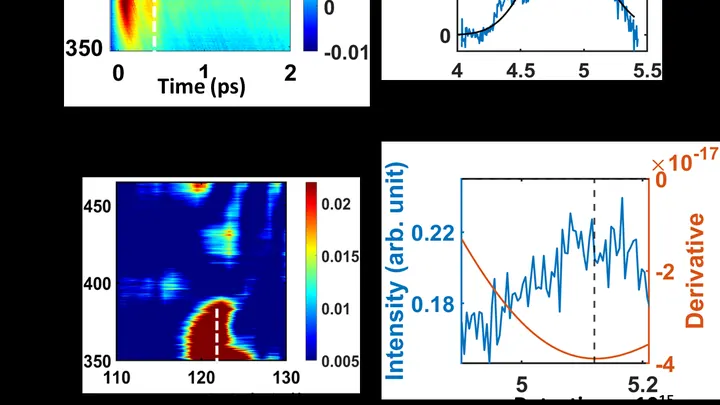
A short laser pulse hits an iodine molecule, and its atoms start to vibrate like a ball on a spring. Scientists track these vibrations with a second, broadband pulse that captures a spectrum at different moments in time.
It turns out that vibrations in the excited B state quickly shift in frequency and fade out, and then vibrations appear in the A state.
When a carbon ion beam enters the body, it doesn't release energy all at once but rather at the end of its path, like a runner who gives their all on the final stretch. Doctors need to know this finish point to avoid damaging healthy tissue. But how can you look inside the body without making an incision?
A neutral-atom quantum computer is like a library where books not only need to be read but also quickly returned to the shelf. Slow readout of results is like a sluggish librarian holding up the entire queue. Scientists have found a way to speed up this process by adding helpers.
Imagine a balance scale with identical weights, yet one pan always tips lower. In the world of elementary particles, this imbalance is called CP violation: particles and their mirror twins (antiparticles) behave slightly differently.
Atoms in a beam travel at different speeds, like runners on a track. A regular laser pulse only pushes those moving at one speed, but the new one acts like a coach giving commands to the whole group at once. This approach involves more atoms in the measurement.
When heavy nuclei collide in accelerators, a multitude of particles is produced, and physicists want to understand how electric charge moves through this chaos. Two trains crash into each other: the passengers (quarks) scatter, but their luggage (charge) may end up far from the crash site.
In the basement of a laboratory in Jyväskylä, a trap holds a single atom aloft, like a magician balancing a ball on a fingertip. The tin-113 atom is unstable: sooner or later it captures one of its own electrons and becomes indium-113, emitting an elusive particle — the neutrino. How much energy is released in the process was previously known only approximately.
Two laser beams of different colors strike a crystal, and inside it, triplets of light particles are occasionally born, like three coins popping out of the same vending machine slot. For the first time, this process has been made efficient enough: 11.6 triplets per second.
The beams were green and invisible infrared.
Snapping an atom is like photographing a startled butterfly without scaring it off. Scientists use two alternating beams: one holds, the other cools like a gentle breeze. This reduces entropy (the atom's jitter) and chills them to millionths of a degree above absolute zero — colder than deep space.
A laser flash lasts a few femtoseconds — imagine a single instant stretched into a million parts. Such a flash mixes many colors, from red to violet. Instruments that measure the pulse shape often err: they see some colors well and others poorly, blurring the picture.
The authors propose a simple fix.
Strike a tuning fork, and it rings with a single pure note. But if the fork is trembling and people are chattering nearby, the sound won't be perfect. Same with molecules: each one absorbs light of a specific color, but due to its own vibrations and the jostling of neighbors, that color gets smeared out.
The authors of the paper figured out how to show this to students without complex formulas.
When an aircraft is on final approach or a submarine is navigating blind, the navigator needs an instrument that never loses track of motion. Conventional gyroscopes based on atomic waves are extremely precise, but they have a quirk: the signal repeats like a wallpaper pattern, and after half a step, the pattern starts to look the same. The instrument loses its sense of position.
A beam of carbon ions strikes the tumor precisely, like a surgeon who can only see the skin. Inside the body, the beam stops, and exactly where used to be a mystery. Now, helium is mixed into the same beam: it passes through the body like an X-ray, and its trail shows where the carbon went.
Laser light is like a perfectly aligned row of soldiers on parade: all waves oscillate in the same plane. Such light is called polarized. In a new study, physicists have for the first time produced polarized gamma rays by colliding electrons with a powerful laser pulse.
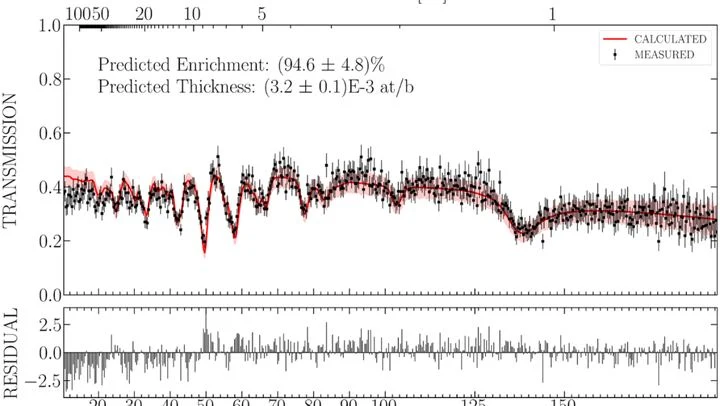
A customs officer can't take a suitcase apart to see what's inside. They shine X-rays through it and, from the shadows on the screen, tell: here's metal, here's organic matter. In much the same way, an inspector for future nuclear disarmament treaties should be able to check a warhead — without opening it or seeing its secret internals.
Neutrons are better suited for this than X-rays.
Deep in the Swiss Alps, there is a vertical shaft that plunges 800 meters down, like two skyscrapers stacked on top of each other. A railway tunnel runs nearby, and trains thunder through it every day. But inside the shaft, it is as quiet as a library at night.
In collisions of heavy nuclei, a fireball of thousands of particles is born. Among them are pions and kaons, two kinds of light particles that look very much alike. To understand what happens in this fireball, physicists need to know exactly how many of each particle flew out.
Standard chemotherapy hits the whole body like carpet bombing: both cancerous and healthy cells suffer. Scientists are hunting for more precise weapons — molecules that light up when they slip into a cancer cell's DNA, revealing its location. Such glowing probes could help doctors spot tumors early and even destroy them with pinpoint accuracy, leaving neighboring tissue untouched.
A charged particle spiraling in a magnetic field doesn't stay silent: it emits light. This light is called synchrotron radiation, and it shows up everywhere — from distant galaxies to laboratory accelerators.
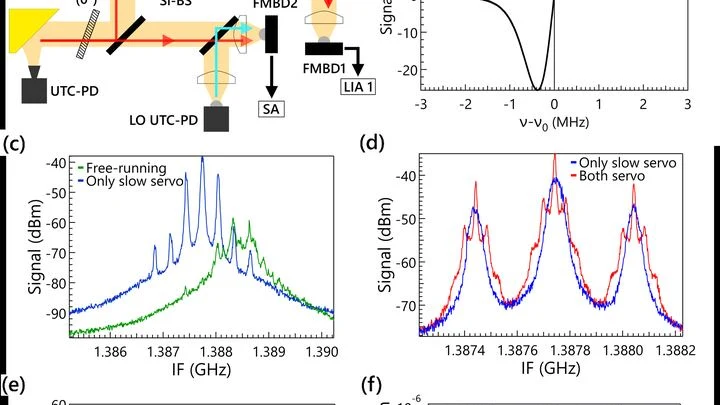
An ordinary comb parts hair into even strands. A laser 'comb' does the same to light: it emits not one color but thousands, spaced at exactly equal frequency steps. Such a tool has already helped measure time to billionths of a second and peer inside atoms.
Light passing through a gas leaves narrow dark lines on the spectrum — the fingerprints of absorption. Acetonitrile molecules, like tiny antennas, respond only to strictly defined frequencies. But when there are many such lines and they are closely spaced, the signals overlap, like voices in a noisy room. As a result, clocks based on these molecules start to drift.
In the cold clouds between the stars, where new suns are born, invisible chemical work is underway. Simple molecules collide, swap atoms, and assemble into chains that may later become part of planets. One such chain is the NCCO+ ion, made of nitrogen, two carbons, and oxygen.
The helium atom is like a tiny solar system: electrons orbit the nucleus, but their orbits are governed by strict rules. Scientists have learned to observe these motions with incredible precision.
An X-ray telescope captures light from hot gas around stars, but that light arrives 'blurred'—like a voice over a bad phone line. To make out the words, you need a dictionary of the exact frequencies at which atoms glow. Such a dictionary is written not only with calculations but also with direct experiments.
Every atom has its own 'voice'—the frequency of light it emits. For isotopes, atoms with different numbers of neutrons, the voices differ slightly. It's like a choir: if you know the score precisely, the slightest false note reveals external interference. The King plot is a way to compare how harmoniously two notes from different isotopes sing together.