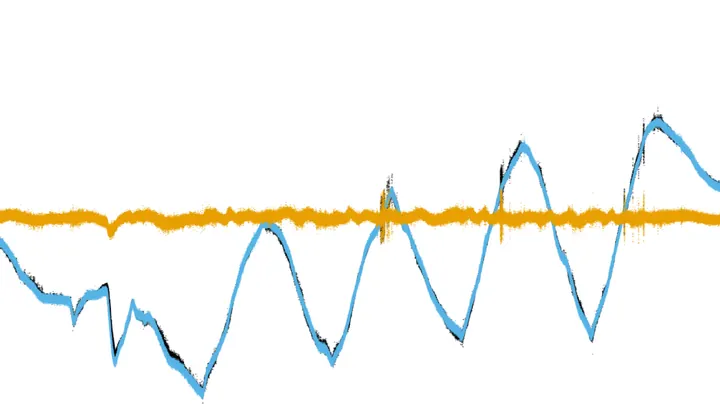
A frequency standard is a device that produces a stable and precise frequency reference, typically used for timekeeping or as a calibration source. The most common type is the atomic clock, which uses the transition frequency of atoms (such as cesium or rubidium) as the reference. Frequency standards are the backbone of modern navigation systems, telecommunications, and scientific experiments that require precise timing.
History
The first accurateatomic clock based on cesium was built by Louis Essen in 1955 at the National Physical Laboratory in the UK. Since then, the definition of the second has been tied to the cesium transition, and optical clocks have been developed that are orders of magnitude more precise.
How it works
In an atomic clock, atoms are prepared in a specific quantum state and then interrogated with electromagnetic radiation. When the radiation frequency matches the atomic transition, the atoms absorb or emit photons, and this resonance is used to steer the oscillator to the correct frequency. The stability of the clock depends on the quality factor of the atomic transition and the number of atoms used. Optical clocks use transitions at optical frequencies, which are much higher than microwave transitions, allowing even greater precision.
In practice
Frequency standards are used in GPS satellites, where they enable precise positioning, and in telecommunications networks to synchronize data transmission. They are also essential in fundamental physics experiments, such as tests of relativity and searches for variations of fundamental constants.
Fun fact
The best optical clocks are so precise that if they had been running since the Big Bang, they would have accumulated an error of less than one second.
In a quiet room of a Budapest laboratory, a bracelet lies on the table, and instead of a strap, it has a thin conductive thread stretched in a zigzag. It doesn't heat up or glow, but when pressed against the wrist, it starts to listen. Each heartbeat sends a pressure wave through the radial artery, and the thread, deforming, changes its electrical resistance.
Fatty liver disease often goes unnoticed, but over time it can lead to serious problems. To avoid taking a tissue sample, doctors use ultrasound: sound waves pass through the tissue and attenuate differently depending on fat content. This parameter, the attenuation coefficient, shows how "fat" the liver is.
But the method has a flaw.
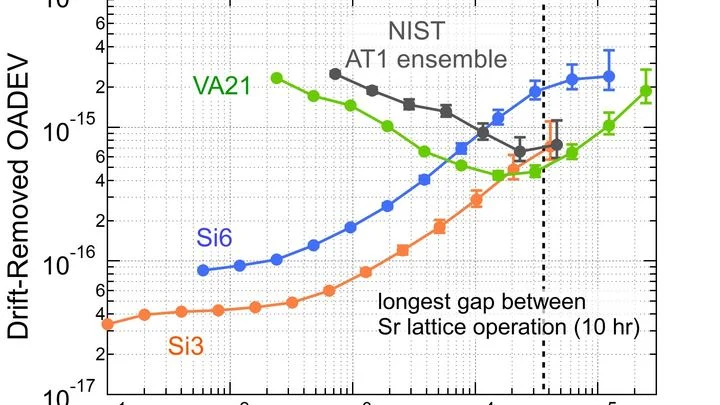
The ticking of atomic clocks is like the beat of a metronome, but instead of a pendulum, it's the oscillation of electrons in an atom. Two such clocks — one using an ytterbium ion, the other using strontium atoms — were made to tick side by side, and their rhythms were compared.
The world's most precise stopwatch still runs with one eye on an old pendulum. Hydrogen masers — the best radio-frequency flywheels (devices that keep the rhythm between comparisons with a reference)—accumulate error because noise between ticks leaks into the final signal.
Imagine an experienced chef during rush hour: suddenly a stove fails or a key ingredient runs out. Instead of panicking, he instantly reworks the recipes — speeding up some dishes, slowing down others, reallocating resources on the fly. This principle of dynamic adaptation underpins a new generation of ultra-reliable networks.
A pendulum that almost nothing can knock off balance (not shaking, not heat, not magnetic fields) because it is hidden in the very heart of the atom. That is the kind of pendulum physicists used when they first switched on a nuclear clock. Previously, the best clocks, optical ones, relied on electron transitions.
Strike a diamond and it rings, but sound lives inside it even without a strike. Waves of compression and rarefaction constantly ripple through it, like the ripples a stone makes on water. Except this ripple is the thermal jitter of the atoms themselves, and it can be detected with a laser.
A pendulum swings with such precision that, had it been counting seconds since the Big Bang, it would have drifted by only half a second by today. That is the stability of the new portable ultraviolet laser — the heart of aluminum atomic clocks.
In the basements of four European institutes stood seven devices: each can be compared to a tuning fork of unimaginable precision. But instead of sound, they emit 'ticks' made of light: oscillations of a laser locked to a specific frequency by atoms of strontium, ytterbium, or mercury.
An ordinary thread sewn into fabric can listen to the body. It feels the chest rising with each breath, a finger bending, and the pulse beating at the wrist. All this — without stiff patches or wires, just as part of your clothing.
The sensor is made from a flexible thread that changes resistance when stretched or pressed. It is woven into fabric in a triangular pattern, like a fine mesh.
A laser that usually produces a steady beam starts to tremble near its threshold, like a string about to sound. This trembling is not a defect but quantum noise: atoms inside the laser emit light randomly, without any external cause.
Atomic clocks are pendulums that tick at the frequency of light. Inside a trap, an aluminum ion hangs, and a laser probes it like a tuning fork. If the laser's frequency matches the atom's natural frequency, the atom responds. The clock's rate is checked against this response.
Sound in a solid is waves of compression and rarefaction rippling through atoms, like ripples across a spring mattress. If you place obstacles with just the right spacing, waves at certain frequencies can't pass: they bounce back. Such a periodic structure is called a phononic crystal, and it works for sound the way a multilayer mirror works for light.
A seismometer is the planet's ear. It picks up the faintest tremors in the ground and turns them into an electrical signal. But this ear isn't perfect: its sensitivity depends on temperature. In the cold and in the heat, the instrument hears slightly differently, and that introduces error into measurements.
A laser beam usually quivers slightly, like a plucked string. In optical clocks, that quiver turns into timing errors. Engineers swapped the shaky light for steady light, and rubidium vapor clocks started ticking five times more evenly.
Light passing through a gas leaves narrow dark lines on the spectrum — the fingerprints of absorption. Acetonitrile molecules, like tiny antennas, respond only to strictly defined frequencies. But when there are many such lines and they are closely spaced, the signals overlap, like voices in a noisy room. As a result, clocks based on these molecules start to drift.
A quantum computer is like an orchestra where every musician must play with precision down to a billionth of a second. If one instrument goes out of tune, the whole symphony collapses. So scientists spent a year watching 27 qubits — the simplest cells of quantum memory.
Heat an ordinary quartz watch by ten degrees, and it will start losing seconds each day. Atomic clocks are more precise, but they take up an entire cabinet. Diamond with a tiny defect, a nitrogen vacancy, promises atomic-clock accuracy in the volume of a grain of sand.
A ruler made of light: that's one way to describe a new method for measuring tiny time delays. In 1987, Chong Ki Hong, Zhe-Yu Ou, and Leonard Mandel noticed that when two indistinguishable photons hit a beam splitter simultaneously, they always exit together from the same port.