Sound Controls Molecular Spin at Room Temperature express
A pentacene molecule is like a tiny top that can spin in two directions. Normally, you need a magnet to flip its direction. But in this work, no magnet was needed: sound did the job instead.
A thin film of pentacene was placed on a lithium niobate plate. A surface acoustic wave was sent across the plate, like ripples on water, but in a solid. The wave mechanically jostled the molecules and changed their spin state. It worked at room temperature, with no external magnetic field.
Spectroscopy revealed that the spin was indeed switching. The scientists observed Rabi oscillations — oscillations between two states, like a pendulum swinging back and forth. The stronger the sound, the faster the "pendulum" swung.
This magnet-free way of controlling spin could be useful in future devices where small size and low power consumption matter. Sound turned out to be just as precise a tool as a magnetic field.
Original abstract
as written by the authors arXiv:2602.08772
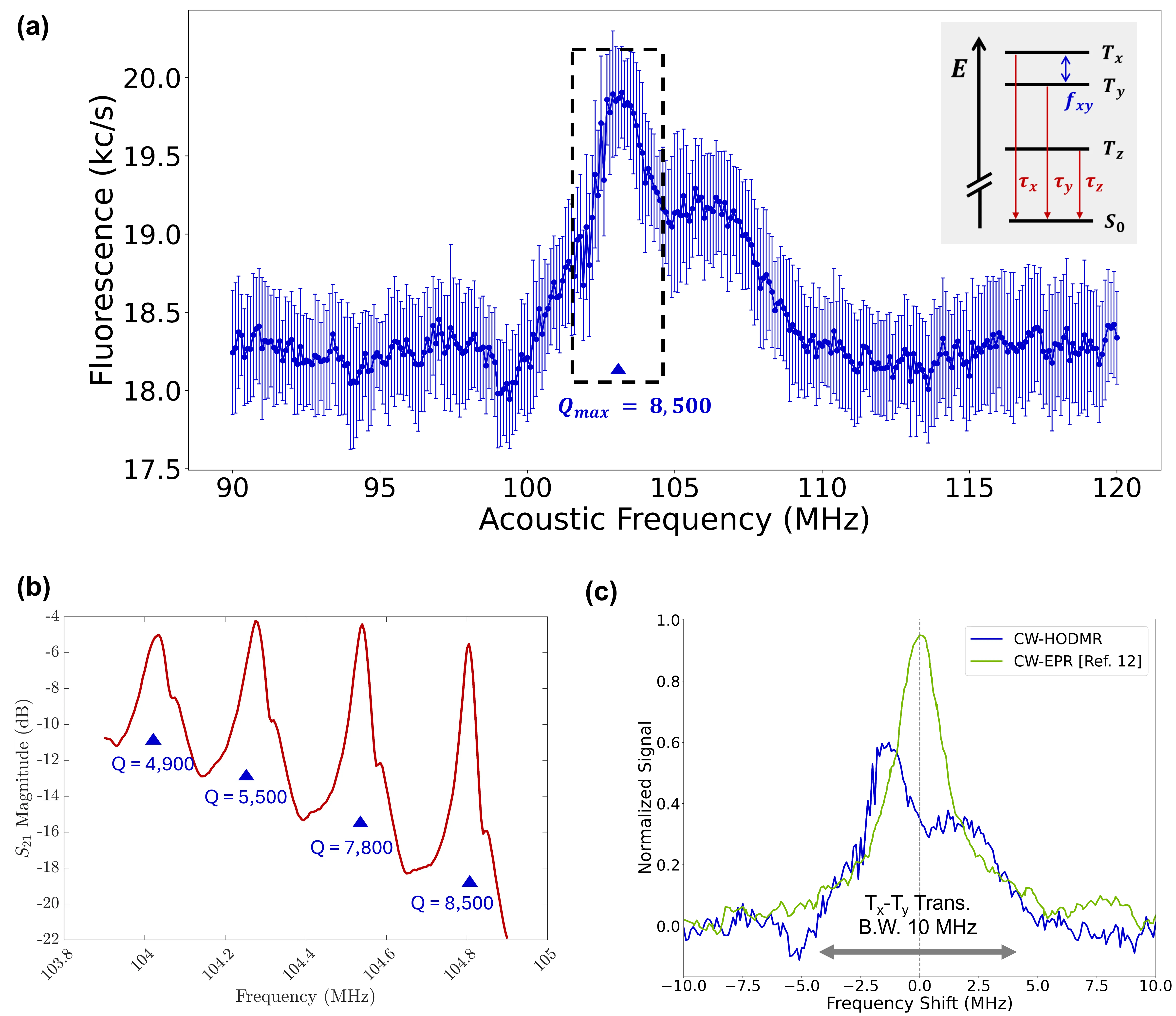
We report an implementation of spin-acoustic resonance in pentacene thin films integrated on a high-quality-factor (high-Q) surface acoustic wave (SAW) resonator on a lithium niobate substrate. Heterogeneous optically detected spin-acoustic resonance (HODSAR) is an optically detected spin-resonance measurement in which the resonant drive is delivered mechanically by a surface acoustic wave (SAW). By leveraging the photo-excited triplet state of pentacene at room temperature, we demonstrate coherent spin manipulation via acoustic driving under zero externally applied magnetic field. The heterogeneously integrated device, referred to as HODSAR, utilizes spin-phonon coupling to achieve mechanically driven, zero-field spin resonance, opening avenues for room-temperature mechanically addressable spin control and device integration. We show that the high-Q multimode response of the SAW resonator enables spectrally selective acoustic addressing of triplet transitions near 105 MHz. Coherent control is evidenced by Rabi oscillations, with a Rabi frequency that increases linearly with the square root of the applied RF input power over the measured drive range, consistent with driven two-level dynamics under acoustic excitation. These results establish spin-acoustic resonance in a heterogeneously integrated molecular thin-film platform and provide a quantitative basis for benchmarking mechanically mediated spin control.
Surface acoustic waves are used in smartphone touchscreens: they travel across the glass surface and respond to touches.