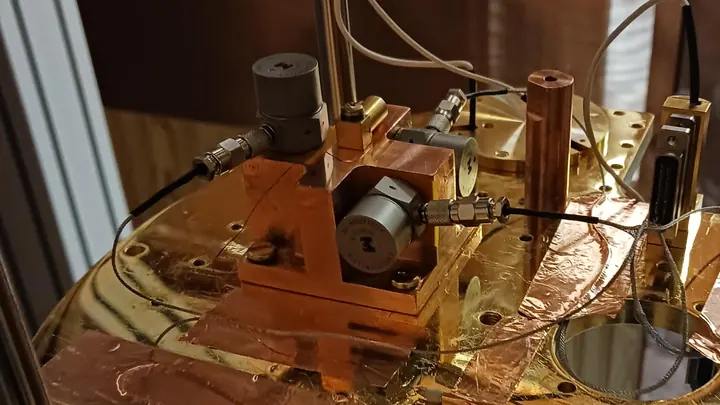
Power consumption refers to the amount of electrical energy a device uses per unit time, typically measured in watts. In cryogenic settings—where temperatures approach absolute zero—minimizing power consumption is critical because any heat generated by electronics must be removed by the cooling system, which is extremely inefficient. For example, removing one watt of heat at 4 Kelvin can require over a thousand watts of input power at room temperature. Thus, reducing power consumption directly reduces operational cost and the physical footprint of cryogenic infrastructure.
How it works
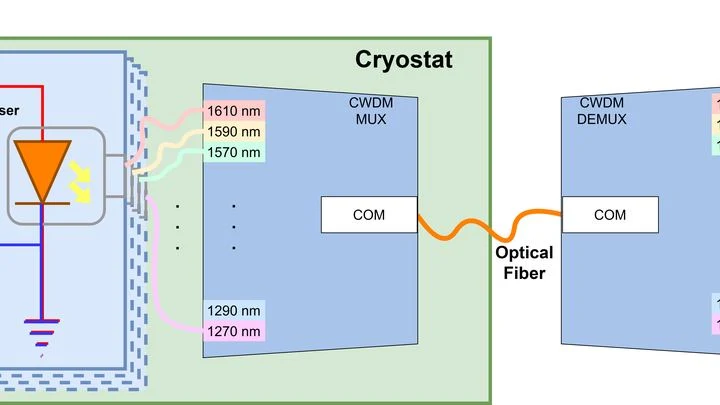
In cryogenic systems, power consumption is minimized through several strategies. Superconducting devices, which have zero electrical resistance below their critical temperature, eliminate resistive heating entirely—this is the basis of 'Сверхпроводящая память' (Superconducting memory). Low-power electronics are designed with reduced supply voltages and clock frequencies, as dynamic power scales with the square of voltage. Additionally, 'Свет вместо проводов' (Light instead of wires) describes using optical fibers to transmit signals into the cryostat, replacing electrical cables that would conduct heat and dissipate power. The cooling itself often uses pulse-tube or dilution refrigerators, where the efficiency is directly tied to the heat load from the device.
In practice
Minimizing power consumption is essential for quantum computers, superconducting qubit readout electronics, and ultra-sensitive detectors in astrophysics, where the entire system must operate at millikelvintemperatures.
Fun fact
In a dilution refrigerator, the coolingpower at 10 millikelvin is typically only a few hundred microwatts—less than the power used by a single LED indicator—so every nanowatt of heat from electronics must be meticulously accounted for.
In the Moon's polar craters, where sunlight never reaches, regolith may accumulate electric charge for decades, buried deep below the surface. It's like a bank account where deposits and balance don't match: a particle delivers energy, but the charge doesn't always stay put.
A quantum lab is like a kitchen where the chef waits a day for the stove to cool down. Superconducting qubits only work at temperatures of a few hundredths of a kelvin, and each 'cool, measure, warm up' cycle eats a whole day. A team of engineers built a fridge the size of a melon, weighing 3 kg, that does the job in just two hours.
A regular battery releases heat smoothly: what you store is what you get. The power is fixed once and for all, like a faucet that pours water in a single stream. But sometimes you don't need a steady flow; you need a short, powerful burst: to instantly heat a part, trigger a reaction, or dump excess heat.
Hot water after a shower, warm air from ventilation, the heated walls of an engine — all this is heat below 100°C. Usually, it dissipates without doing any useful work. Now it can be captured and turned into electricity.
Inside the new device is a wire made of a nickel-titanium alloy. This material remembers its shape: when heated, it contracts; when cooled, it returns to its original shape.
A conventional computer computes by shuttling electric charges along wires. But can you compute with heat? A network of pipes carrying hot and cold water can perform simple logic operations if the pipes are connected in the right order.
The river splits in two. One branch is wide and fast, with water flowing smoothly, but as temperature rises, the flow slows: eddies and waves appear. The second branch is narrow, with rapids, where water leaps from rock to rock. This flow, on the contrary, becomes more lively with warming.
Hot tea cools down, and ice cream melts — heat always flows from warm to cold, and this law seemed unbreakable. But in the quantum world, even familiar rules can be rewritten. Physicists placed a tiny mechanical resonator (a vibrating bridge the size of a microbe) in an optical cavity between two mirrors.
Any battery, from a AA to a quantum one, is simple in principle: there's a store of energy, and there's a way to get it out. In the quantum world, this 'way' looks like a careful switching between particle states, akin to moving a ball from a high shelf to a low one.
Imagine water as a ballroom, where each molecule is a dancer, constantly forming fleeting partnerships. These hydrogen bonds give rise to local patterns: some resemble a stiff waltz — an ordered network with cavities (low-density structure), others a wild jitterbug, where partners crowd into chaotic dense clusters.
An ordinary field-effect transistor is like a faucet with a very sensitive handle: turn it slightly, and water flows. In the cold depths of a quantum computer, where everything is chilled to near absolute zero, such a faucet must open strictly on command.
A busy intersection without traffic lights. Cars drive, brake, and change lanes, and from the outside, it looks like complete chaos. But if you watch for a while, you can notice a rhythm: the flow thickens and thins. In physics, this rhythm of disorder is called entropy: it shows how far a system is from calm equilibrium, like water in a boiling kettle.
A tuning fork grows quieter not because someone stops holding it, but because the very hand that strikes it creates an invisible haze around it that damps the vibrations. A superconducting resonator behaves much the same way — a tiny track along which a microwave signal runs with almost no loss.
A kettle cools on the table. Heat escapes into the air, and is wasted. Yet you could squeeze a bit of electricity out of it. Devices that can do this are called thermomagnetic generators. Inside them, there are no pistons or turbines — only a material that changes its magnetic properties when heated and cooled.
A detector that hunts for rare particles is like an ear trying to catch a whisper in a noisy room. The quieter the signal, the harder it is to tell apart from random noise. In the NUCLEUS experiment, such detectors, cryogenic calorimeters, are cooled to near absolute zero so they can pick up even a faint pulse of heat from a single particle.
Dark energy is usually seen as an innate property of the cosmos, at work from the very first moments. But a new model suggests it behaved like water on the verge of boiling: long unnoticed, then suddenly kicking in at a critical moment. This scenario is called 'late activation': around 5–7 billion years ago, a shift occurred, and the universe’s expansion began to accelerate.
Quantum materials are like finicky flowers: they only bloom in the cold. At room temperature, they hide their unusual properties, but when deeply cooled, they become superconductors or change their magnetic behavior. To understand how they work, you need to examine their atoms in the very cold where these properties reside.
An ordinary heat engine is like a mill between the hot and cold banks of a river: the greater the drop, the stronger the current. Here, the drop is tiny, just one or two degrees, but water can still turn the wheel. The secret is that water is made to boil not by heating but by a sudden drop in pressure, so steam bursts out even from barely warm liquid.
A water molecule resembles a tiny dumbbell: two hydrogen atoms attach to an oxygen atom at an angle. This dumbbell doesn't stay still: it stretches, compresses, and rotates. Each such motion has its own energy, like steps on a ladder.
A cell is a city where tiny motors work nonstop. They carry cargo, move cilia, and make muscles contract. All this work generates heat, just like a car engine warms up. But measuring the heat from a single motor a few nanometers in size is no easy task.
Stochastic modeling helps us peek into this world.
A thermos of liquid xenon cooled to minus 100 degrees Celsius. Inside are sensitive sensors that catch rare signals from dark matter particles. To bring these signals out, copper cables are usually used. But over the long haul, the signal weakens, and adjacent cables start 'cross-talking' — that's called crosstalk.
At the South Pole, where the air is dry and transparent to millimeter waves, stands a telescope that looks not at stars but at the oldest light in the universe. This light is the cosmic microwave background — the radiation left over from the Big Bang, filling the entire sky.
Inside a refrigerator that cools matter to near absolute zero beats a mechanical heart — the pulse tube. It pumps gas and extracts heat, but along with the cold it brings tremors. Each beat of this heart shakes the instruments sitting next to the sample and ruins delicate measurements.
When making popcorn, a microwave uses electricity only to heat the kernels. A gas stove heats the entire burner and the air around it. The same difference applies between a photonic quantum chip and a classical supercomputer when solving a problem devised by Scott Aaronson.
Ordinary computer memory constantly consumes energy to avoid forgetting what's stored. A superconductor could store data without loss, but it's hard to make it switch.
In the new work, a superconductor is sandwiched between two magnetic insulators.