The Fourth Spring of Climate express
A planet's climate is like an old spring mattress: press down on one edge, the springs compress; let go, they rebound and put everything back. Earth has three such springs, working as a team. Carbon dioxide weathers out of rocks, clouds reflect sunlight, and ice caps bounce heat back into space. Together, they keep the planet from boiling or freezing.
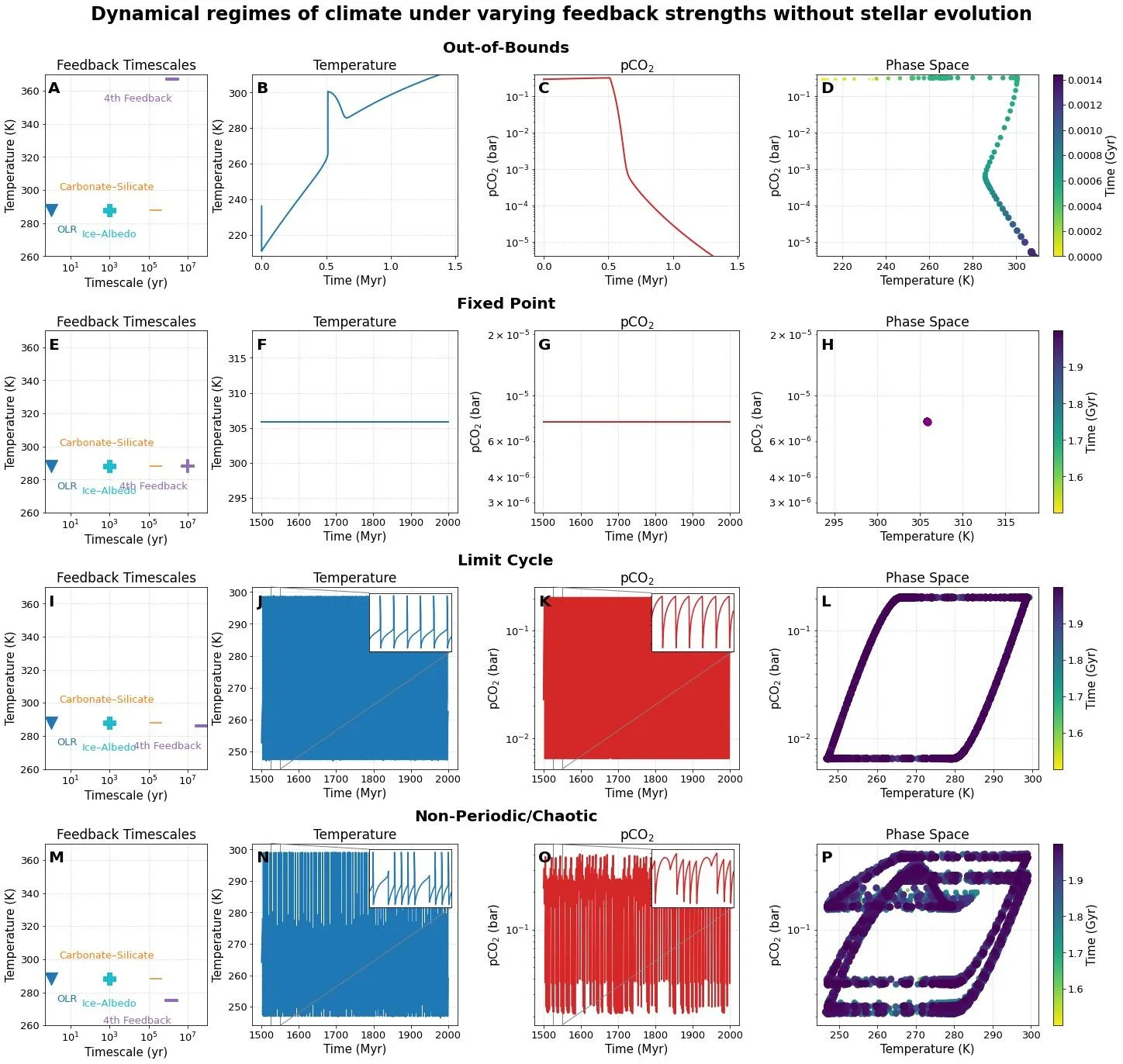
Astronomers hunting for planets around other stars usually assume all Earth-like worlds have the same springs. A group of researchers decided to test what happens if you add a fourth spring — possibly a very stiff one. They ran computer models with different versions of such an extra link. The results surprised them: even one extra feedback loop can break the familiar picture. Some planets accelerated into a runaway greenhouse hell, others slipped into chaos, with climate jumping around with no pattern at all.
This changes the map of habitable worlds. The classic "habitable zone"—the region around a star where liquid water can exist on a planet's surface — shrinks if the planet has a strong fourth spring. The authors stress that their calculations do not predict how many such planets actually exist. They only show that the diversity of climates in the universe may be far richer than what we see on Earth alone.
Back to the spring mattress. Three familiar springs keep our world in comfortable balance. But add a fourth, and the bed might toss the sleeper to the ceiling, or pin them to the floor. When searching for other Earths, we should keep in mind that their springs may be nothing like ours.
Original abstract
as written by the authors arXiv:2602.10369
Earth's climate is influenced by over a dozen feedbacks, but only three dominate its long-term climate behavior. Models of the exoplanet habitable zone (HZ) assume that this is similar for other Earth-like planets. We used dynamical simulations to study Earth-like planets with a fourth, (potentially strong) generalized climate feedback. Across over 20,000 climate simulations, we find that the addition of the fourth feedback produces novel behaviors, including runaway and chaotic climate trajectories, that are more diverse than one would expect based on Earth's climate configuration. Non-negligible fourth feedbacks -- if negative -- would not lessen the probability of planets with temperate climates. However, positive fourth feedbacks decrease the fraction of exo-Earth candidates that are long-term habitable. Therefore, strong fourth feedbacks will alter (and mostly shrink) the boundaries of the classical habitable zone. When combined with occurrence rates of Earth-sized planets around sun-like stars, our results imply that the fraction of stars hosting rocky planets with temperate climates may be substantially lower than classical estimates under Earth-like climate assumptions. Our results are subject to the validity of the model assumptions and not intended to represent conclusive predictions about exoplanet populations but rather to demonstrate the potential climate diversity that emerges from non-Earth-like model configurations. Our conclusions provide context on sample sizes and science questions for next-generation exoplanet surveys.
The word "feedback" in climate means a loop: the warmer it gets, the more water evaporates, the more clouds form, and clouds reflect sunlight, so it cools down again. It's like a thermostat that adjusts itself.
In Kim Stanley Robinson's novel "Aurora," colonists discover that an Earth-like planet has a hidden biological loop that makes it uninhabitable — exactly that "fourth spring."