Mercury is the smallest and innermost planet in our solar system, orbiting the Sun at an average distance of just 58 million kilometers. Its proximity to the Sun makes it an extreme world: surface temperatures swing from -180°C at night to 430°C during the day. In the context of exoplanet research, Mercury serves as a reference point for understanding how planets form and evolve in the scorching inner regions of planetary systems, where only the most refractory materials can survive.
History
Mercury has been known since ancient times, with the earliest recorded observations by the Sumerians around 3000 BCE. Its odd orbital behavior was a puzzle until Einstein's general relativity explained the precession of its perihelion in 1915.
How it works
Mercury's orbit is noticeably elliptical, and its rotation is locked in a 3:2 resonance with its orbit — meaning it rotates three times for every two orbits around the Sun. This unusual spin-orbit coupling, along with its large iron core (about 85% of the planet's radius), provides clues about its formation. The leading theory is that Mercury was once a larger planet that suffered a giant impact, stripping away much of its rocky mantle and leaving behind the dense core. Its proximity to the Sun also means it experiences strong tidal forces and solar wind interactions, which shape its thin exosphere.
In practice
Mercury's extreme environment makes it a natural laboratory for testing theories of planetary formation and for calibrating models of how planets interact with their host stars, which is crucial for interpreting exoplanet observations.
Fun fact
Despite being the closest planet to the Sun, Mercury is not the hottest — Venus, with its thick atmosphere, holds that record.
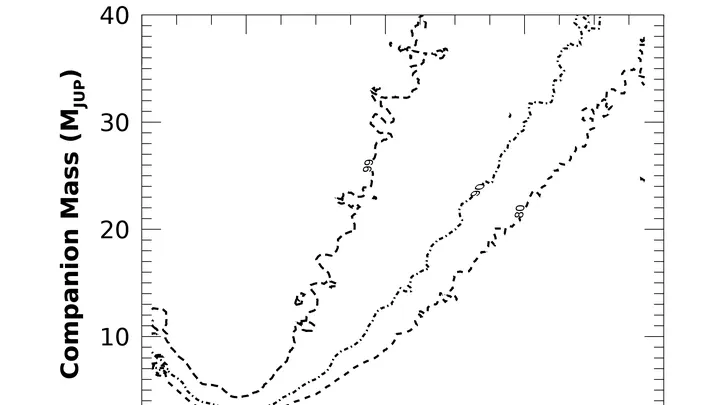
The orchestra is playing fortissimo, and someone in the third row is whispering. Hearing that whisper is the challenge astronomers face at the star HR 8799: four bright giant planets drown out the faint light of a possible fifth, hidden very close to the star.
The HR 8799 system is a proving ground for direct exoplanet imaging.
A little monster hides in a dwarf galaxy, and its neighbor feeds it. The satellite galaxy is slowly merging with a massive companion, and gas from the outer regions falls toward the center, where a black hole sits. By cosmic standards, it is not large: only 800 to 5000 solar masses, but its appetite is ferocious.
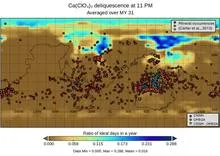
Every Martian night, salt crystals on the planet's surface soak up moisture from the thin air, much like a sponge draws water from a damp cloth. By morning, a microscopic brine accumulates inside them, and during the day, as temperatures rise, that brine finds itself trapped in tiny cavities.
Astronomers catch distant planets by the trembling of their stars: an invisible companion tugs the star toward us and away, and its light subtly shifts in color. But that trembling tells only half the truth. If the planet's orbit is tilted to our line of sight, only part of its weight rocks the star, so telescopes reveal not the true mass but its shadow.
On a sunny street, there's a house with a big family: a giant father who always sits by the window and a small child running around the yard. That's the TOI-4468 system: a gas giant hot Jupiter hugs the star, while a bit farther out circles a sub-Neptune — a planet smaller than Neptune but larger than Earth.
Jupiter's atmosphere resembles a layered cake, where each layer plays its role. Scientists took data from four instruments at once (VLT/MUSE, Cassini/VIMS, IRTF/SpeX, and Juno/JIRAM) and built a model of clouds and ammonia in the planet's equatorial zone, from 0.1 to 10 bar (pressure equivalent to hundreds of kilometers below Earth's…
Edge of the spotlight. Remove the dazzling light of the central star, and a theater of shadows emerges. The James Webb coronagraph, like a dense curtain, hid the star TW Hydrae — and on a stage 120 astronomical units long (four times the distance to Neptune), its protoplanetary disk came alive.
In 1,433 pairs of galaxies scattered across the sky, astronomers noticed an unusual pattern. Neighbors located 'above' or 'below' a massive stellar system contain up to a quarter more oxygen than those lying in the plane of its disk.
When a distant planet passes in front of its star, it briefly blocks part of the light. Astronomers call this a transit and judge the planet's size by the depth of the dip. But light has a property: a massive body acts like a lens. Even a giant planet can slightly bend the star's rays, and the dip becomes a bit shallower than you might expect.
A quarter-century ago, Michel Mayor and Didier Queloz discovered the first hot Jupiter, and shattered all the rules of planet formation. A gas giant on a days-long orbit couldn't have formed next to the star: it's far too hot and lacks building material. So, it must have been born far away and then migrated.
A waterfall that doesn't heat up from the fall but freezes — that's roughly how gas behaves as it flows onto a neutron star in an X-ray pulsar when the star shines dimly. Usually, infalling matter is heated to a white-hot glow, but new work shows the opposite.
A spotlight blazes straight into your eyes, and a few steps away a tiny firefly flickers. That's roughly what it's like hunting for an Earth-like planet around a neighboring star: the planet is a hundred million to ten billion times fainter than its star, and in the sky they almost merge into a single point.
In the Galactic bulge, where the light of billions of stars merges into a continuous glow, four cold giants passed unnoticed. You can't see them through a telescope — too far, too dim.
A ball, almost weightless for its size, circles its star every four days. Planet TOI-2195 A b is a real riddle: by mass it's slightly heavier than Neptune, yet bloated to Jovian volumes. If there were an ocean big enough, this exoplanet would float on its surface like a giant inflatable ball.
When a star dies, it turns into a white dwarf — a dense ball of carbon and oxygen the size of Earth. Predicted by Subrahmanyan Chandrasekhar, these objects were long thought to be lifeless graveyards.
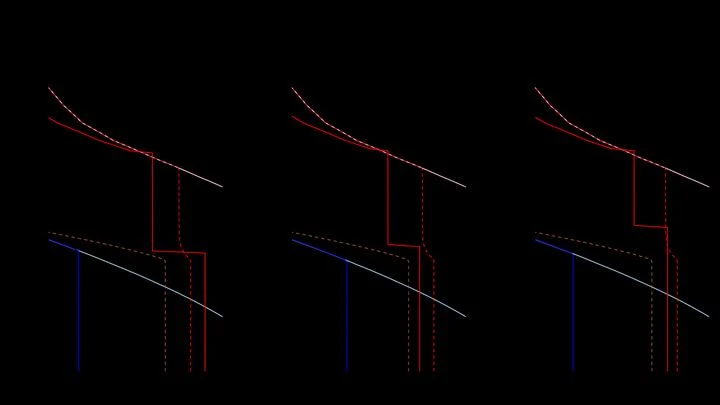
A sub-Neptune is a planet that falls between Earth and Neptune in size. These worlds are abundant in our galaxy, but their internal structure has been hotly debated. New research shows that in their youth, these planets behave like a sponge soaked with water.
Some 158 light-years away, around the dim star TOI-6894, a red dwarf, a planet moves leisurely. Its year lasts less than two Earth days, yet it is a cool world with an equilibrium temperature around 420 K, just a bit warmer than a sauna.
Using James Webb, astronomers 'fished out' a third giant planet from the murky dust disk of the star β Pictoris. Two others were already known, but this one was hiding in the bright light, like a fish in muddy water.
The planet WASP-121 b is a gas giant, heated to 2500°C. It always faces its star with one side, like a globe frozen under a lamp. But as it passes in front of the star's disk, its rotation reveals different facets to us — as if that globe were slowly turned, letting us peer into every corner.
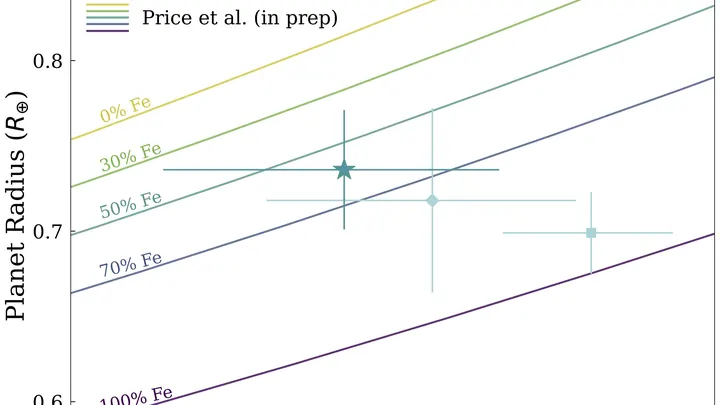
A cosmic sprinter on a short track: that's how you might describe planet GJ 367 b. It whips around its star in just 7.7 hours. This world is slightly smaller than Earth but has a personality: it was once thought to be nearly a solid ball of iron.
In the catalogs of exoplanets, there are many worlds with sizes between Earth and Neptune. They are divided into two groups: rocky super-Earths and gaseous mini-Neptunes. The Solar System has none of these, and scientists debate where they come from.
The authors of the study looked into each planet's 'passport'—its orbit.
A planet glides across a star's disk, and for a moment becomes a flashlight. It blocks a tiny patch of surface, revealing details that otherwise escape our view. That's exactly how astronomers peered into the dark spots on V1298 Tauri, a young twin of our Sun. They were aided by the James Webb Space Telescope JWST and three giant planets in orbit.
The Sun is a giant nuclear reactor that continuously sends us light and heat. But it also has another, almost silent postal service: every second, tens of billions of neutrinos, ghostly particles born in the thermonuclear furnace, fly through a square centimeter of your palm. Most of them leave no trace.
Red dwarfs are tireless blacksmiths of planetary fate. Their radiation, like a hammer, beats off gas envelopes, leaving only naked rocky cores.
In the depths of the constellation Hercules, around the dim M-dwarf GJ 3929, orbits a world one-and-a-half times Earth's size, like a billet on an anvil.
Among the hundreds of moons in the Solar System, Nereid dances the most desperate dance: diving toward Neptune as close as 1.4 million kilometers, then soaring away to 9.7 million — all within less than an Earth year. An eccentricity of 0.75 — the brand of a captured wanderer.
A kindergarten where some kids are busy making sandcastles while others are already assembling building blocks. That's roughly what the V1298 Tau system looks like: it's only 20 million years old — by cosmic standards, it just left the nursery. Several planets orbit it, and two of them, b and e, turned out to be surprisingly different.
Among the icy chunks hurtling through the void, there are special travelers — interstellar comets. They were born around distant stars and happened to wander into our neighborhood. One of them, 3I/ATLAS, came under the gaze of telescopes as it approached the Sun. Its material, frozen gases and refractory dust, began to evaporate, leaving a glowing tail behind.
At the edge of the solar system, where the Sun is barely brighter than other stars, icy boulders, trans-Neptunian objects, circle around. Their orbits resemble hoops scattered by someone. But look closer: twelve of these hoops are not just floating in the void.
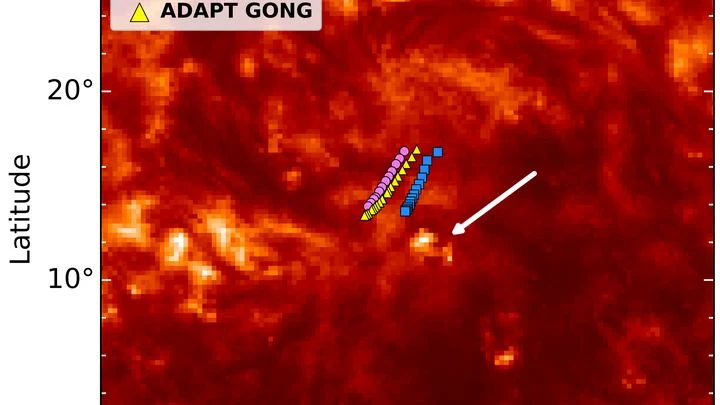
A streetlamp flickers as someone walks past. That's roughly how our nearest star, Proxima Centauri, behaves: it flares in response to the motion of its planets.
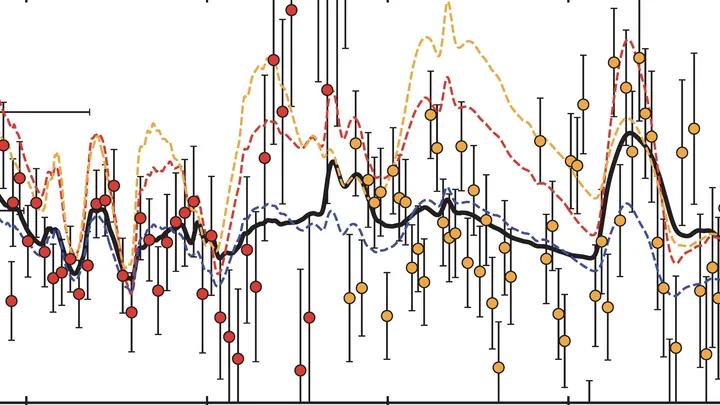
Astronomers observed the star with a highly sensitive instrument, the ESPRESSO spectrograph. It captures light and splits it into colors, much like a prism.
In December 2011, Comet Lovejoy boldly raced through the searing corona of the Sun. Right after — a flare. Scientists checked whether the comet could have caused it. The atmosphere of the Sun is threaded with taut magnetic loops, like a drawn bowstring.
Steam over a boiling pot slightly tints the light of a flashlight: it blocks some colors and lets others through. That's roughly how we study the air of distant planets.
Planet WASP-121 b always shows the same face to its star, like a rock in a campfire. The dayside is so hot that ordinary hydrogen, the very stuff most of the universe is made of, can't take it: its molecules tear apart into individual atoms, and the temperature flips upside down: the higher you go, the hotter it gets.
A giant planet hangs in space in complete solitude, separated from its star by a distance 160 times greater than the path from the Sun to Pluto. The light from its parent star arrives so faintly that the surface temperature barely exceeds 200 degrees Celsius — about as warm as a well-heated sauna.
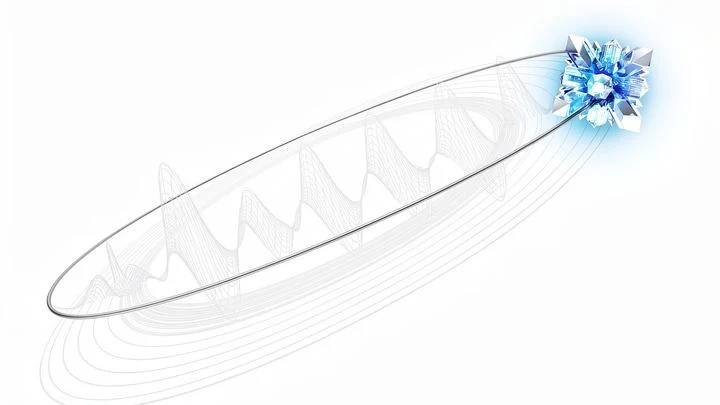
A handful of coins accelerates to one-fifth the speed of light. That's what Coracle interstellar probes will be like — tiny spacecraft weighing just a few grams, each with an ultrathin sail film. A powerful laser beam pushes them forward: light presses on the sail like wind fills a yacht's sails, except instead of air, it's a stream of photons.
The carousel spins all the horses in one direction, but one stubbornly gallops against the flow. That's exactly how the planet TOI-1710 b behaves around its star. Using the HARPS-N and GIANO-B instruments, astronomers measured its tilt at 149 degrees. That's nearly a 180-degree flip, meaning the planet orbits "backward" relative to the star's rotation.
At the edge of the solar system, far beyond Neptune's orbit, something is knocking icy chunks off their paths. Their orbits are stretched and tilted in the same way, as if an invisible hand arranged them in a pattern.
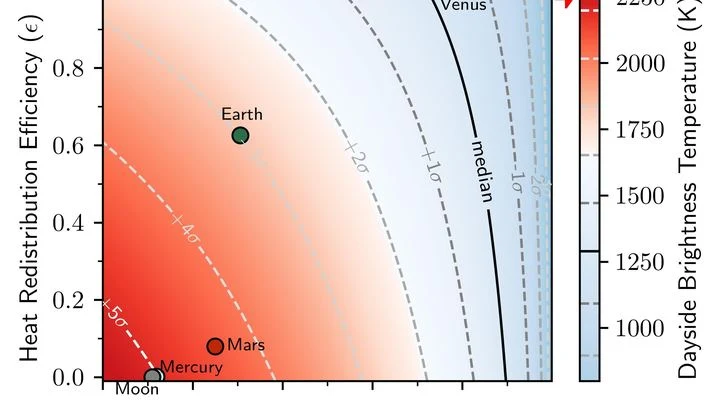
A hot skillet on the stove glows in the dark, but if you cover it with a lid, the heat escapes more slowly and the surface doesn't look as bright. That's roughly the situation on planet HD 3167 b: it always shows the same face to its star, and the dayside is heated to temperatures that melt rock.
Every 1151 years, seven planets of the Solar System, from Mercury to Neptune, find themselves at almost the same points in their orbits. Their positions scatter by less than a degree, as if the celestial mechanism is wound to the same tune. This rhythm was discovered by comparing planetary positions over 2600 years using precise tables of celestial motion.
Around distant icy bodies the size of a city, circling beyond Neptune, rings of dust and ice have been found. Small moons often whirl nearby. Mathematical analysis shows that a moon's gravity rocks the ring like a swing, making it tilt.
Rocky planets orbit dim red stars. Some of them have a year shorter than an Earth day: these worlds are called ultra-short-period planets. Their surfaces are scorching, and their skies are forever bathed in crimson light.