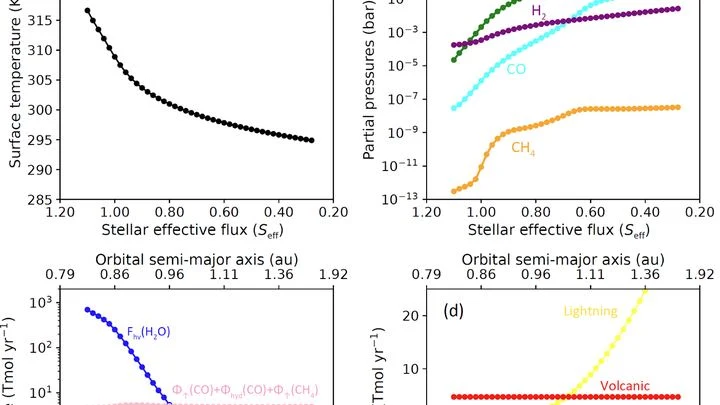
The habitable zone, often called the 'Goldilocks zone,' is the region around a star where a rocky planet with an Earth-like atmosphere could maintain liquid water on its surface. This definition is based on the balance between the star's radiant energy and the planet's greenhouse effect. The inner edge is where water would evaporate and be lost to space (runaway greenhouse), while the outer edge is where carbon dioxide condenses, preventing a sufficient greenhouse effect to keep water liquid. The concept is central to the search for potentially life-bearing exoplanets.
History
The concept was formalized in the 1950s by astrophysicists like Su-Shu Huang, who considered the conditions for life based on stellar radiation. It gained prominence in the 1990s with the discovery of the first exoplanets and has since been refined with more sophisticated climate models.
How it works
The habitable zone's boundaries depend on the star's luminosity and spectral type. For a given star, the distance at which a planet receives the right amount of stellar flux to keep water liquid is calculated using climate models that account for atmospheric composition, albedo, and greenhouse gas concentrations. Planets with thick atmospheres or tidal heating can sustain liquid water outside the classical zone, as seen in the case of some moons around gas giants.
In practice
The habitable zone guides the selection of targets for exoplanet observation missions, such as the James Webb Space Telescope, which searches for biosignatures in the atmospheres of potentially habitable worlds.
Fun fact
The habitable zone is not fixed; it moves outward as a star ages and becomes more luminous, meaning a planet can enter or leave the zone over billions of years.
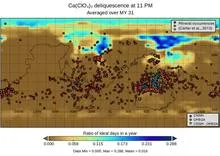
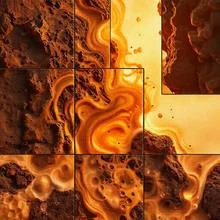
Every Martian night, salt crystals on the planet's surface soak up moisture from the thin air, much like a sponge draws water from a damp cloth. By morning, a microscopic brine accumulates inside them, and during the day, as temperatures rise, that brine finds itself trapped in tiny cavities.
Twelve stars have received X-ray passports. Now, for each of them, we know the exact radiation dose received by a planet in the habitable zone, the region where liquid water is possible.
The JWST space telescope aimed its lens at the scorching rocky world 55 Cancri e, and spotted a dense gas envelope. But the cooler TRAPPIST-1 b, which orbits a dim red dwarf, showed no envelope: just bare rock. The picture came out upside down: hot planets hold onto atmospheres, while cooler ones lose them.
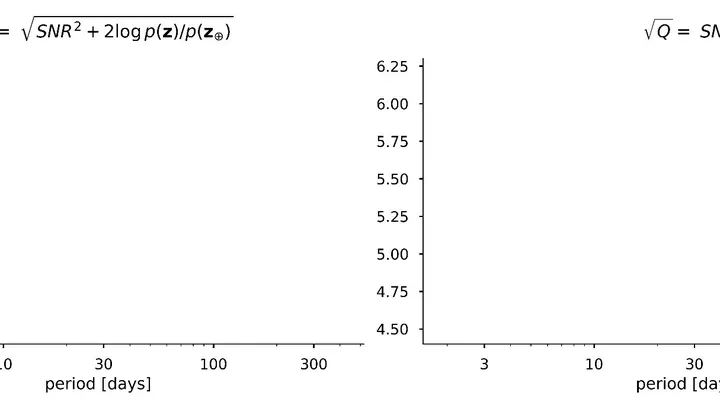
A telescope stares at a star for many nights in a row. Somewhere in the stream of light hides a tiny dip in brightness — an Earth-sized planet briefly blocking part of the star. Such a dip lasts a few hours and repeats once a year or less. Catching it is like hearing a single quiet click in a noisy hall.
A planet in the habitable zone is no guarantee of life. Like a conductor leading an orchestra, a star dictates the tempo and character of planetary atmosphere evolution over billions of years.
In 2024, the team led by David Charbonneau pointed the Magellan telescope with the WINERED spectrograph at LHS 1140. During transit, high-resolution spectroscopy caught the absorption line of metastable helium at 10833 Å.
Every civilization is born with a gravitational debt. The home planet's mass determines the loan amount, and the Tsiolkovsky equation is the interest rate applied to each kilogram of payload. To send a probe to the stars, you have to pay with fuel, and the debt grows exponentially.
The Martian surface is a place where anything alive quickly dies. Cosmic rays and ubiquitous oxidizers sterilize the top layer of soil. But dig a little deeper, and the picture changes. There, beyond the reach of ultraviolet light, a zone suitable for life may lurk.
This zone runs on a strange fuel — radiation.
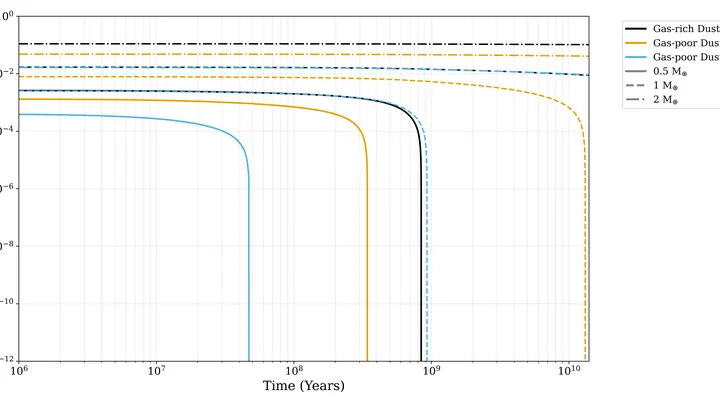
A scorching rocky planet is like a pot of boiling soup, except its lid is the atmosphere. Gases escape from the magma, wrap the world in a thick blanket, and in turn influence how quickly the celestial body cools. For GJ 1132 b, which orbits so close to its star that a year lasts just one and a half Earth days, this connection is especially important.
A stone falls into a pond — near the shore, the ripples are barely visible, while the water churns at the point of impact. The electric field around a charge behaves similarly: close in, it's sharp and tangled, but at a distance it stretches into a smooth wave that carries energy away. Physicists call this distant region the radiation zone.
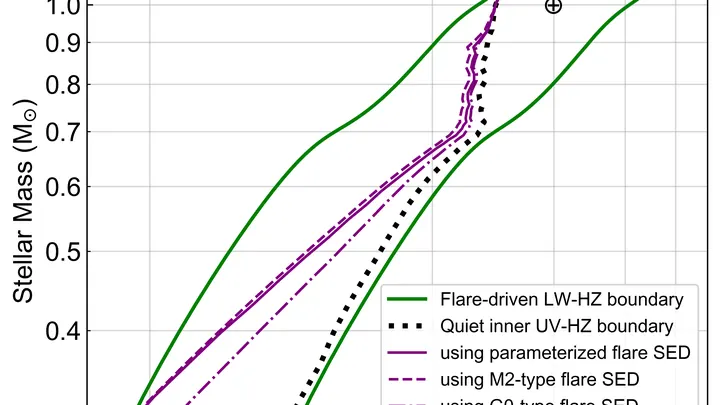
Water isn't the only thing life needs. To assemble the first RNA-like chains from simple molecules, you need ultraviolet light, like the sunlight that helps plants, but harsher and with shorter wavelengths. Big stars like the Sun emit plenty of this light. Small, dim stars, however, have almost none: they shine mostly in red and infrared, like a glowing ember.
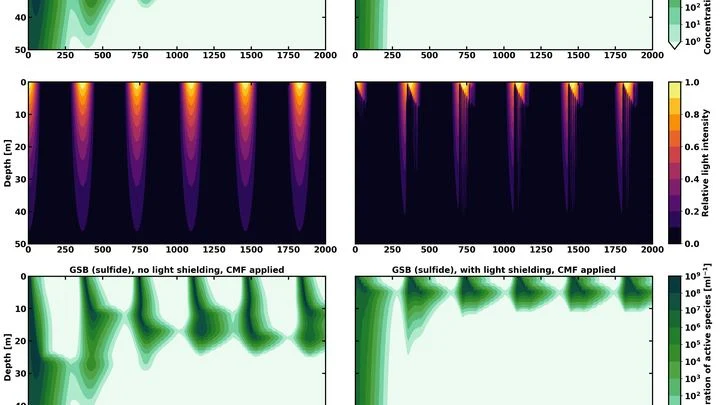
Simple equations that describe fox and rabbit cycles have been turned to bacteria on distant exoplanets, like K2-18 b. These worlds hold deep oceans under thick hydrogen skies. Like duckweed on a pond, light-eating microbes cover the sunlit water surface, stealing light from those below.
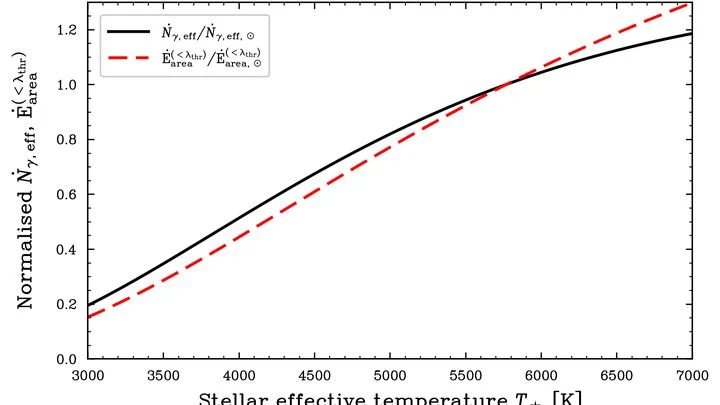
Oxygenic photosynthesis requires splitting water. It's kind of like a water wheel: to make it spin, you need a strong current. Light acts as the current, and light particles are the streams. For red dwarfs, the most common stars, the light is "cool" and weak — the streams barely move the wheel.
For exoplanets that always face their star with one side, the night side is doomed to eternal cold. But mountains can turn things around. Surface irregularities shake up the ocean of air, steering moisture flows across the day-night boundary. Once in the dark, water freezes into clouds, and clouds act like a blanket: they trap heat and keep the world from cooling down.
4 billion years ago, the young Earth was mercilessly bombarded by meteorites, leaving behind impact craters. Rains filled them with water, forming shallow ponds where lipid bubbles accumulated. These bubbles, like soap bubbles but with a double-layered lipid membrane (just like modern cells), formed spontaneously when water mixed with fat-like substances.
The solar wind and ultraviolet constantly peel a thin layer of gases off Earth, like wind carrying away steam over a hot pot. This process is slow, taking billions of years. But for planets near red dwarfs, it's harsher: they bask right next to the star, and X-ray fluxes sandblast their atmospheres like an abrasive blaster.
Life may be hiding in the oceans beneath the ice of Europa, Ganymede, and Callisto. Its carbon-based building blocks perhaps baked before the moons were born — in a disk of gas and dust around a young Jupiter. This giant cosmic oven ran on slow frictional heating, not harsh ultraviolet light.
Deep beneath us, hundreds of kilometers down, lies a layer that can absorb water like a sponge. The minerals there, wadsleyite and ringwoodite, can hold up to 1–2% water by weight within their crystal lattices.
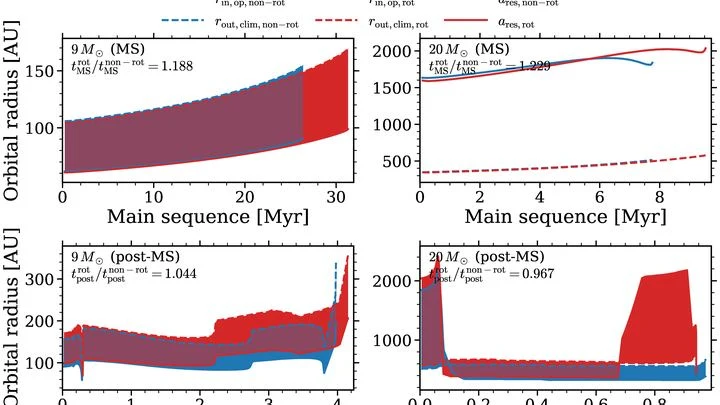
A star nine times heavier than the Sun ignites a zone around it where liquid water could slosh on a planet's surface. But this zone is like a narrow strip of beach at low tide: it will vanish in 30 million years. Such stars live bright and die young, leaving life no time for the long journey from microbes to complex beings.
The Kepler telescope William Borucki's caught the faint twinkling of distant stars and discovered thousands of planets around other suns. Among them gapes a gap: almost no worlds sized between rocky balls and puffy water giants.
Rogue planets, ejected from star systems, may harbor life on their moons. A moon of such a planet can preserve heat and liquid water for billions of years. The whole secret lies in a reliable "blanket" and an internal "stove."
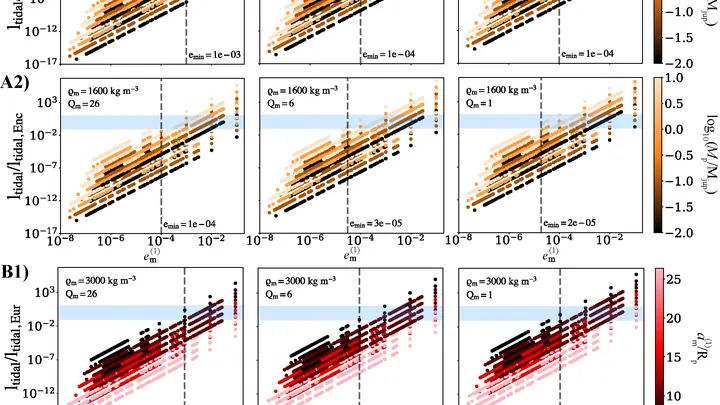
The stove is tidal forces: they squeeze and stretch the moon's interior, heating it up like kneading clay.
Scientists built a model of Earth with all living organisms removed — from bacteria to trees. Over billions of years, this 'empty house' didn't turn into an icy desert. Volcanoes, like a furnace, release carbon dioxide, and rock weathering, like a thermostat, absorbs it.
Earth is like dough mixed to a precise recipe: two parts water to one part land. Too much water, and the planet becomes a vast ocean where intelligence has nothing to grasp onto. Too much land, and water retreats deep, leaving a desert. Scientists put this culinary analogy to the test with statistics.
The night sky is dotted with stars, and many of them have planets. But how do you spot a tiny dark disk against the glare of a distant sun? The Kepler telescope spent nine years watching hundreds of thousands of stars, waiting for a planet to pass in front of its star and briefly dim it. That 'wink' is the only way to find worlds like ours.
To spot life on other planets, you don't necessarily need to search for oxygen in the air. Living beings paint the surfaces of their worlds: Earth's plants in green, bacteria in purple. The future HWO space telescope will capture these "paints of life" on exoplanets.
The planet's gravity rhythmically squeezes and kneads the moon like dough: from this constant 'kneading', the interior heats up, and oceans of water can persist under the icy crust for ages.
In the Galaxy, there are plenty of rogue planets, thrown out by supernova explosions.
The Moon can have its own tiny moon — like a nesting doll, but in space. The outer doll is a planet, the middle one is a moon, the inner one is a small moon-satellite, or submoon. Ньютон showed that all bodies attract each other, and gravity holds them together.
Many planets around other stars — exoplanets — have elongated orbits. With each close approach, the star’s gravity squeezes and stretches them, like kneading dough. Friction heats up the interior to the point where rock melts, creating underground oceans of magma.
A young sub-Neptune is a pressure cooker where hydrogen and rock simmer in the same pot. Six Earth masses, three percent hydrogen by mass, and interior temperatures above 4000 K. At that heat, silicate melt and hydrogen don't just coexist: they mix completely, forming a single supercritical fluid. There is no boundary between core and envelope.
Water is the gold standard for life. We search for its traces on Mars, in icy moons, and in the atmospheres of distant planets. But what if life doesn't need water? On a warm rocky exoplanet with a thin atmosphere, water would evaporate within hours.