Planetaryatmospheric loss refers to the processes by which a planet loses volatile elements, especially hydrogen and helium, from its atmosphere. This is a critical factor in determining a planet's habitability, as it shapes the final composition and density of the atmosphere. For hot exoplanets orbiting close to their stars, atmospheric loss can be dramatic, stripping away entire envelopes and leaving behind bare rocky cores or creating comet-like tails of escaping gas.
History
The concept dates back to the early 20th century with studies of Earth's atmospheric evolution, but it became a major focus in exoplanet science after the 2003 discovery of a hydrogen envelope escaping from the hot Jupiter HD 209458b.
How it works
The main mechanisms are thermal escape (Jeans escape), where light molecules at high temperatures exceed the planet's escape velocity, and hydrodynamic escape, where intense stellar radiation heats the upper atmosphere, causing a bulk outflow of gas. Additionally, stellar winds and coronal mass ejections can erode atmospheres through sputtering and stripping. On some planets, volcanic activity or impacts can replenish lost gases, creating a balance between loss and supply.
In practice
This knowledge is used to interpret exoplanet observations, particularly transit spectroscopy, to determine whether a planet retains its atmosphere and what its composition might be. It also guides the search for potentially habitable worlds by identifying which planets are likely to hold onto their water and volatiles.
The JWST space telescope aimed its lens at the scorching rocky world 55 Cancri e, and spotted a dense gas envelope. But the cooler TRAPPIST-1 b, which orbits a dim red dwarf, showed no envelope: just bare rock. The picture came out upside down: hot planets hold onto atmospheres, while cooler ones lose them.
A planet in the habitable zone is no guarantee of life. Like a conductor leading an orchestra, a star dictates the tempo and character of planetary atmosphere evolution over billions of years.
Glass lenses and mirrors appear perfectly smooth and still. But beneath the surface, a hidden life teems. Atoms in an amorphous material (a substance without a crystalline lattice) are packed haphazardly, and this disorder creates a complex energy landscape, like a mountainous region with countless hills and valleys.
In 2024, the team led by David Charbonneau pointed the Magellan telescope with the WINERED spectrograph at LHS 1140. During transit, high-resolution spectroscopy caught the absorption line of metastable helium at 10833 Å.
A sub-Neptune is a planet that falls between Earth and Neptune in size. These worlds are abundant in our galaxy, but their internal structure has been hotly debated. New research shows that in their youth, these planets behave like a sponge soaked with water.
A world where a year lasts just one and a half Earth days, and the star in its sky is hundreds of times larger than our Sun. This is KELT-9 b — a gas giant heated to temperatures at which iron vaporizes. Its atmosphere is not just hot; it is literally boiling away into space, like steam rising from a giant cauldron.
A scorching rocky planet is like a pot of boiling soup, except its lid is the atmosphere. Gases escape from the magma, wrap the world in a thick blanket, and in turn influence how quickly the celestial body cools. For GJ 1132 b, which orbits so close to its star that a year lasts just one and a half Earth days, this connection is especially important.
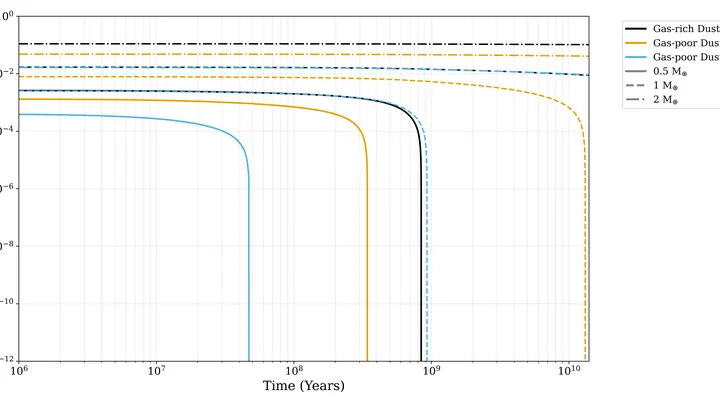
A planet the size of Neptune, but glowing white-hot. Beneath the clouds lies an ocean of magma capable of absorbing an entire hydrogen atmosphere. The new SEAMIST model is the first to trace how such dissolution changes a planet's fate from birth to old age.
The big surprise is the mechanism of catastrophic boiling.
When astronomers peer at distant worlds, they often don't see crisp lines of water vapor or methane, but a blurry silhouette, as if the planet has thrown on a thick veil. This veil, a haze of organic particles, behaves like a temperamental photographic plate: it darkens under harsh ultraviolet light, revealing hidden chemical patterns.
Among the icy chunks hurtling through the void, there are special travelers — interstellar comets. They were born around distant stars and happened to wander into our neighborhood. One of them, 3I/ATLAS, came under the gaze of telescopes as it approached the Sun. Its material, frozen gases and refractory dust, began to evaporate, leaving a glowing tail behind.
A planet hugging its star is like an ice cube forgotten on a scorching skillet. The ice melts and evaporates, except instead of water, it's hydrogen and helium from the planet's upper layers.
The solar wind and ultraviolet constantly peel a thin layer of gases off Earth, like wind carrying away steam over a hot pot. This process is slow, taking billions of years. But for planets near red dwarfs, it's harsher: they bask right next to the star, and X-ray fluxes sandblast their atmospheres like an abrasive blaster.
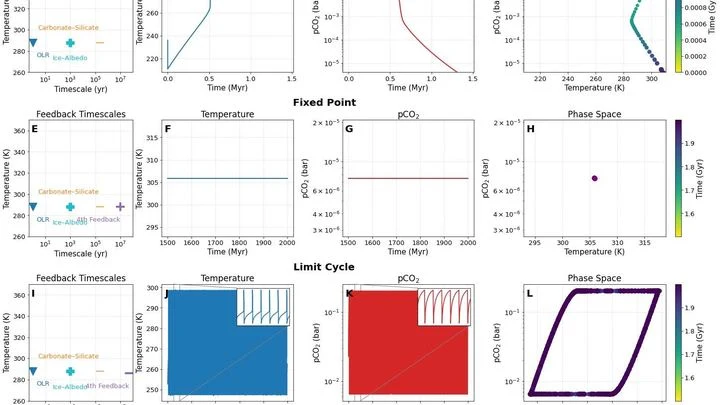
A planet's climate is like an old spring mattress: press down on one edge, the springs compress; let go, they rebound and put everything back. Earth has three such springs, working as a team. Carbon dioxide weathers out of rocks, clouds reflect sunlight, and ice caps bounce heat back into space. Together, they keep the planet from boiling or freezing.
Rogue planets, ejected from star systems, may harbor life on their moons. A moon of such a planet can preserve heat and liquid water for billions of years. The whole secret lies in a reliable "blanket" and an internal "stove."
The stove is tidal forces: they squeeze and stretch the moon's interior, heating it up like kneading clay.
A young star is surrounded by a flat, rotating disk of gas and dust — the construction site for future planets. The disk lives its own life: gas flows toward the star, dust clumps together, and from outside, harsh ultraviolet light from neighboring hot stars presses down on it all, like wind blowing leaves off a path.
A young planet grows like a snowball rolling down a slope: countless small pebbles from the surrounding gas disk stick to it. The larger it gets, the stronger it pulls in gas — hydrogen and helium. A dense, hot envelope forms around it. Pebbles falling through it heat up from friction and their own weight, like grains of sand falling into thick honey.
An ordinary lump of coal left under the blazing sun just heats up. But if you take it into space and bring it twenty times closer to the Sun than Earth is, it won't survive for more than a few minutes. That's roughly how dark, carbon-rich asteroids behave. They are rarely found on orbits that dive deep inside Mercury's orbit.
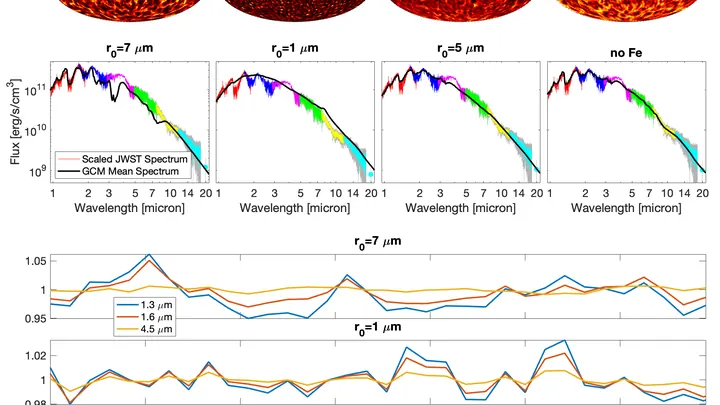
Far beyond the Solar System, a world called VHS 1256B wanders — a giant planet without a star. For a long time, astronomers couldn’t figure out why its brightness jumped by nearly 40% in just a few days. The answer came with the James Webb telescope: it turns out, colossal storms of silicate dust engulf the entire planet.
Planet WASP-121b orbits so near its star that the fierce heat boils its atmosphere away, streaming like a comet's tails. With the James Webb Space Telescope, astronomers continuously watched this process for the first time.
Many planets around other stars — exoplanets — have elongated orbits. With each close approach, the star’s gravity squeezes and stretches them, like kneading dough. Friction heats up the interior to the point where rock melts, creating underground oceans of magma.
The super-hot super-Earth TOI-561 b completes an orbit around its star in just 10.7 hours. It is a scorched rocky sphere, so close to its star that its dayside should heat up to 2950 K, a temperature at which many minerals melt.