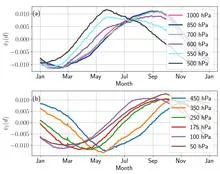
The University of Alabama in Huntsville processes microwave sounder data into monthly temperatures of four atmospheric layers, from the lower troposphere to the lower stratosphere, since December 1978.
The four-layer breakdown is valuable because it reveals how the atmosphere responds to greenhouse gas increases. Theory predicts that the troposphere should warm while the stratosphere cools, a fingerprint of human-caused climate change. The UAH record has documented both trends, providing evidence that the observed changes are not due to natural solar variability alone. It also helps scientists study phenomena like the El Niño–Southern Oscillation, volcanic eruptions, and the effects of ozone depletion, all of which leave distinct signatures in different atmospheric layers.
History
The record was pioneered by John Christy and Roy Spencer at UAH, who published their first results in 1990. They developed the methodology for converting raw microwave data into atmospheric temperatures, and the dataset has been maintained and refined by their team ever since.
How it works
The challenge is maintaining consistency over decades, as satellites age, drift in their orbits, and are replaced by new instruments with slightly different characteristics. The UAH team applies corrections for these effects, using overlapping observations from successive satellites to calibrate the record. The result is a time series of monthly global and regional temperatures that is continuously updated and made freely available to the scientific community.
In practice
The UAH record is used by climate scientists to validate climate models, monitor the rate of global warming, and study atmospheric circulation changes, and it is frequently cited in assessments by the Intergovernmental Panel on Climate Change.
Fun fact
The satellite instruments that feed this record were originally designed for weather forecasting, not climate monitoring, and their data has been reprocessed multiple times as scientists discovered subtle errors—such as the cooling effect of the satellites' own orbital decay—that initially masked the true warming trend.
Picture a guitar string stretched between two frets. When you pluck it, a standing wave forms: some points on the string oscillate strongly, while others, the nodes, remain almost still. The chromosphere, a layer of the solar atmosphere sandwiched between the photosphere and the corona, behaves in much the same way.
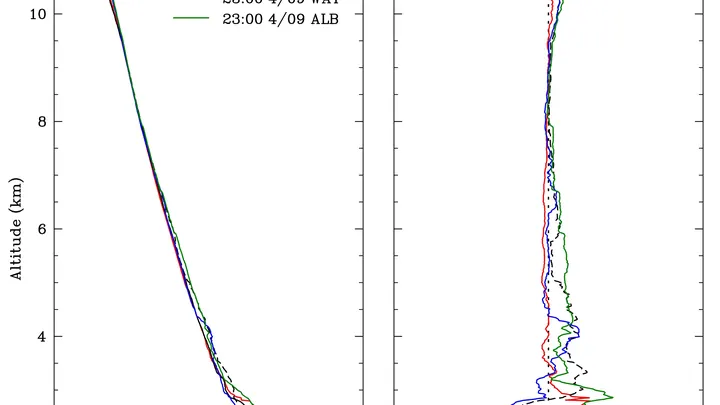
Every second, thousands of passenger aircraft in the sky transmit radio signals: that's how air traffic controllers track where each flight is. These signals don't travel in a straight line: air of varying humidity bends them like a lens. If you can measure that bending, you can work out where the air is drier and where it's more humid.
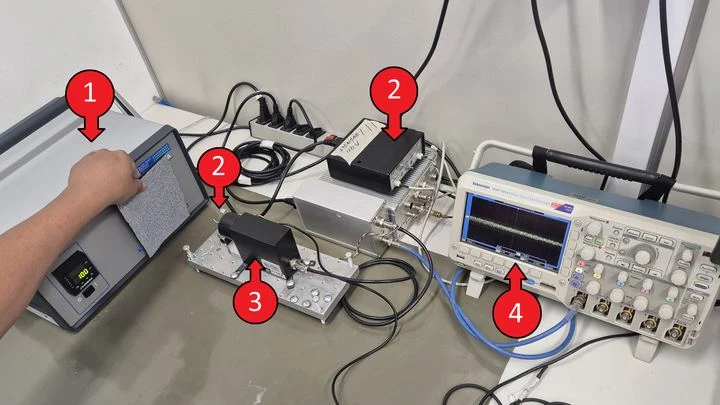
In the kitchen, when a pan heats up, your hand feels the heat before you even touch it. A solar telescope picks up similar invisible heat — only from a star, not a stove. The instrument, called HATS, captures radiation in the terahertz range, which was previously little studied due to technical difficulties.
Betelgeuse, the red supergiant familiar from Orion's shoulder, keeps surprising us. After the mysterious Great Dimming of 2019–2020, when the star suddenly dimmed, it didn't just recover; it changed its ways.
A translator in a conference hall tries to convey the speaker's words, but the hall is noisy: someone coughs, chairs creak, and the street outside is loud. If the speaker lowers their voice, the translator still keeps translating, but their voice drowns in the noise.
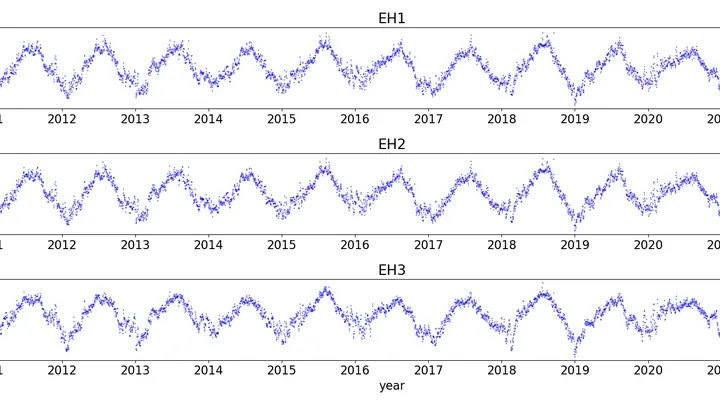
Deep underground, in the thickness of granite, detectors catch rare visitors from space — muons. These particles are born high in the atmosphere when cosmic rays slam into air nuclei. They make it to the underground lab thanks to their enormous speed, close to the speed of light.
In the orchestra of interstellar life search, every note counts. And the score here is dictated not by man, but by a distant star. For the planet TRAPPIST-1 e, one of seven in the system of an ultracool red dwarf, the conductor's baton is harsh ultraviolet light.
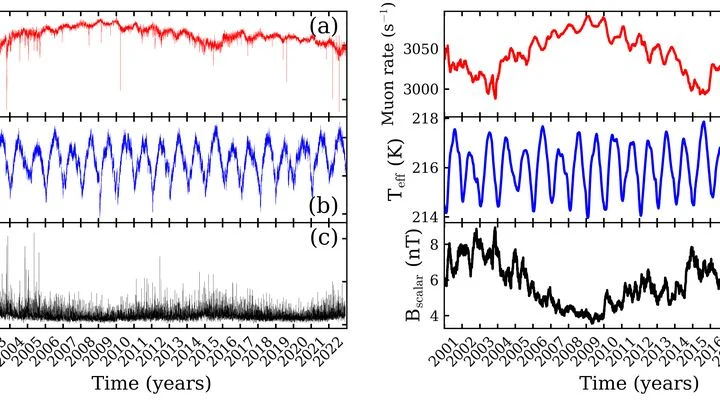
Every second, invisible particles from space, cosmic rays, strike Earth's atmosphere. Colliding with air molecules, they produce showers of secondary particles, among which muons are especially abundant. A muon is a heavy cousin of the electron that lives only a couple of microseconds but still manages to reach the ground.
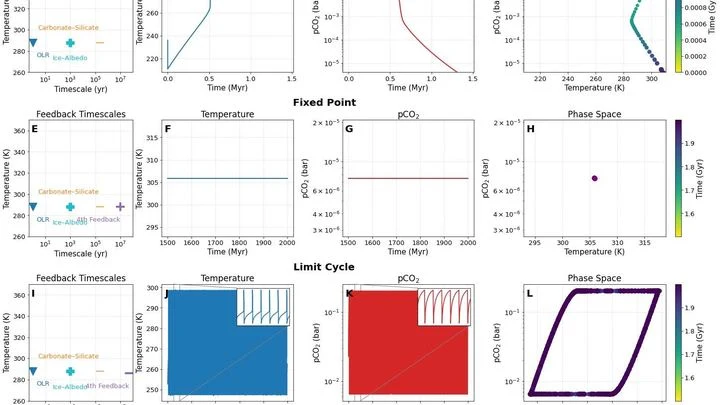
A planet's climate is like an old spring mattress: press down on one edge, the springs compress; let go, they rebound and put everything back. Earth has three such springs, working as a team. Carbon dioxide weathers out of rocks, clouds reflect sunlight, and ice caps bounce heat back into space. Together, they keep the planet from boiling or freezing.
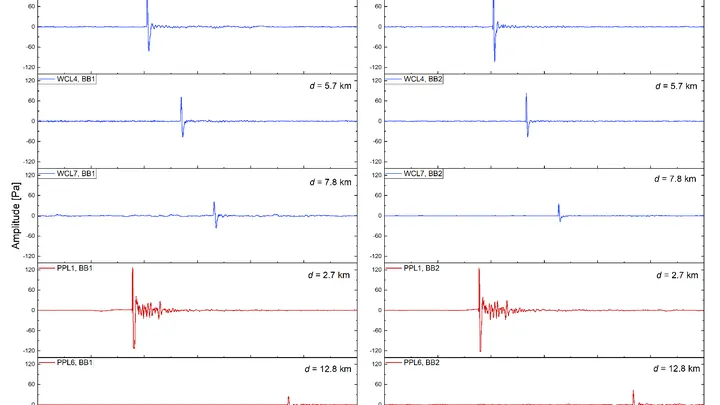
The same explosion can sound different: it all depends on which way the wind is blowing. In 2024, researchers set off charges equivalent to ten tons of TNT twice and recorded the sound with a network of 31 microphones spread over a radius of 23 kilometers. The source was identical, but the acoustic pictures turned out to be quite different.
The scorching gas streaming from the Sun is not a continuous flow but rather a soup of charged particles. In this soup, waves constantly boil up: electric fields flare and fade like ripples on water from a tossed stone. One such wave is the ion-ion acoustic wave.
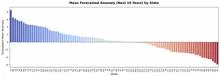
The climate of the United States is not a straight line creeping upward. It is an orchestra without a conductor, where every violin and every drum plays its own part, and together they create an intricate pattern of warm and cold, wet and dry years.
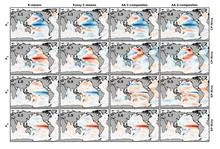
An artist painting the ocean does not limit themselves to two colors: warm and cold. Likewise, climatologists studying El Niño increasingly speak of a whole palette of shades. El Niño is a warm current off the coast of Peru that, every few years, alters weather across the planet. Its counterpart, La Niña, brings cold.
In the summer of 2023, thermometers around the world registered numbers that even the boldest forecasts had not anticipated. The planet's average temperature rose to 1.48°C above pre-industrial levels, a jump of 0.17°C that broke the previous record as if the climate had suddenly shifted gears.
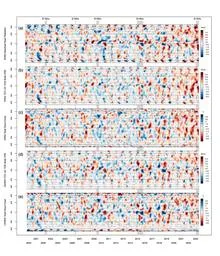
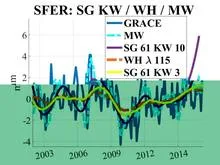
Imagine sensitive scales scattered across Europe. Each GPS station is one such scale, recording daily how much the ground beneath it has risen or fallen. When water accumulates underground, the surface sags slightly; when water leaves, the surface lifts. These movements are tiny, on the order of millimeters, but the stations pick them up.
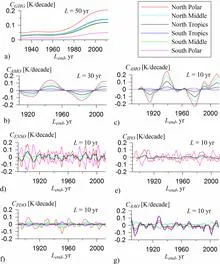
Picture an orchestra where each instrument plays at its own tempo: violins speed up, woodwinds slow down, and percussion keeps losing the beat. That's roughly what Earth's climate looks like, with the ocean, the Sun, volcanoes, and human activity pulling temperature in different directions.
An interpreter at a negotiation hears not only the volume of the voice but also the shift in topic. Climatologists have long listened only to volume: the average temperature. If it rises, the planet is warming. But behind the average hide events that matter more than the trend: heat waves, cold snaps, sudden changes.
The orchestra of world weather is playing a tune we didn't expect. The first violin is not carbon dioxide but chlorofluorocarbons—gases that until recently hid in refrigerators and aerosol cans. They trap heat ten thousand times more effectively than CO₂, and for decades they have been quietly warming the planet.
Warm air rises from a radiator, and the room seems to heat evenly. But if you put your hand against the wall by the window, it feels cooler than by the door.
In the vast concert hall of the atmosphere, ozone plays a part that changes from tier to tier. Near the surface, its notes sound alarming, for there it is a pollutant that irritates lungs and leaves. At 25 kilometers up, the same gas becomes a protective shield that absorbs harsh ultraviolet radiation.
From 1955 to 1979, the extent of Antarctic sea ice shrank by 23% in winter and 67% in summer, then partially recovered. This is like a spring that was slowly compressed and then released: the climate of the Southern Hemisphere responded with a delay of several decades.
Picture a web stretched across every corner of the Earth: each strand is a coincidence of temperature fluctuations at two points. In ordinary years, the web is neatly divided into regional clusters, but when El Niño arrives, the strands break and reweave, linking distant continents.
In a climate trial, the judge doesn't listen to who shouts loudest. He watches who whispers to whom. Nine witnesses, from carbon dioxide to cosmic rays, testified from 1984 to 2005. Their statements were recorded every month. The judge doesn't trust mere coincidences, because two witnesses might echo each other without knowing who started first.
A kitchen thermometer doesn't creep upward gradually when you turn on the stove: first it stays put for a while, then suddenly jumps a few degrees. According to researchers' calculations, global temperature behaved much the same way from 1950 to 2013.
The bathtub fills with warm water, but the drain is open. Each El Niño wave adds a pulse of heat, and only part of it escapes back to space. Over decades, this tub can heat up noticeably more than from just the slow turning of the greenhouse gas faucet.