Stretched film reshapes magnetic pattern express
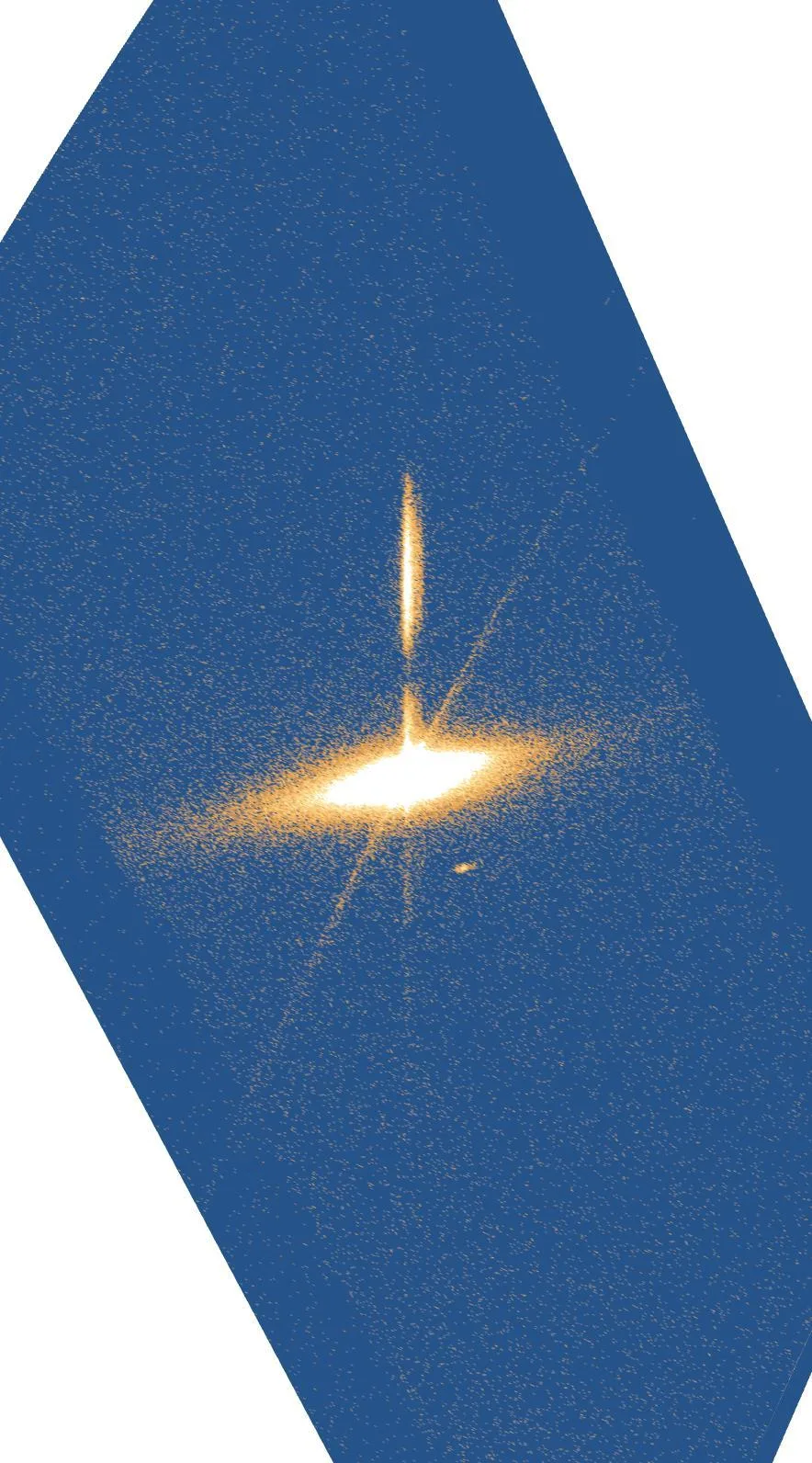
A thin film of iron oxide SrFeO3 sits on a substrate that slightly stretches it. Inside the film, the magnetic moments of atoms twist into a spiral, like a spiral staircase. The strain changed that staircase: the step became shorter, and the axis itself tilted.
The reason lies in oxygen. A stretched lattice more readily loses oxygen atoms, leaving vacancies. These vacancies push neighboring iron atoms apart, and the iron–oxygen bonding changes. One type of magnetic exchange (direct, through oxygen) strengthens, while another (via itinerant electrons) weakens. As a result, the spiral compresses and tilts.
This trick, controlling magnetism through chemical expansion, opens a route to tuning magnetic patterns without strong magnetic fields. In the future, it could benefit devices where information is carried not by electrons but by magnetic vortices.
Original abstract
as written by the authors arXiv:2602.10372
We demonstrate control of helimagnetic order in biaxially strained SrFeO3 thin films using neutron diffraction and resonant soft x-ray scattering. SrFeO3, a negative charge-transfer oxide, exhibits a complex magnetic phase diagram that includes multi-q spin structures. Tensile epitaxial strain produces a pronounced shortening of the helimagnetic ordering length and a tilting of the magnetic ordering vector. We interpret this behavior in terms of chemical expansion: lattice dilation under tensile strain lowers the energetic cost of oxygen vacancies, leading to an expanded unit cell that modifies Fe-O hybridization and enhances superexchange relative to double exchange. These results reveal how epitaxial strain can indirectly tune helimagnetism through defect-driven chemical expansion, highlighting the strong coupling between lattice, chemistry, and magnetic order in transition-metal oxides. Our findings establish chemical expansion as an effective mechanism for engineering complex magnetic textures in oxide thin films, with implications for spintronic, magnonic, and quantum information applications.
The iron oxide SrFeO3 belongs to a family of materials where oxygen easily leaves the lattice, like water from a sponge. Each departing oxygen molecule leaves behind a vacancy that slightly pushes neighboring atoms apart.
In Peter Watts's novel Blindsight, alien ships use magnetic fields for camouflage. Controlling magnetic vortices in films is a step toward such exotic technology.