Magnetic films are ultra-thin layers of magnetic material, often just a few atoms thick, that exhibit unique magnetic properties not found in bulk materials. These films are central to modern spintronics and data storage technologies. Under mechanical strain, they can undergo dramatic changes in their magnetic ordering, such as switching from ferromagnetic to antiferromagnetic states or altering the direction of their magnetization, which is of great interest for developing flexible and tunable magnetic devices.
History
The study of magnetic films began in earnest in the 1980s with the discovery of giant magnetoresistance (GMR) in layered magnetic structures, which earned Albert Fert and Peter Grünberg the 2007 Nobel Prize in Physics. The manipulation of magnetism by strain has been explored since the early 2000s, driven by the goal of creating more energy-efficient memory and logic devices.
How it works
In a thin film, the reduced dimensionality and the influence of the substrate and interfaces can stabilize magnetic configurations that are not possible in bulk. Strain, applied by bending the substrate or growing the film on a lattice-mismatched material, changes the distances between atoms, which in turn alters the exchange interactions that govern magnetic ordering. This can lead to effects like strain-induced magnetic anisotropy, where the magnetization prefers a particular direction, or even the emergence of novel magnetic phases like skyrmions.
In practice
Magnetic films are used in hard disk drive read heads, magnetic random-access memory (MRAM), and magnetic sensors. Strain-controlled magnetic films are being developed for flexible electronics, spintronic devices, and neuromorphic computing applications.
Fun fact
Some magnetic films can be so thin that they are transparent, yet they still retain enough magnetism to be used in devices like smartphone compass sensors.
A sheet of paper left on a wet table warps and lifts its edges. No one controls that motion, but it follows the same laws as plant growth: some areas of the sheet shrink more than others, and the flat form becomes three-dimensional. Engineers have long dreamed of taming this process so that a flat blank folds itself into a desired sculpture. In the new work, that trick succeeded with accuracy down to one percent.
A thin film of zirconium nitride lies on a magnesium oxide substrate. Its thickness is two-tenths of a micron, like a spider's web, but inside it quantum life is boiling. When cooled to half a kelvin, superconductivity does not disappear all at once: it breaks up into rare islands that still hold on amid the disorder.
The laser beam in an optical tweezer is not just a spot of light but a force bag. A particle caught in it usually rolls toward the brightest point, like a ball into a dimple.
A magnetic field usually acts like a strict traffic cop: for heat to turn into electricity, it must stand across the road. If the field lies along the heat flow, the effect disappears, or so it was believed for decades.
Scientists took an ultra-thin film of a magnetic oxide — a material where electron spins are aligned in a plane, like compass needles on a table.
A ceramic plate as thin as a soap film, and through it flows current with zero resistance. That's the superconductivity achieved in nickelates, relatives of the famous cuprate superconductors. Previously, this required enormous pressure, comparable to that at the ocean floor.
Inside planets and stars, in rotating oceans of plasma, turbulent flows, Coriolis forces, and magnetic tension collide. The central question is how the energy of this chaos crystallizes into a stable magnetic framework that can last billions of years.
Some crystals behave like a switch: nudge the temperature or pressure, and they turn from a conductor into an insulator. This is called a metal–insulator transition (a change in the ability to conduct electricity).
The thinner the ferroelectric film, the stronger the depolarizing field — a dictate of classical physics. Imagine a pencil balancing on a fingertip: the shorter it is, the harder to keep it upright. Nanoscale polarization likewise strives to vanish.
In some crystals, the magnetic moments of atoms oscillate in sync, like a wave in a stadium. It carries spin without charge current, without heating the material. This flow resembles an invisible river — silent and cold. Two-dimensional altermagnets are special materials: spin waves in them run differently along different axes.
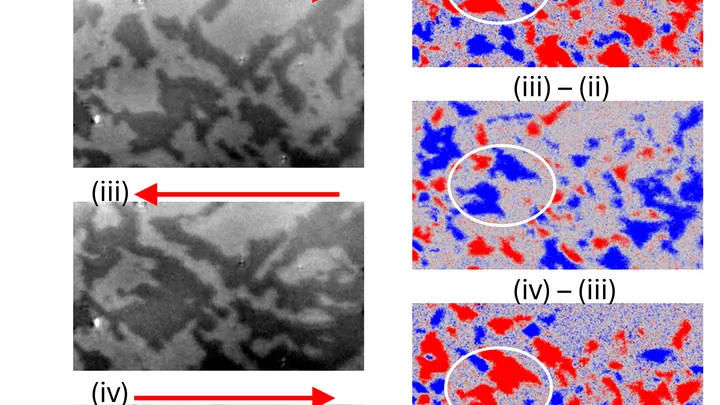
Two magnets on a table either attract or repel — depending on how their poles are oriented. Inside each piece hide tiny regions where all the magnetic arrows point in the same direction. These regions are called domains, and their arrangement determines how the material behaves in an electrical circuit.
In altermagnets, a new class of materials, domains are trickier.
A crystal that looks like a stack of pancakes was placed on a smooth substrate of magnesium oxide. The result was a film only a few hundred atoms thick. When they ran a current through it and switched on a magnet, the resistance jumped by nearly a quarter—22.5% in a 9-tesla field.
Inside the film, electricity is carried by two streams of particles.
A sheet of paper weighs almost nothing, but stack a hundred sheets and you get a noticeable pile. That's roughly what scientists did with a material that excels at converting one color of light into another, but only when it's just one atom thick. A single layer is like a single sheet: it works beautifully, but it's too thin to produce much light.
In a strong magnetic field, electrons in a thin metal film move along circular orbits. When the film thickness is comparable to the size of such an orbit, the resistance starts to oscillate: these are Sondheimer oscillations, known since the mid-20th century as a purely geometric effect.
In a thin nickel oxide film, magnetic regions are arranged in strict order like mosaic pieces. A single laser pulse instantly heats the material, and the mosaic falls apart: domains lose their orientation and mix.
A rug lies flat, but if you push it from the edge, wrinkles run across it. In a thin film of tantalum sulfide (1T-TaS2), wrinkles made of electrons, charge waves, freeze as if the rug were stuck to the floor. To move them, you need to apply force. Scientists have found a way to control this force using an electric field and a magnet.
A piece of zinc oxide film lies on a table. A magnet is brought near, and slowly rotated around the film. The film, thinner than a human hair, begins to change its dimensions: now contracting, now stretching. This property is called magnetostriction — the ability of a material to deform under a magnetic field.
A fridge magnet holds on thanks to many atoms aligned in one direction. But what if you take a single atom and ask it to remember which way it was magnetized? That's exactly what physicists did: they placed a dysprosium atom on a thin film of ordinary table salt and tested how long the atom holds its magnetic state.
The atom turned out to be stubborn.
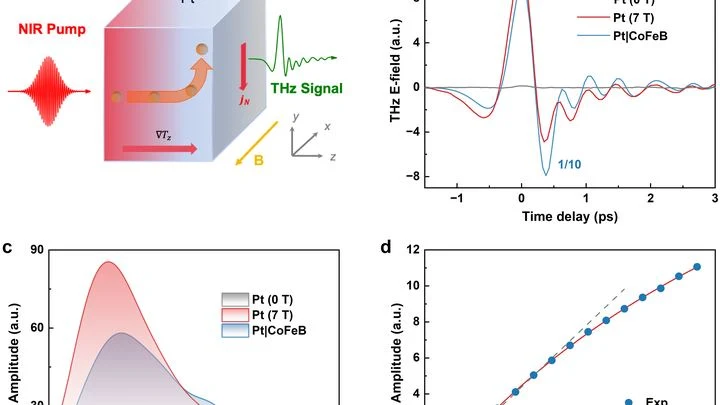
Usually, to generate terahertz waves (light between microwaves and infrared), researchers build a sandwich of different metals. One layer acts as the source, another as the receiver of charges. In such designs, platinum was assigned the role of a simple conductor. But it turns out it can work alone.
A thin film is like a taut sheet: the thinner it is, the harder it is to push through. Scientists have noticed that films made of very different materials (graphene, graphene oxide, polymers) resist projectile penetration surprisingly well under high-speed impact. And the thinner the film, the more energy it absorbs per unit mass.
A thin film of nickel oxide, tens of nanometers thick, is like a sheet of paper folded hundreds of times thinner. At room temperature, it conducts electricity, but cool it slightly and it becomes an insulator.
Magnetic atoms in a solid are like compass needles: usually, when cooled, they align in one direction: that's how magnetism arises. But in TbInO3, the terbium needles sit on a triangular lattice where it's impossible to please all neighbors at once. One needle wants to point north, another south, and in the end none can settle into a stable position.
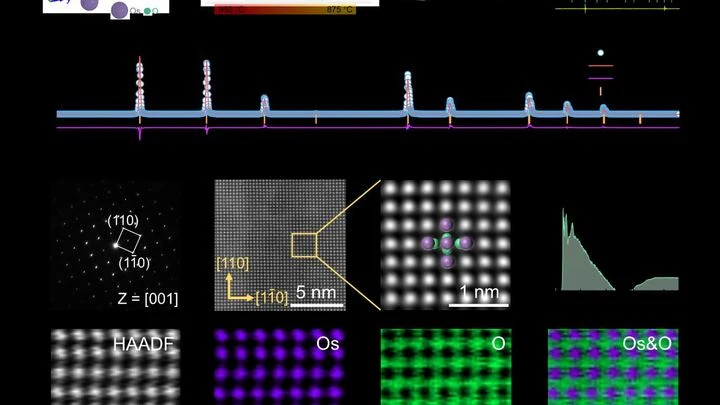
A crystal of osmium dioxide, OsO₂, is like a stubborn teenager: under ordinary conditions it behaves like a typical metal, but press hard enough and its character changes.
A beam of charged particles, like a fine pen, draws an invisible pattern on a metal film. Where it touches, the material changes its internal atomic order: from a close-packed arrangement, like a pyramid of oranges in a crate, the atoms rearrange into a looser one, like cubes stacked in a box.
A sheet of paper hundreds of times thinner than a human hair: that's roughly the thickness of the vanadium oxide film scientists grew. Inside this film, electrons, the tiny carriers of electric current, move almost without collisions. Like cars on an empty night highway, they accelerate and don't lose speed.
A thin film of niobium and tin conducts electricity without resistance — until you make it really thin. Then it suddenly becomes an insulator. A team of physicists tested what happens when you add a bit more tin to the film than the formula calls for.
A quantum computer is like a musical instrument: even a tiny scratch on a string ruins the sound. Instead of strings, we have superconducting resonators — thin traces of titanium nitride on a silicon wafer.
A crystal is like a perfectly laid mosaic of atoms. But growing such a mosaic is a tricky task: if the order slips even slightly, 'seams' appear — boundaries where rows of atoms don't align. For ordinary electronics, that's a minor issue, but for a quantum computer, it's a disaster.
An electron in a metal is usually like a person in rush hour: it constantly bumps into others and loses its way. But if you remove the obstacles, it can fly in a straight line, like a car on an empty night highway. This kind of motion is called ballistic — from the word "ballista," an ancient catapult that hurled a stone without interference.
The crystal Ca2RuO4 resembles a stack of thin sheets. Inside each sheet, the electron spins are arranged in strict order, like rows of soldiers on a parade ground. The bonds between the sheets are weak, and their sign can be flipped by slightly pulling the crystal apart.
A quantum computer is like an orchestra where every musician must play in perfect harmony. If even one instrument is off-key, the melody falls apart. Superconducting qubits play the role of these musicians, and their "off-key" is the loss of quantum coherence.
A thin film of iron oxide SrFeO3 sits on a substrate that slightly stretches it. Inside the film, the magnetic moments of atoms twist into a spiral, like a spiral staircase. The strain changed that staircase: the step became shorter, and the axis itself tilted.
The reason lies in oxygen.
A flexible screen as thin as a human hair is glass you can bend. But this marvel has a quirk: touch it, and an invisible electric charge lingers on the surface. Like dust on polished furniture, it builds up and interferes with operation.
Magnetic materials can store oscillatory energy, like a tuning fork that keeps ringing after being struck. When such a material is placed in a microwave cavity, its oscillations (magnons) start interacting with light (photons).
If you dump a handful of coins on a table, the surface becomes bumpy. But add more coins, and they spread out into a flat layer on their own. Something similar happens when you deposit ultra-thin films of individual molecules onto a substrate.
At first, islands appear on the surface — molecules cluster together like people in a queue. The film gets rougher and rougher.
An ordinary wave in a magnet is like ripples on water: the shorter the wavelength, the higher the energy. Physicists call such waves magnons. But in a thin film of bismuth yttrium iron garnet, they managed to create waves with the opposite behavior: their energy decreases as the wavelength gets shorter. These are antimagnons.
Magnetic fields are all around us, from the compass in your phone to the MRI machine at the hospital. To measure them with high precision, you need special materials that respond to the slightest changes in the field. One such material is molecular crystals, where electron spins, think of them as tiny tops, can hold their state for a long time.
At the centers of many galaxies lurk supermassive black holes, surrounded by disks of gas, cosmic dust, and stars. Their collisions can spawn gravitational waves — ripples in spacetime.
A thin film of a bismuth-selenium compound sits on a substrate. A laser pulse lasting a millionth of a billionth of a second strikes it. Nearby, a magnet is switched on, with a field weaker than that of a fridge magnet.
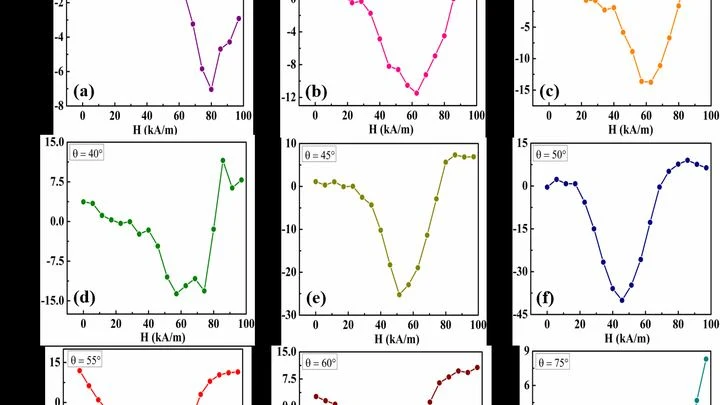
Using a method similar to spectroscopy (magnetic sensing), scientists pass a current through a multilayer film and observe the orientation of the microscopic magnetic arrows inside. Previously, everything was predictable: in some materials, the arrows aligned only along the current, in others — strictly across it. But in bismuth ferrite with a platinum coating, a glitch occurred.