Iron oxide is a chemical compound composed of iron and oxygen, with several known forms, including FeO (wüstite), Fe2O3 (hematite), and Fe3O4 (magnetite). The most common form, rust, is a hydrated iron oxide (Fe2O3·nH2O) that forms when iron reacts with oxygen and moisture. Iron oxides are widespread in nature and have been used by humans since prehistoric times as pigments for cave paintings and later in ceramics and cosmetics.
History
Iron oxides have been used as pigments since the Stone Age, with ochre (a mixture of iron oxides and clay) found in ancient burial sites. The scientific understanding of their chemistry developed in the 18th and 19th centuries as part of the broader study of oxidation and corrosion.
How it works
Iron oxides form through oxidation-reduction reactions. When iron is exposed to oxygen and water, it loses electrons (oxidizes) to form Fe2+ and Fe3+ ions, which then combine with oxygen to create various oxide structures. The specific form depends on conditions like temperature, pH, and the presence of other elements. For example, magnetite (Fe3O4) contains both Fe2+ and Fe3+ ions and is naturally magnetic, while hematite (Fe2O3) is a common iron ore and pigment.
In practice
Iron oxides are used in steel production, as pigments in paints and cosmetics, in magnetic recording media (e.g., in tapes and disks), and as catalysts in chemical reactions. They also play a role in environmental remediation, such as removing arsenic from water.
Fun fact
The red color of Mars is due to iron oxide (rust) on its surface, which is why the planet is often called the Red Planet.
Turn off the stove, and water stops boiling almost instantly. In the world of catalysis, researchers expected a similar picture: stop the reaction, and all intermediate particles vanish right away. But fresh observations of platinum nanoparticles tell a different story.
Deep beneath our feet, in the scorching mantle, iron leads a double life. It can be divalent or trivalent, like a coin that lands heads or tails. Which side dominates determines how much oxygen stays in the planet's rocky shell and how much sinks into the core.
A chef pours hot sugar syrup onto a cold table, and it sets into crystals. That's roughly how engineers pictured metal solidification: the liquid instantly becomes a scatter of crystalline grains. But close-up imaging revealed an extra stage wedged between liquid and solid.
In a crystal of water and caustic cesium, oxygen and cesium atoms sit in place like beads in a rigid lattice. Hydrogen atoms behave differently: they are like passengers constantly changing seats. In this layered material, each oxygen is linked to three neighbors via hydrogen bridges, forming a honeycomb-like pattern.
Chondrules look like frozen raindrops made of stone. They're about the size of a grain of sand, but they record the history of the first few million years of the Solar System. Once, these droplets floated in the scorching gas around the young Sun, then clumped into asteroids and fell to Earth as meteorites.
Iron dust burns like a tiny firework: a flash, heat, sparks. To turn that firework into a safe fuel for power plants, you need to know exactly when and how a particle will ignite. Until now, engineers were working blind: they saw that the powder burns, but couldn't peek inside a single grain.
When a baker kneads dough, the grains of flour can tell you which mill they came from. It's the same with Earth: the composition of iron in its depths preserves a memory of where the pieces that assembled the planet were born.
Comet 3I/ATLAS was spotted when it entered the Solar System from interstellar space. The James Webb Telescope split the light from its gas cloud into a rainbow, a spectrum, and in this pattern, the lines of rare molecules with deuterium (heavy hydrogen) appeared.
A cosmic dust grain is covered in ice, and on this ice, like in a tiny kitchen, molecules are cooked. One of them is methanol, an alcohol that serves as a building block for more complex compounds in space. Previously, it was thought that methanol only forms when hydrogen atoms stick one by one to a carbon monoxide molecule.
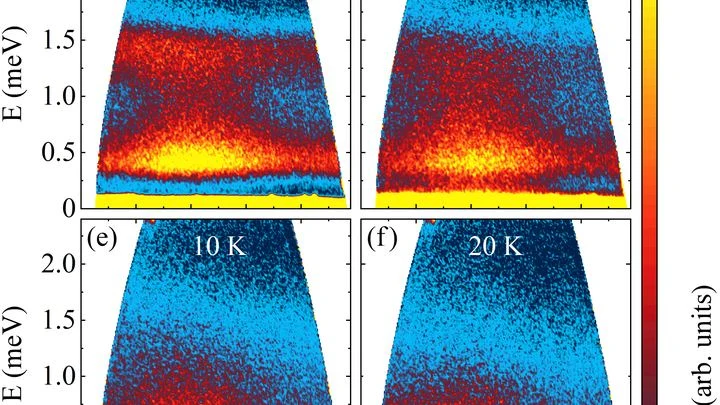
The tiny magnetic arrows inside a crystal of terbium-iridium oxide behave strangely: instead of lying along their preferred axis, they stand across it. This state fully forms when cooled to 1.5 Kelvin — colder than outer space.
Researchers probed the crystal with neutrons and observed how these flipped arrows oscillate and exchange energy.
The second interstellar guest, comet 3I/ATLAS, shines unusually due to rusting metal grains in its icy core. As it gets closer to the Sun, it behaves like an old tin can tossed into a fire: the heat melts the ice, water seeps into the metal, and vigorous corrosion begins.