An oxygenvacancy is a point defect in a crystal lattice where an oxygen atom is missing from its regular site. This seemingly small absence can dramatically alter the material's electronic, optical, and magnetic properties. In metal oxides, oxygen vacancies often act as charge carriers or trapping centers, influencing conductivity, catalytic activity, and even magnetic ordering. They are central to understanding the behavior of many functional materials, from semiconductors to superconductors.
History
The concept of point defects in crystals was formalized by Frenkel and Schottky in the 1920s, with oxygenvacanciesspecifically studied in the mid-20th century as understanding of transition metal oxides grew.
How it works
When an oxygenatom leaves, its two electrons are left behind, typically localizing on neighboring metal ions or forming a defectstate in the band gap. This changes the local charge balance and can introduce new energy levels that absorb light or facilitate electron transfer. The vacancy can also distort the surrounding lattice, creating strain fields that affect long-range order, such as ferromagnetism or ferroelectricity.
In practice
Oxygenvacancies are engineered in materials for applications like solid oxide fuel cells, resistive switching memories (memristors), and catalysts for water splitting.
Fun fact
In some two-dimensional materials, a single oxygenvacancy can induce a magnetic moment large enough to be detected at room temperature, effectively turning a non-magnetic sheet into a magnet.
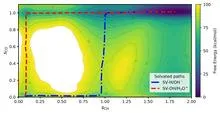
Picture a tiny hole in a sheet of graphene: a single missing carbon atom. It used to be thought that a water molecule splits apart at this defect only on its own, in dry gas. But if liquid water is sloshing all around, everything changes.
A frozen orchestra where musicians swap seats when the conductor, magnetism, sets a new score. In a spinel crystal, iron and magnesium atoms sit in two types of seats: some surrounded by four neighbors, others by six. At room temperature, they barely stir, but cool the material to 5 K and a mass migration begins.
A transparent film of bismuth tungstate sits on a substrate and does not conduct electricity. Three minutes in a cloud of nitrogen plasma, and it turns black, with resistance dropping by a factor of a billion.
A camera flash that fires in a thousandth of a second doesn't heat the subject — unlike a regular flash that lasts a full second. A similar trick has been found in radiotherapy: when a radiation dose is delivered in milliseconds instead of minutes, healthy tissues suffer less. This is called the FLASH effect.
A honeycomb made not of wax but of atoms is graphene — a flat crystal just one atom thick. Electrons in it are like runners at an intersection: they speed up here, slow down there, but never get stuck at the edge. Physicists call such a sheet "topologically trivial," meaning its edges are perfectly ordinary, with no special properties.
Now, let's knock out a single atom from the honeycomb.
An ionic conductor resembles a crowded bus where passengers (ions) try to squeeze toward the exit. Previously, it was thought that fast exit could be achieved either by a gently swaying bus (soft lattice) or by passengers standing in chaotic order (geometric disorder). The new work shows these are not two different tricks but the same one.
In diamond quantum devices, there's a tiny defect — the nitrogen-vacancy center (a nitrogen atom plus a vacancy where a carbon atom should be). It acts as a switch that spontaneously flips back and forth: it can carry an extra electron or not, and this determines whether it emits light or not.
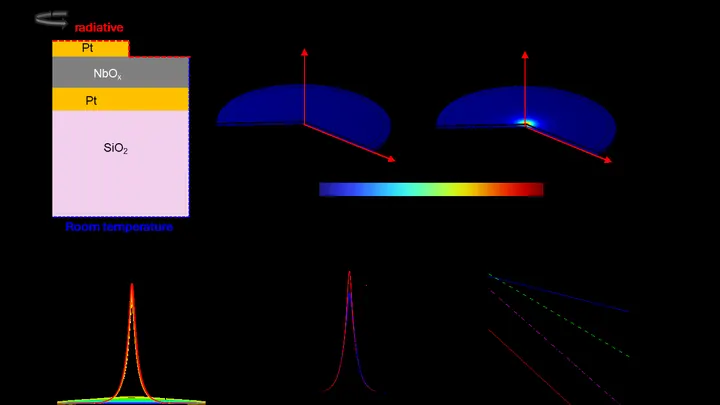
A memristor is a resistor with a memory: after the current is turned off, it retains its resistance. Inside, a thin film of metal oxide is sandwiched between two metal electrodes. When a strong current is first passed through the device, conductive filaments of oxygen vacancies form in the oxide, and the resistance drops sharply.
A crystal one atom thick is like a sheet of paper you can write on with electricity. Such a material promises to become the foundation for tiny, fast microchips. But before putting it into production, you need to know exactly what it's made of. And that's where the usual formula falls apart.