Heavy Quarks in the Fireball express
At the center of a collision between two lead nuclei, a tiny fireball is born for an instant — matter so hot that protons and neutrons melt, and quarks and gluons swim freely in this 'soup.' This soup is called quark–gluon plasma. It existed in the first microseconds after the Big Bang, and now it is recreated in accelerators.
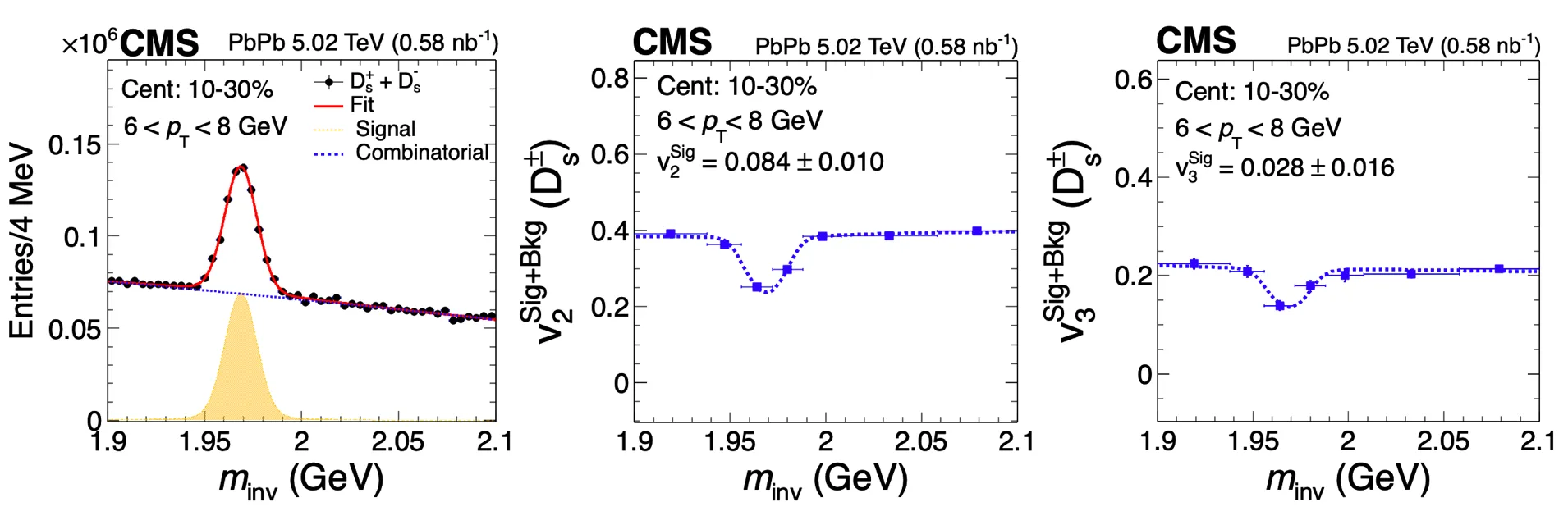
In this soup, particles containing heavy quarks are born — for example, D mesons with a charm quark. Physicists from the CMS collaboration measured how unevenly D mesons with an added strange quark (D±s) fly out in different directions. This unevenness, or anisotropy, shows how strongly the particles interact with the medium: the stronger the friction, the more noticeable the 'flattening' of the flow. It turned out that D±s behave just like ordinary D0 mesons without the strange quark.
This result tells us that in the hot soup, strangeness gives charmed particles no special privileges. They lose energy in the same way and gather into the flow in the same way. Such measurements are like soil samples from different depths: they help us reconstruct how the quark–gluon plasma is structured and how it cools.
Quark–gluon plasma is the hottest matter ever created by humans: its temperature is thousands of times higher than that at the center of the Sun.
In the series 'Star Trek,' quark–gluon plasma is mentioned as fuel for starship engines.