The charm quark is one of the six flavors of quarks in the Standard Model of particle physics. It has a mass of about 1.27 GeV/c², which is roughly 1.5 times the mass of a proton, making it the third-heaviest quark. Charm quarks are not found in ordinary matter but are produced in high-energy particle collisions, such as those in particle accelerators. They are constituents of hadrons like the J/ψ meson (a charm-anticharm pair) and the D mesons (charm plus a lighter quark). The discovery of the charm quark was a major milestone, confirming the quark model and the mechanism of quark mixing.
History
The charm quark was proposed in 1970 by Sheldon Glashow, John Iliopoulos, and Luciano Maiani (the GIM mechanism) to explain the absence of flavor-changing neutral currents. It was experimentally confirmed in November 1974, when the J/ψ meson was independently discovered by Samuel Ting's group at Brookhaven and Burton Richter's group at SLAC, an event known as the 'November Revolution'.
How it works
Charm quarks are produced in pairs via the strong interaction, typically in proton-proton or electron-positron collisions. Because of their large mass, they decay quickly via the weak interaction into lighter quarks (strange or down) and leptons. In detectors, charm quarks are identified by their decay products, such as muons or kaons, and by the characteristic 'displaced vertex'—a decay point separated from the collision point due to the quark's short but measurable lifetime. The J/ψ meson, a bound state of charm and anticharm, was a key discovery because its narrow width indicated a new quantum number, later identified as charm.
In practice
Charm quarks are studied in high-energy physics experiments to test the Standard Model, search for new physics beyond it, and understand the strong force. They are also used as probes in heavy-ion collisions to study quark-gluonplasma.
Fun fact
The J/ψ meson, made of a charm and anticharm quark, was so surprising that its discovery is often called the 'November Revolution' because it overturned the idea that quarks came in only three flavors.
In nuclear physics, a puzzle has long been nagging: why among elements lighter than bismuth, only technetium (No. 43) and promethium (No. 61) have no stable isotope at all? All their neighbors in the periodic table can boast at least one long-lived variant, but these two seem to fall out of the general pattern.
Spacetime is not empty: it shivers. After the Big Bang, the universe was filled with a hum of gravitational waves, like the low rumble of a giant bell. In this ripple, as it turns out, particles of dark matter, the invisible substance that holds galaxies together, can be born.
But the previous idea had a snag.
A drop of cream in a glass of milk. Shake it, and the fat doesn't spread evenly: it clumps into denser blobs that move differently from the rest of the liquid. Quarks inside mesons, tiny particles that live for mere fractions of a second, behave in much the same way.
A meson consists of a quark and an antiquark, and they are rarely equals.
Three oddly shaped weights sit on a table. Their exact masses are unknown, but place them on a balance scale in a certain combination, and the needle always points to the same magic number. That is roughly the puzzle physicists call the Koide relation for the three charged leptons: the electron, the muon, and the tau.
Ordinary matter consists of atoms, and atoms are made of nuclei and electrons. But in a neutron star, gravity compresses matter so strongly that electrons are squeezed into protons, and almost everything turns into a dense packing of neutrons. It's like one giant atomic nucleus the size of a city.
In the LHCb detector, where protons collide, one unusual track was found among billions of decays. The particle, named $$D_{s1}$$(2933)^+, appears for a moment and immediately decays into other particles. Its lifetime is so short that it cannot be observed directly — only through its decay products can its existence be reconstructed.
Heavy particles, which physicists call baryons, are like tiny families of three quarks. The common baryons are protons and neutrons, which make up everything around us. But there are also exotic relatives: instead of light quarks, they harbor charm or bottom quarks — heavy and short-lived.
From 2016 to 2018, at the Large Hadron Collider at CERN, protons collided at energies of 13 teraelectronvolts, as if two peas were accelerated to speeds where their impact spawns a whole swarm of new particles.
Water boils at 100 degrees Celsius, but if you squeeze it hard enough, it behaves differently. Similarly, quarks and gluons, the building blocks of protons and neutrons, change their properties in a strong magnetic field.
In proton collisions at the Large Hadron Collider, physicists have for the first time caught a particle with two charm quarks. It is called Ξcc+ (pronounced "ksi-ksi-plus") and resembles a bead with not one but two heavy nuclei.
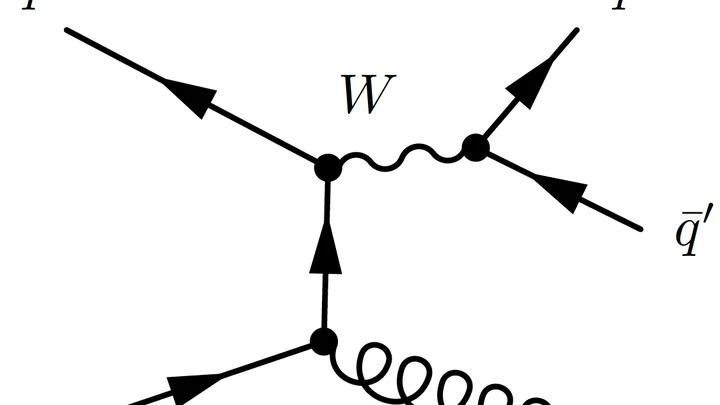
When a W boson, the particle that carries the weak force, decays into a quark and an antiquark, these two fragments fly off in nearly the same direction at the collider's immense speeds.
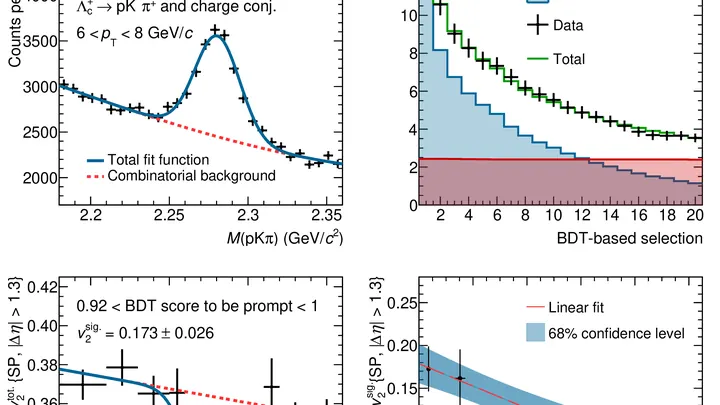
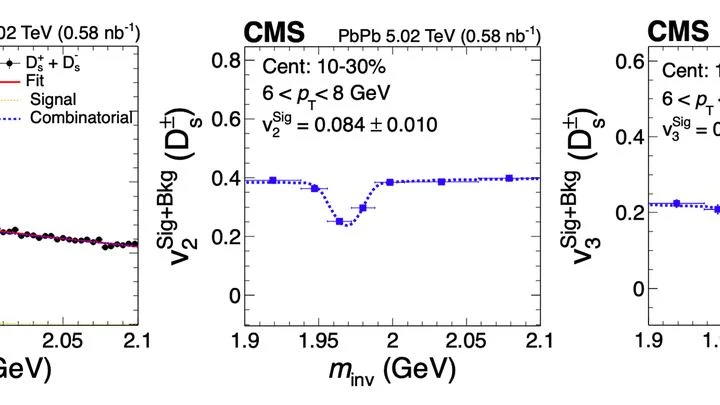
In 2010, physicists at the Large Hadron Collider first produced a quark-gluon plasma — a state of matter where quarks and gluons are as free as water in steam, not locked inside protons and neutrons. Now the ALICE collaboration has studied how charmed particles, those containing a heavy c-quark, move in such a medium.
In an underground ring 27 kilometers in circumference, protons are accelerated to nearly the speed of light and smashed head-on. At the collision point, conditions briefly recreate those of the first trillionth of a second after the birth of the universe.
In 2017, protons at the Large Hadron Collider collided with an energy of 5.02 TeV. The CMS detector recorded these collisions, and among billions of events, physicists hunted for a rare occurrence: the production of a single top quark without its antiparticle.
A crystal the size of half a matchbox was grown in a furnace, where a molten zone slowly crept along a rod, leaving perfectly ordered layers behind. Inside this crystal, copper ions sit at the nodes of a triangular lattice, but the triangles are slightly skewed, as if someone pressed on one corner. Each copper ion behaves like a tiny magnetic needle that can point up or down.
In a giant particle accelerator, where protons traveling at nearly the speed of light smash into a neon target, charmed baryons are born — particles that live for less than a billionth of a second.
At the Large Hadron Collider, by accelerating particles to nearly light speeds, top quarks are created — the heaviest building blocks of the Standard Model. They live for vanishingly small fractions of a second but manage to exhibit complex quantum connections.
At the center of a collision between two lead nuclei, a tiny fireball is born for an instant — matter so hot that protons and neutrons melt, and quarks and gluons swim freely in this 'soup.' This soup is called quark–gluon plasma. It existed in the first microseconds after the Big Bang, and now it is recreated in accelerators.
In 2018, the Large Hadron Collider ran a special data-taking campaign: the CMS detector captured proton collisions at breakneck speed to collect ten billion particles containing a beauty quark.
The top quark is the heaviest known building block of matter, but theory predicts a stealthy twin, the T-quark, which could be several times heavier. To coax it into the open, physicists collide protons with muons — the electron's unstable relatives.
Two spinning tops are set off simultaneously in opposite directions. If one spins left, the other always spins right — no matter how far apart they fly. That's roughly how quantum entanglement works, except instead of tops, we have top quarks, the heaviest known particles.