Heavy quarks are the charm, bottom, and top quarks, which have masses significantly larger than the proton mass. Unlike the light up and down quarks that make up ordinary matter, heavy quarks are produced only in high-energy collisions, such as those at particle accelerators or in cosmic rays. Their large mass makes them excellent probes for studying the strong force, as they move slowly enough in quark-gluon plasma to reveal its properties.
History
The charm quark was predicted in 1964 by Glashow, Iliopoulos, and Maiani and discovered in 1974 at SLAC and Brookhaven. The bottom quark was discovered in 1977 at Fermilab, and the top quark in 1995 at Fermilab.
How it works
Because of their mass, heavy quarks are produced early in high-energy collisions and interact with the surrounding medium differently than light quarks. Their production cross-sections can be calculated with perturbative QCD, and their subsequent interactions (like energy loss) depend on the medium's density and temperature. By measuring the yields and momentum distributions of heavy-flavor hadrons, physicists infer the properties of the quark-gluon plasma.
In practice
Heavy quark measurements are a primary tool in heavy-ion collision experiments at the LHC and RHIC to study the quark-gluon plasma, and in precision tests of the Standard Model through rare decays.
Fun fact
The top quark is so heavy that it decays before it can hadronize, meaning it never forms bound states — it is the only quark that exists as a 'bare' particle.
In the first moments after the Big Bang, the universe was a searing 'soup' of particles. As it cooled, phase transitions occurred — much like water turning to ice. At one such moment, magnetic monopoles of dark matter could have been born: tiny clumps of field with a single magnetic pole.
In the first moments after the Big Bang, the universe expanded at an incredible rate — a phase known as inflation. Even the vacuum was restless back then: quantum jitters shook the fields like wind rustling through a wheat field.
The proton is not a monolithic ball. It is a seething cloud of quarks and gluons that constantly appear and vanish. Parton distribution functions help describe this picture: they show the probability of encountering a quark or gluon with a certain energy inside the proton.
At the center of every atom lies a nucleus — a dense ball of protons and neutrons. These particles don't just crowd together randomly; they fill strict energy levels, much like floors in a skyscraper. When a floor is completely filled, the nucleus becomes especially stable — physicists call this a magic number.
Spacetime is not empty: it shivers. After the Big Bang, the universe was filled with a hum of gravitational waves, like the low rumble of a giant bell. In this ripple, as it turns out, particles of dark matter, the invisible substance that holds galaxies together, can be born.
But the previous idea had a snag.
Imagine a perfectly tuned orchestra, where every instrument is adjusted with flawless precision, trying to play in a noisy hall. That noise is quantum gravity — the microscopic ripples of spacetime. It constantly threatens to throw the musicians off.
The universe is filled with invisible dark matter. Just as a drop of water, as it evaporates, leaves behind a tiny salt crystal, so too can a black hole evaporate, leaving behind a minuscule stable remnant.
A handful of sand weighing as much as a small mountain: that's roughly what strangelets are like: tiny clumps of 'strange' quark matter where particles are squeezed to unimaginable densities. In a new study, astrophysicists tested whether such objects could exist in nature and what they would look like.
In the CMS detector at the Large Hadron Collider, protons accelerated to nearly the speed of light collided. Among billions of such collisions, physicists searched for a rare signature: the production of a single heavy particle that immediately decays into a W boson and a b quark.
Heavy particles, which physicists call baryons, are like tiny families of three quarks. The common baryons are protons and neutrons, which make up everything around us. But there are also exotic relatives: instead of light quarks, they harbor charm or bottom quarks — heavy and short-lived.
In collisions of heavy nuclei at colliders, quark-gluon plasma is born — a state of matter where quarks and gluons are as free as water in steam. Heavy quarks, such as b-quarks, entering this plasma lose energy, and their bound states, bottomonia, are destroyed.
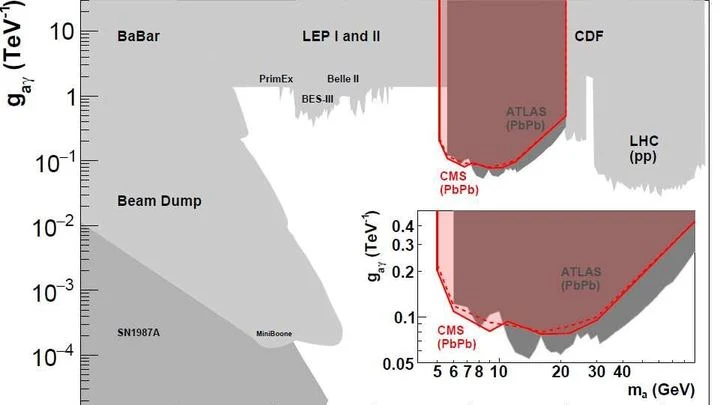
In the kitchen, two flashlight beams pass through each other without noticing. Light barely interacts with light. But if you accelerate particles to enormous energies, two photons can collide and give birth to something new.
In 2017, protons at the Large Hadron Collider collided with an energy of 5.02 TeV. The CMS detector recorded these collisions, and among billions of events, physicists hunted for a rare occurrence: the production of a single top quark without its antiparticle.
Somewhere above our heads, every second, a proton accelerated to energies millions of times greater than those at the Large Hadron Collider slams into the atmosphere. It strikes an air molecule, and a cascade is born — a wide atmospheric shower of thousands of particles.
Two spinning tops are set off simultaneously in opposite directions. If one spins left, the other always spins right — no matter how far apart they fly. That's roughly how quantum entanglement works, except instead of tops, we have top quarks, the heaviest known particles.