Gluons are invisible threads that glue quarks in protons and neutrons, like superglue. Without them all matter would crumble into dust.
History
The concept of gluons emerged with quantum chromodynamics in the early 1970s. The works of Gross, Wilczek, and Politzer (Nobel Prize 2004) demonstrated the property of asymptotic freedom, explaining the weakness of interaction at short distances. First experimental confirmation was obtained in 1979 at DESY (Hamburg) by observing three-jet events in e⁺e⁻ annihilation. Later, gluon properties were studied in detail at LEP, HERA, and LHC colliders.
How it works
The gluon field is described by the tensor G_{μν}^a within QCD with the gauge group SU(3). The Lagrangian contains gluon self-interaction terms (triple and quartic vertices), which leads to saturation of the gluon field at high energies and confinement. The exchange of gluons between quarks generates a force whose potential grows linearly with distance: V(r) ~ kr. When trying to isolate a color charge, the field energy reaches the threshold for quark-antiquarkpair production, leading to hadronization and jet formation. Asymptotic freedom ensures that at ultra-short distances the interaction weakens, allowing the application of perturbation theory.
Fun fact
Gluons are so sticky that they cling not only to quarks but also to each other! This makes the strong interaction very unusual.
Imagine two spinning tops set on a table. If they spin in the same direction, their combined rotation is large; if they spin toward each other, the total rotation can be zero even though each top spins rapidly on its own. In a pair of neutron stars approaching merger, their individual rotations, spins, play the role of such tops.
A neutron star is the remnant of an exploded star, compressed so tightly that a teaspoon of its material would weigh as much as a mountain. Inside such an object, protons and neutrons are packed tightly together, and under enormous pressure, hyperons, particles containing a strange quark, can appear.
When a proton is smashed apart in an accelerator, quarks and gluons fly out. But you never see them free: almost immediately they stick together into new particles, like droplets of mercury merging into spheres.
Ordinary ice turns into water at zero degrees. And matter at nuclear density, quark-gluon plasma, undergoes something similar at about 155 MeV (roughly two trillion degrees).
The proton is not a solid ball but a tiny prison. Inside it, three quarks are locked up, and the gluon field keeps them from escaping — something like invisible threads that only grow stronger if the quarks try to move apart.
The proton is not a monolithic ball. It is a seething cloud of quarks and gluons that constantly appear and vanish. Parton distribution functions help describe this picture: they show the probability of encountering a quark or gluon with a certain energy inside the proton.
A massive aluminum cylinder weighing a ton hangs in a vacuum. A gravitational wave, a ripple in spacetime, passes through it, and the bar begins to tremble almost imperceptibly. That trembling can be heard as sound: gravitational waves turn into a phonon — a quantum of sound vibrations.
A pot of extremely thick and hot glue: that's roughly what the early Universe looked like. It wasn't ordinary glue, but a 'gluon soup': particles carrying the strong force (gluons) zipped freely through space. The temperature was so high that even quarks and gluons didn't stick together into protons and neutrons.
Over time, the Universe cooled.
A handful of sand in your fist: the grains press against each other, and your hand can't squeeze any further. Ordinary matter behaves similarly. But in a neutron star, compression is billions of times stronger — atoms are crushed, electrons are squeezed into protons, and nearly all space is filled with neutrons.
In accelerators like the Large Hadron Collider, heavy nuclei collide at enormous speeds. For an instant, quark-gluon plasma (QGP) is born — a state of matter where quarks and gluons float freely, just like in the first microseconds after the birth of the universe.
This plasma is not just hot.
In the microscopic world of the strong interaction, nature's most powerful glue, quarks never wander alone. Over large distances, they stick together into the protons and neutrons we know. But under extreme compression, like in the depths of a neutron star, this glue creates far more exotic forms of matter.
At accelerators, by smashing heavy nuclei, physicists briefly create a quark-gluon plasma — a state of matter where quarks and gluons are not confined inside particles but are free. For a long time, it was imagined as a gas, but experiments showed it's an almost perfect liquid.
Spacetime can be imagined as a tightly stretched fabric. A massive body dents it, guiding light. Rotation twists the fabric into a spiral. Such a gravitational funnel can entangle a passing photon with the very source of rotation — say, a tiny mirror. Quantum entanglement springs up: an invisible thread binding their fates.
Ice, water, steam — phase transitions we all know. But what happens if you squeeze and heat an atomic nucleus itself? Theorists think protons and neutrons inside it 'melt,' releasing smaller building blocks — quarks and gluons.
Inside the proton, life is boiling. Quarks don't just sit there: they're glued together by carrier particles called gluons (from the word glue). Usually, this glue is spread evenly, like butter on a skillet. But when energies become enormous, gluons start clumping together. This is the gluon condensate — an ultra-dense state of the gluon field.
Atomic nuclei are wrapped in fluffy electron coats — in such attire, they can't get close enough to embrace. But swap the light coat for a heavy one: a muon, a particle from the standard model, shrinks the cloud by nearly 200 times.
If you squeeze a handful of sand down to the size of a pinhead, it turns into a rock. But squeeze it even harder, to the density of an atomic nucleus, and the grains lose their identity. Protons and neutrons dissolve, and the stuff becomes a soup of free quarks.
A drop of cream in a glass of milk. Shake it, and the fat doesn't spread evenly: it clumps into denser blobs that move differently from the rest of the liquid. Quarks inside mesons, tiny particles that live for mere fractions of a second, behave in much the same way.
A meson consists of a quark and an antiquark, and they are rarely equals.
The universe is full of invisible substance that governs the movement of galaxies. In the 1970s, astronomer Vera Rubin showed: without dark matter, stars on the outskirts would have long since flown apart. But what it's made of remains unknown.
A single graviton, a quantum of spacetime, is incredibly weak. For detectors like LIGO, built by Rainer Weiss and colleagues, quantum effects are suppressed by a factor of 10⁻³⁸: it's like trying to hear a grain of sand changing the wind's direction in a hurricane.
If you try to break a proton apart and pull out a quark, you're in for a surprise. Ordinary forces, like the electric force, weaken as particles fly apart. Here, it's the opposite. The farther a quark gets from its neighbors, the harder it's pulled back.
A translator gets distracted by every rustle in the hall, and a one-hour meeting stretches into two. Gluons, the particles that carry the strong force inside protons, behave much the same way. Usually, they dart back and forth, holding quarks together.
The proton looks like a solid ball, but inside it's a hive of activity: quarks exchange gluons — the particles that bind them together. Gluons pop in and out of existence, and their distribution within the proton is not just a curious detail but a key to predictions at the Large Hadron Collider.
In collisions of heavy nuclei at colliders, quark-gluon plasma is born — a state of matter where quarks and gluons are as free as water in steam. Heavy quarks, such as b-quarks, entering this plasma lose energy, and their bound states, bottomonia, are destroyed.
If an atomic nucleus is a family, then in an ordinary helium house live two protons and two neutrons, holding hands tightly. Now imagine that one family member is an oddball who loves to wander far from home.
In a dark room, an invisible lamp flashes. Its light is unlike anything familiar: it has no steady brightness, only rare but powerful bursts. This is bright squeezed vacuum — a state of light with no ordinary wave but strong quantum fluctuations. It is with such light that physicists bombarded xenon atoms.
Colliding two lead nuclei at the Large Hadron Collider is like throwing two hefty bags of marbles at each other. Usually, the marbles scatter in all directions, but sometimes one bag passes so close that the marbles don't collide: they just exchange glances.
Water boils at 100 degrees Celsius, but if you squeeze it hard enough, it behaves differently. Similarly, quarks and gluons, the building blocks of protons and neutrons, change their properties in a strong magnetic field.
Inside every proton and neutron, invisible work is underway: gluons, the particles that carry the strong force, glue quarks together into a single whole. You can think of this field as rubber bands that keep quarks from flying apart.
The proton is not a solid ball but a seething cloud of quarks and gluons. Each particle carries its own bit of rotation, but if you add up all the bits, you don't get the full proton spin. Part of the rotation seems to hide in the cloud's slowest inhabitants: those carrying only a tiny share of the total motion.
A sheet of graphene one atom thick is like a perfectly smooth tablecloth on which electron marbles roll. Place an electric barrier in their path, and usually they'll bounce back. But in graphene, it's different: under certain conditions, electrons pass through the barrier without even noticing it, as if the wall were made of mist.
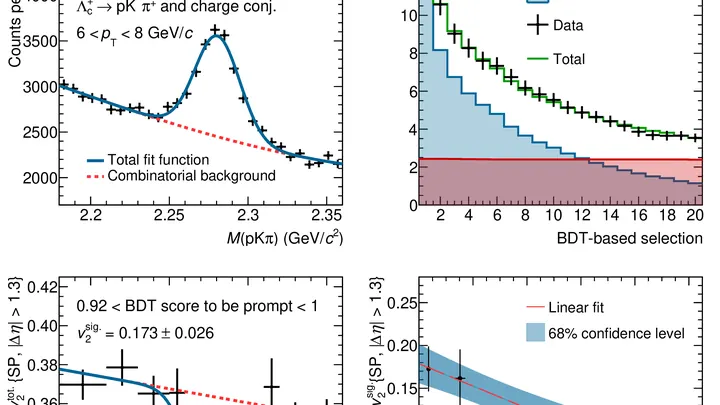
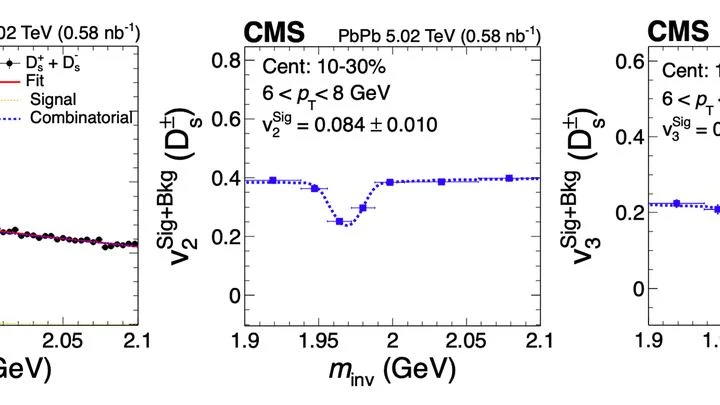
In 2010, physicists at the Large Hadron Collider first produced a quark-gluon plasma — a state of matter where quarks and gluons are as free as water in steam, not locked inside protons and neutrons. Now the ALICE collaboration has studied how charmed particles, those containing a heavy c-quark, move in such a medium.
The quantum Hall effect has long been suspected of superfluidity — the ability to flow without friction. Imagine a cook following a recipe: for each unit of magnetic flux, he must add exactly a certain number of electrons.
Deep inside the Large Hadron Collider, lead nuclei collide with such force that, for an instant, matter hotter than the Sun is born. This is the quark-gluon plasma — a soup of the tiniest building blocks of matter that existed only in the first microseconds after the Big Bang.
The proton isn't a solid ball; it's more like a tight tangle of quarks and gluons. Gluons are the particles that carry the strong force — a kind of glue that holds quarks together. But this glue doesn't just connect; it presses.
In the J/ψ-007 experiment at Jefferson Lab, a beam of photons was aimed at protons.
The proton is not a solid ball. Inside, it's a seething mix of quarks and gluons. Gluons are the particles that glue quarks together, much like wood glue binds pieces of wood. The question is: how much of the proton's "weight" comes from this glue? Physicists have calculated this on a computer by discretizing space and time into a fine grid.
At the center of a collision between two lead nuclei, a tiny fireball is born for an instant — matter so hot that protons and neutrons melt, and quarks and gluons swim freely in this 'soup.' This soup is called quark–gluon plasma. It existed in the first microseconds after the Big Bang, and now it is recreated in accelerators.
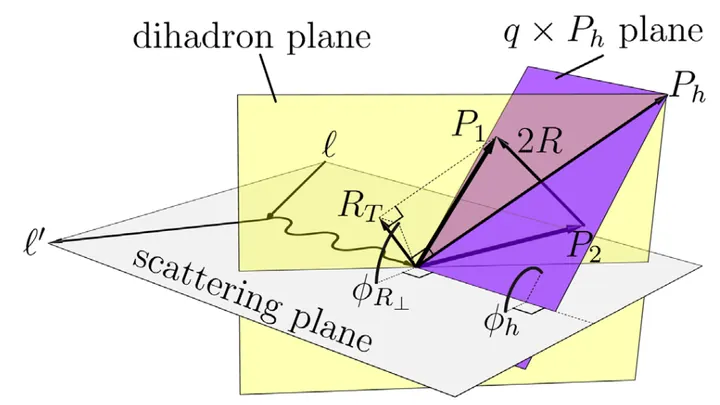
A beam of electrons, twisted like a corkscrew, slams into a proton. From the collision point, pairs of particles, a positive and a neutral pion, fly out. For the first time, physicists measured how often such pairs scatter at different angles when the electron's spin points left or right.