BESIII is a particle detector at the Beijing Electron Positron Collider (BEPCII) in China, operating since 2009. It studies the decays of particles containing charm quarks and tau leptons, which are produced in electron-positron collisions at energies around 3-5 GeV. BESIII is particularly known for its precision measurements of hadron properties and its searches for rare or forbidden decays that could hint at new physics beyond the Standard Model.
History
BESIII was proposed in the early 2000s as an upgrade to the earlier BESII detector, with data-taking beginning in 2009. It is operated by an international collaboration led by the Institute of High Energy Physics in Beijing.
How it works
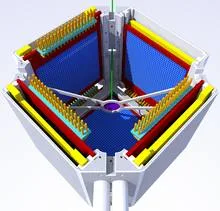
BESIII surrounds the collision point of electron and positron beams. It uses a drift chamber to track charged particles, a time-of-flight system for particle identification, and an electromagnetic calorimeter to measure photon energies. A superconducting magnet provides a uniform field for momentum measurement. The detector records the decay products of particles like the J/psi, psi(2S), and D mesons, allowing physicists to reconstruct their properties and decay modes.
In practice
BESIII's precise measurements of hadron decays contribute to testing quantum chromodynamics and provide input for calculations of the muon's anomalous magnetic moment, a potential window to new physics.
Fun fact
BESIII has collected the world's largest sample of J/psi decays, with over 10 billion events, making it a unique laboratory for studying the strong interaction.
Deep inside a mountain, where cosmic-ray muons are muffled by a thick layer of rock, stands a detector that catches not light but its absence. Positronium is a tiny atom in which an electron and its antiparticle, the positron, circle each other like a pair of dancers. Usually they come together and vanish in a flash of two or three gamma quanta.
Silicon-25 lives for just 219 milliseconds. In that time, it manages to emit a beta particle and, occasionally, a proton. These protons, ejected from the nucleus after beta decay, have become the calibration benchmark for a new microscope that physicists have assembled at the FRIB accelerator.
For three days straight, a laser blasted a jet of gas, and every second it produced a beam of electrons with the energy of a tiny lightning bolt. Previously, such beams could only be produced in huge halls where the accelerator takes up an entire building. Now the whole setup fits in a room and ran without a glitch for 72 hours.
An archaeologist carefully brushes away layer after layer, and each new stratum at the charmonium dig is a rare decay captured by the detector. Charmonium — a bound state of a charm quark and its antiquark — lives for mere fractions of a second, yet it manages to tell us about the forces that hold quarks together.
When a ψ(2S) particle decays into a proton and an antiproton, two different mechanisms act simultaneously: the strong interaction, like glue holding quarks together, and the electromagnetic one, like light pushing charges apart. Their contributions add up with a certain phase shift.
The helium atom is like a tightly stretched string: every note it plays is strictly predicted by theory. But in recent years, precise measurements of one such "note"—the energy needed to strip an electron from an excited helium atom — have started to sound slightly higher than they should.
Three billiard balls scatter across the table after a strike: their trajectories depend only on the initial push. But in the world of atomic nuclei, things are more complex: particles sense each other on the fly, even if they are not bound together. For a long time, physicists could only measure pairwise interactions, while what happens when three meet remained behind the scenes.
For a long time, astronomers searched for the 'factories' of the most energetic cosmic rays — particles that carry the macrocosm compressed to the size of an atomic nucleus. Colossal star-forming regions like Cygnus OB2, where winds from young giants collide, were prime suspects.
The tau lepton is a short-lived particle, a heavy cousin of the electron. When it decays, quarks inside it exchange gluons, like players in a closed room tossing a ball back and forth. You can't see the throws themselves, only the final score: two pions flying off at certain angles.
A pot of water always boils the same way: hit 100 degrees and bubbles start. Quantum fluids are different. When a cloud of atoms is cooled to near absolute zero, it can turn into a single matter wave — a Bose–Einstein condensate. But the transition itself, it turns out, can happen in three different ways.
A noisy train station at rush hour. Thousands of people hurry past, voices merging into a dull roar. Somewhere in the crowd, two people try to shake hands with a special, barely visible gesture. Spotting such a handshake is nearly impossible.
A firework bursts, and one point explodes into four sparks at once. That's how the Z boson, the particle that carries the weak force, behaves when it decays into four charged leptons (electrons or muons). The process is extremely rare: for every million Z bosons produced, only about five decay this way.
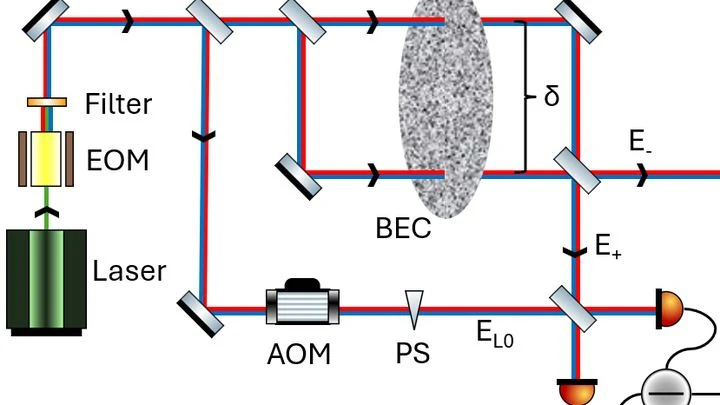
Physicists have proposed an experiment: a laser beam acts as a quantum detector and splits into two beam-ears. Each ear is directed through a tiny cloud of ultracold atoms — in this state, atoms merge into a single wave.
A coin landing on its edge is about as rare as a heavy B meson decaying into a light pion and an electron-positron pair. Over a decade of collider operation, only a handful of such events have accumulated, but physicists have finally managed to spot them.
The decay probability is about 2.4×10⁻⁸.
A drop of water stretches in a strong electric field. The deuterium nucleus, a bound pair of a proton and a neutron, behaves the same way, except here the field comes from a passing gamma ray, and instead of just stretching, the nucleus can simply fall apart.
In the LHCb detector, where protons collide, one unusual track was found among billions of decays. The particle, named $$D_{s1}$$(2933)^+, appears for a moment and immediately decays into other particles. Its lifetime is so short that it cannot be observed directly — only through its decay products can its existence be reconstructed.
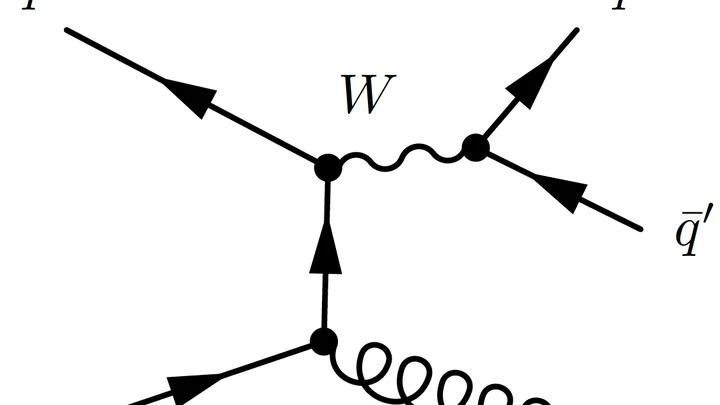
In the CMS detector at the Large Hadron Collider, protons accelerated to nearly the speed of light collided. Among billions of such collisions, physicists searched for a rare signature: the production of a single heavy particle that immediately decays into a W boson and a b quark.
Quarks are the tiny building blocks that make up protons and neutrons. Usually, they stick together in pairs: a particle and its mirror-image antiparticle. But sometimes quarks form more exotic combinations, which physicists call exotic states.
When two particles fly at almost the same speed in the same direction, their signals in the detector merge, like two voices in unison. Telling a duet from a soloist is an art in itself.
From 2016 to 2018, at the Large Hadron Collider at CERN, protons collided at energies of 13 teraelectronvolts, as if two peas were accelerated to speeds where their impact spawns a whole swarm of new particles.
Every second, billions of decays happen inside our bodies, and nobody notices. But physicists do: they smash particles in accelerators and watch what fragments they fly into. Hidden in those fragments is the answer to why we exist at all. Right after the Universe was born, there were equal amounts of particles and antiparticles, but today all we see around us is particles.
Imagine a balance scale with identical weights, yet one pan always tips lower. In the world of elementary particles, this imbalance is called CP violation: particles and their mirror twins (antiparticles) behave slightly differently.
A ring road around the Sun, where the traffic is not cars but clumps of matter. The diameter of this road is measured in light-years: it encircles our planetary system at its outer edge, in the Oort Cloud, where the star's weak gravity still holds sway.
In an accelerator near Beijing, electrons collide with positrons, and for an instant, particles are born that you wouldn't find in ordinary matter. One of them is lambda-c-plus: inside it sits a heavy charmed quark, like a stone in a slingshot. Now physicists have for the first time seen this particle break apart into a neutron, a positive pion, and an eta meson.
In proton collisions at the Large Hadron Collider, physicists have for the first time caught a particle with two charm quarks. It is called Ξcc+ (pronounced "ksi-ksi-plus") and resembles a bead with not one but two heavy nuclei.
The J/psi particle lives for an instant and then decays into lighter particles, much like a snapped string scattering into pieces. Physicists from the BESIII collaboration caught over ten billion such decays to figure out exactly what 'pieces' are produced.
When a W boson, the particle that carries the weak force, decays into a quark and an antiquark, these two fragments fly off in nearly the same direction at the collider's immense speeds.
Inside the proton and neutron, life is boiling: quarks exchange gluons, and for an instant pairs of particles appear and vanish. Some of them, the so-called scalar mesons, live for only 10⁻²³ seconds — less time than light needs to cross an atomic nucleus.
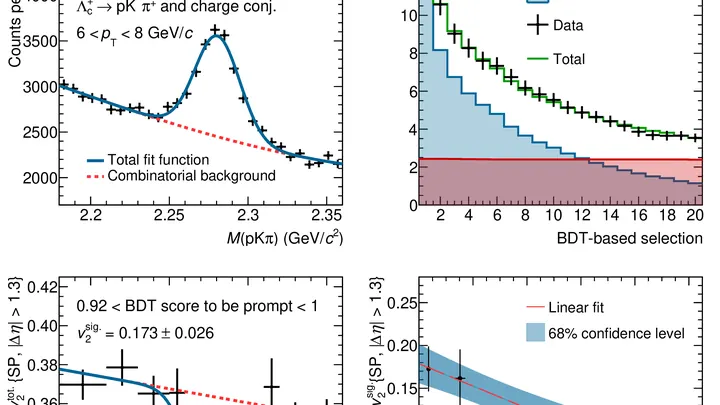
In 2010, physicists at the Large Hadron Collider first produced a quark-gluon plasma — a state of matter where quarks and gluons are as free as water in steam, not locked inside protons and neutrons. Now the ALICE collaboration has studied how charmed particles, those containing a heavy c-quark, move in such a medium.
A tiny ghostly particle zips through a piece of germanium. Usually it leaves no trace, but sometimes, like a billiard ball, it smacks into an atom's nucleus. The nucleus recoils, and that jolt can be detected. At Oak Ridge National Laboratory, the Ge-Mini detector caught such recoils for two years.
Neutrinos are the most elusive of known particles.
The tau lepton is a heavy cousin of the electron, living less than a trillionth of a second. It usually decays into lighter particles, but never directly into three muons: such a transition is forbidden by known laws of particle physics. If it did happen, it would mean unknown forces are at play.
A tiny glass sphere floats in a laser beam like a speck of dust in sunlight. Inside it is radioactive lead, which decays from time to time. Each decay ejects charged particles, and the sphere loses or gains a tiny electric charge.
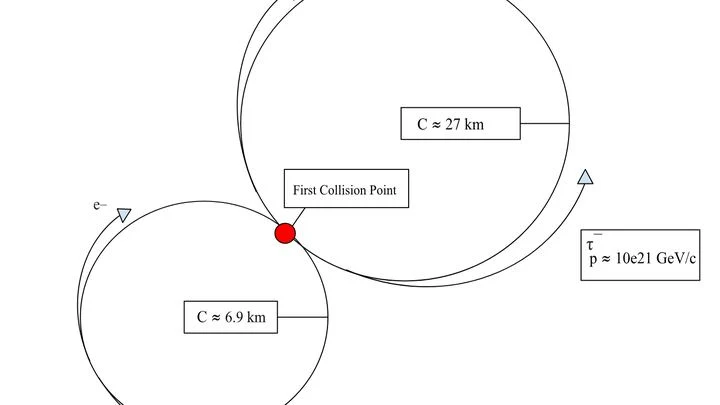
In an underground ring 27 kilometers in circumference, protons are accelerated to nearly the speed of light and smashed head-on. At the collision point, conditions briefly recreate those of the first trillionth of a second after the birth of the universe.
In 2017, protons at the Large Hadron Collider collided with an energy of 5.02 TeV. The CMS detector recorded these collisions, and among billions of events, physicists hunted for a rare occurrence: the production of a single top quark without its antiparticle.
The glowing hydrogen clouds in other galaxies are like a sponge: the gas itself takes up only a small fraction of the volume, and the rest is nearly empty space. For a long time, astronomers could only guess how 'holey' these nebulae are. Now a team of scientists has proposed a way to measure it.
Titan, Saturn's largest moon, is wrapped in a thick orange haze. It's made of hydrocarbons and other organic molecules that are born when sunlight breaks apart methane and nitrogen in the upper atmosphere.
When a fast proton slams into an atomic nucleus, new particles are born for an instant. One of them is the phi meson: a short-lived clump of matter that decays into an electron-positron pair. Catching this decay is like hearing the echo of a distant explosion: the blast itself is over, but its trace is still flying.
In a circular accelerator, electrons are accelerated to nearly the speed of light and smash into positrons: their antiparticles. At the collision point, a burst of pure energy briefly appears, from which new particles are born. The BESIII detector, like a high-speed camera, captures the tracks of these short-lived guests.
When an electron and a positron collide at the BESIII collider, they produce a short-lived particle — the charmed baryon Λc+. Inside it, like in an overstuffed box, another particle quickly emerges: the Λ hyperon. This hyperon has its own rotation, its spin, and physicists have for the first time been able to measure how much that rotation is aligned with the particle's direction of motion.
Deep inside the Large Hadron Collider, lead nuclei collide with such force that, for an instant, matter hotter than the Sun is born. This is the quark-gluon plasma — a soup of the tiniest building blocks of matter that existed only in the first microseconds after the Big Bang.