The CMS collaboration is an international team of roughly 5,000 scientists and engineers who operate the Compact Muon Solenoid (CMS) detector at the Large Hadron Collider (LHC) at CERN. CMS is one of two general-purpose particle detectors at the LHC, designed to study proton-proton collisions at energies up to 13.6 TeV. It played a crucial role in the discovery of the Higgs boson in 2012, along with the ATLAS experiment.
History
The CMS collaboration was formed in the early 1990s from the merger of several smaller detector proposals, and the detector was completed and installed at the LHC in 2008.
How it works
The CMS detector is a cylindrical, onion-like structure of subdetectors, each specialized for measuring different particles. From the collision point outward, a silicon tracker measures charged particle paths, a lead-tungstate crystal calorimeter measures photon and electron energies, a hadron calorimeter measures hadron energies, and a large superconducting solenoid magnet bends charged particle trajectories to measure their momenta. The outermost layers are muon chambers, since muons are the only charged particles that typically escape the inner detectors. The entire apparatus is 21 meters long and 15 meters in diameter, weighing about 14,000 tonnes.
In practice
Beyond the Higgs boson, CMS is used to search for supersymmetric particles, dark matter candidates, extra dimensions, and to study the properties of the quark-gluon plasma produced in heavy-ion collisions.
Fun fact
The CMS solenoid magnet has a field of 3.8 tesla — about 100,000 times stronger than Earth's magnetic field — and stores enough energy to melt 18 tonnes of gold.
The antiproton beam hits the plate, and each impact bursts into a shower of charged particles. In the GBAR experiment at CERN, this picture is captured not by a sophisticated detector but by an ordinary industrial camera without a lens, pressed against the vacuum window from the outside.
Three billiard balls scatter across the table after a strike: their trajectories depend only on the initial push. But in the world of atomic nuclei, things are more complex: particles sense each other on the fly, even if they are not bound together. For a long time, physicists could only measure pairwise interactions, while what happens when three meet remained behind the scenes.
The five-hundred-meter FAST radio telescope picked up a signal at the 21-centimeter wavelength — the telltale glow of cold hydrogen. The signal came from a cloud named Cloud-9. It hangs in space near the galaxy M94, but it contains not a single star.
In proton collisions at the Large Hadron Collider, sometimes not one but two Higgs bosons are produced. The rate of such events is a direct imprint of how the Higgs field interacts with itself. In the Standard Model, this coupling is rigidly fixed, but extended theories allow deviations.
The Higgs boson is like a tuning fork that rings at a strictly defined note. But physicists have learned to hear it even when the note is off — in the so-called 'off-shell' region. It was there, in the data from the CMS detector, that answers were hiding about what the Higgs mechanism is really made of.
The 21-kilometer ring near Protvino was once planned to accelerate protons. Today, the same tunnel could host a very different machine — a muon collider. The muon is a heavy cousin of the electron, and that's its strength. On a curve, an electron radiates like a searchlight, losing precious energy. A muon radiates a billion times less.
Seventeen minutes: that’s the heartbeat frequency of AM Canum Venaticorum, setting the rhythm for the entire class of ultracompact binaries. In these systems, two white dwarfs whirl in a death dance, tightening their orbit to the still-inaudible whisper of gravitational waves.
In the late 1990s, the night sky delivered a surprise: Saul Perlmutter and Adam Riess found that the expansion of the Universe is accelerating. Ever since, the greatest riddle has been dark energy — a substance making up nearly 70% of the cosmos, yet evading laboratory study.
Every second, about a hundred invisible particles, muons, pass through your body. They are born high in the sky when cosmic rays collide with air atoms, raining down on Earth. These particles are so penetrating that they can pass through a multi-story building, but they slightly change direction when they encounter dense material, such as lead or uranium.
Ice, water, steam — phase transitions we all know. But what happens if you squeeze and heat an atomic nucleus itself? Theorists think protons and neutrons inside it 'melt,' releasing smaller building blocks — quarks and gluons.
Deep inside the detector at the Large Hadron Collider, protons collide, and for a fleeting moment something heavy is born. It instantly shatters into two Higgs bosons — particles that, like nesting dolls, each hide two pairs of b-quarks.
A noisy train station at rush hour. Thousands of people hurry past, voices merging into a dull roar. Somewhere in the crowd, two people try to shake hands with a special, barely visible gesture. Spotting such a handshake is nearly impossible.
A firework bursts, and one point explodes into four sparks at once. That's how the Z boson, the particle that carries the weak force, behaves when it decays into four charged leptons (electrons or muons). The process is extremely rare: for every million Z bosons produced, only about five decay this way.
Imagine the early Universe as a giant balloon, instantly inflated to incredible size. The tiny bumps on its surface are frozen quantum ripples that later became galaxy clusters. This rapid inflation left behind an ancient glow — a map of the sky that astronomers study.
Two blindingly bright beams smash head-on. At the point of impact, a particle is born for an instant — the very one responsible for the mass of everything in the universe. That's the Higgs boson. Usually, it's produced by accelerating protons or electrons, but here the projectiles are particles of light themselves — photons.
In the dense gaseous cocoon around a young massive star, streams of matter collide as if in a giant chemical flask. One stream moves relative to us at about 11 kilometers per second, the other at about 5. The telescope at Onsala (Sweden) caught their radio voices and resolved them into hundreds of spectral lines — molecular fingerprints.
Two clocks tell different times. One sits on our desk, the other lies far in the past, in the glow left over from the Big Bang. The first, looking at nearby galaxies, ticks off the expansion rate of the universe — about 73 kilometers per second per megaparsec of distance. The second, peering into ancient light, gives a noticeably lower value — roughly 67.
At the Large Hadron Collider, protons collide billions of times per second, and only once in a trillion collisions does a pair of Standard Model Higgs bosons (the particles responsible for the mass of everything) emerge. In the CMS experiment, physicists hunted for exactly such events.
At the very heart of the Milky Way, something is continuously glowing in gamma rays. This light is special: its energy is exactly 511 thousand electronvolts. Such energy is produced when an electron meets its antimatter counterpart, a positron, and they annihilate, leaving behind a flash of light.
The Higgs boson is like a conductor that gives mass to all other particles. Without it, electrons would be massless and atoms would fall apart. But how does the conductor interact with itself? That is the key question a future muon collider aims to answer.
In the CMS detector at the Large Hadron Collider, protons accelerated to nearly the speed of light collided. Among billions of such collisions, physicists searched for a rare signature: the production of a single heavy particle that immediately decays into a W boson and a b quark.
Oil droplets in boiling broth usually scatter apart, but if you bump them together very slowly, they may stick for a moment. Something similar happens with top quarks — the heaviest known building blocks of matter.
When two particles fly at almost the same speed in the same direction, their signals in the detector merge, like two voices in unison. Telling a duet from a soloist is an art in itself.
From 2016 to 2018, at the Large Hadron Collider at CERN, protons collided at energies of 13 teraelectronvolts, as if two peas were accelerated to speeds where their impact spawns a whole swarm of new particles.
At the Large Hadron Collider, protons collide, and from the flash dozens of particles are born. Among them may be traces of rare processes — for example, the decay of a Standard Model Higgs boson into two W bosons. But these particles fly apart so quickly that their tracks merge into a single wide jet.
Cosmic rays are particles that arrive from deep space. When such a particle hits the atmosphere, it triggers a whole shower of new particles, like a billiard ball breaking a rack, sending balls scattering in all directions. To predict what such a shower will look like, we need to know how the primary particle interacts with the nuclei of air atoms.
Every second, billions of decays happen inside our bodies, and nobody notices. But physicists do: they smash particles in accelerators and watch what fragments they fly into. Hidden in those fragments is the answer to why we exist at all. Right after the Universe was born, there were equal amounts of particles and antiparticles, but today all we see around us is particles.
Imagine a balance scale with identical weights, yet one pan always tips lower. In the world of elementary particles, this imbalance is called CP violation: particles and their mirror twins (antiparticles) behave slightly differently.
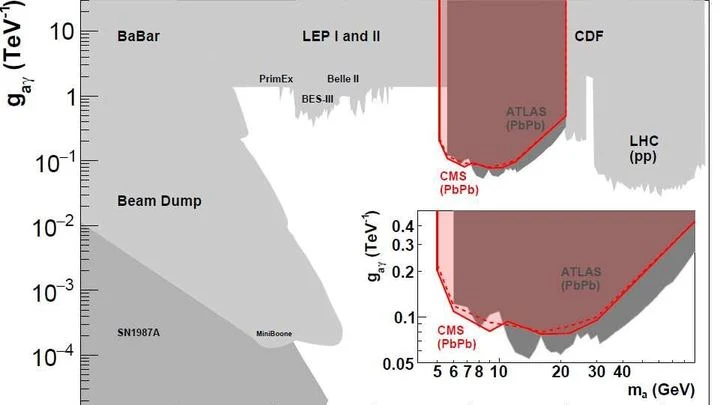
Colliding two lead nuclei at the Large Hadron Collider is like throwing two hefty bags of marbles at each other. Usually, the marbles scatter in all directions, but sometimes one bag passes so close that the marbles don't collide: they just exchange glances.
Protons accelerated to enormous energies slam into a thick metal plate, like bullets into armor. Inside the metal, a J/ψ particle is born for an instant, which immediately decays into two muons — light relatives of the electron. These muons fly out of the target, and detectors catch their tracks.
The scientists compared the number of caught muons with predictions from a computer model.
A ring road around the Sun, where the traffic is not cars but clumps of matter. The diameter of this road is measured in light-years: it encircles our planetary system at its outer edge, in the Oort Cloud, where the star's weak gravity still holds sway.
Two astronomers look at the same universe but see it differently. One measures the expansion rate using ancient light that has been traveling toward us for nearly 14 billion years. The other uses recent stellar explosions in nearby galaxies. The first gets 67 kilometers per second per megaparsec, the second gets 73.
Two particles flying apart in opposite directions behave as a single whole: measuring one instantly determines the state of the other. Such quantum entanglement has long been known for light particles, but now it has been observed for the first time in heavy Z bosons — the carriers of the weak force.
In the kitchen, two flashlight beams pass through each other without noticing. Light barely interacts with light. But if you accelerate particles to enormous energies, two photons can collide and give birth to something new.
At the Large Hadron Collider, protons collide at nearly the speed of light. Sometimes they don't smash apart but exchange photons — particles of light. These photons can produce a pair: one particle the detector sees, and another that flies off unnoticed.
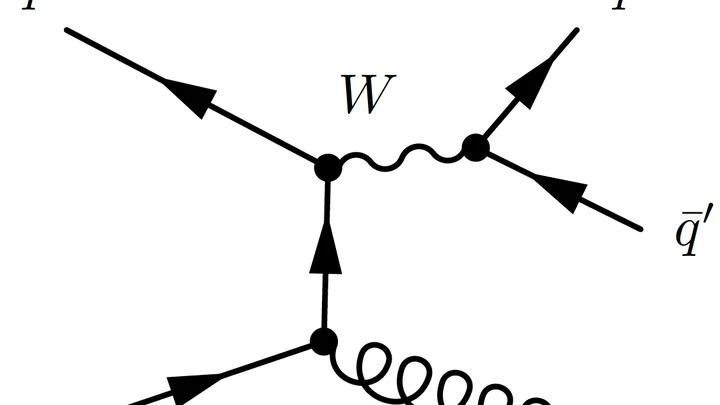
When a W boson, the particle that carries the weak force, decays into a quark and an antiquark, these two fragments fly off in nearly the same direction at the collider's immense speeds.
In a particle accelerator, nuclei shatter into fragments like a porcelain cup dropped on the floor. Each fragment flies through silicon wafers, which register the impact and its strength. But to distinguish a real signal from random noise, you need a threshold: below it, readings are considered interference.
In the ATLAS detector at the Large Hadron Collider, protons collide with enormous energy, and among the debris, a Higgs boson is sometimes born — the particle that gives mass to other particles.
A tiny ghostly particle zips through a piece of germanium. Usually it leaves no trace, but sometimes, like a billiard ball, it smacks into an atom's nucleus. The nucleus recoils, and that jolt can be detected. At Oak Ridge National Laboratory, the Ge-Mini detector caught such recoils for two years.
Neutrinos are the most elusive of known particles.
In an underground ring 27 kilometers in circumference, protons are accelerated to nearly the speed of light and smashed head-on. At the collision point, conditions briefly recreate those of the first trillionth of a second after the birth of the universe.