Heavy flavor physics is the branch of particle physics that studies particles containing charm or bottom quarks — the 'heavy' quarks of the Standard Model. These particles, such as B mesons, D mesons, and their antiparticles, are produced in high-energy collisions at accelerators like the LHC. Because they are heavy, they decay in ways that are highly sensitive to the subtle effects of quantum mechanics, making them excellent probes for testing the Standard Model's predictions with extreme precision.
History
The field emerged in the 1970s with the discovery of the charm quark and the J/psi particle, followed by the bottom quark in 1977. The theoretical framework was developed by Kobayashi and Maskawa, who extended the CKM matrix to explain CP violation, earning them the 2008 Nobel Prize in Physics.
How it works
The heavy quarks are produced in particle collisions and then decay into lighter particles through the weak force. By measuring the decay rates, angular distributions, and asymmetries between particles and antiparticles, physicists can compare these observations to theoretical predictions. Any deviation could signal new physics beyond the Standard Model, such as unknown particles or forces. The LHCb experiment at CERN is a leading facility for these studies, using advanced detectors to track the short-lived heavy particles and their decay products.
In practice
Heavy flavor physics is used to search for new physics beyond the Standard Model, such as deviations in CP violation or rare decays that could hint at new particles. It also helps in understanding the matter-antimatter asymmetry of the universe.
Fun fact
The B meson, containing a bottom quark, can oscillate into its own antiparticle and back again, a quantum phenomenon that allows precise tests of time-reversal symmetry.
Neutrinos are like invisible dancers who change masks mid-flight. The three types (electron, muon, and tau neutrinos) constantly morph into each other. This dance is described by a complex mixing matrix, and physicists have long tried to break it down into simple moves.
The authors of the new work reassembled one such decomposition, TM1, using the 'flavor spin' formalism.
The Universe doesn't just expand — it resonates. After the Big Bang, stretched strings remained in its fabric — thin as a proton, yet heavy as a mountain range. Their oscillations give birth to gravitational waves, and in this radiation, like in a musical score, the history of fundamental symmetries is encoded.
Deep inside the detector at the Large Hadron Collider, protons collide, and for a fleeting moment something heavy is born. It instantly shatters into two Higgs bosons — particles that, like nesting dolls, each hide two pairs of b-quarks.
A magnet with only one pole — north, but no south. Split it in half, and instead of two ordinary magnets, you get two more one-pole magnets. In our world, no such particle has been found, although many theories predict their existence. These hypothetical objects are called magnetic monopoles.
The authors of the study noticed a curious connection.
A drop of cream in a glass of milk. Shake it, and the fat doesn't spread evenly: it clumps into denser blobs that move differently from the rest of the liquid. Quarks inside mesons, tiny particles that live for mere fractions of a second, behave in much the same way.
A meson consists of a quark and an antiquark, and they are rarely equals.
In the CMS detector at the Large Hadron Collider, protons accelerated to nearly the speed of light collided. Among billions of such collisions, physicists searched for a rare signature: the production of a single heavy particle that immediately decays into a W boson and a b quark.
Heavy particles, which physicists call baryons, are like tiny families of three quarks. The common baryons are protons and neutrons, which make up everything around us. But there are also exotic relatives: instead of light quarks, they harbor charm or bottom quarks — heavy and short-lived.
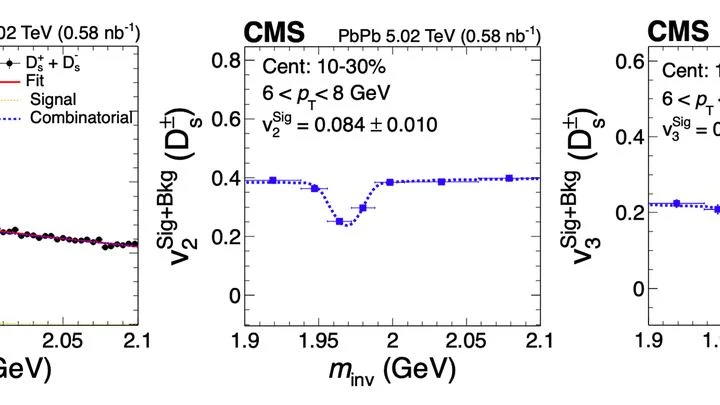
In collisions of heavy nuclei at colliders, quark-gluon plasma is born — a state of matter where quarks and gluons are as free as water in steam. Heavy quarks, such as b-quarks, entering this plasma lose energy, and their bound states, bottomonia, are destroyed.
An electron beam in an accelerator is like a flock of birds: it flies in a tight group, but over time it spreads out. To keep particles together, heavy magnets are usually used. Here they did without them — the beam squeezed itself.
In the kitchen, two flashlight beams pass through each other without noticing. Light barely interacts with light. But if you accelerate particles to enormous energies, two photons can collide and give birth to something new.
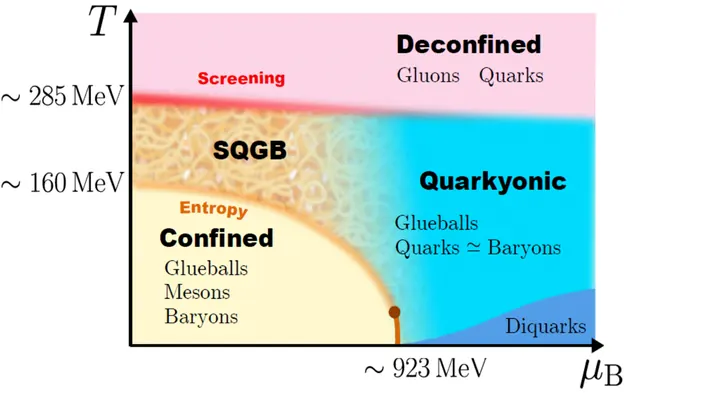
At the center of a collision between two lead nuclei, a tiny fireball is born for an instant — matter so hot that protons and neutrons melt, and quarks and gluons swim freely in this 'soup.' This soup is called quark–gluon plasma. It existed in the first microseconds after the Big Bang, and now it is recreated in accelerators.
The cosmos is filled with invisible dark matter, which betrays itself only through gravity. Its existence was suspected by Fritz Zwicky and confirmed by Vera Rubin.
Water in a kettle heats to 100 degrees, and stops being water, turning into steam. Something similar happens to atomic nuclei when they are smashed together at enormous speeds in the Large Hadron Collider.
In 2016, the LHCb detector at the Large Hadron Collider recorded millions of proton-proton collisions. Among the debris of these collisions, neutral B mesons were born—particles that can spontaneously transform into their antiparticles and back.