The strange quark is one of the six fundamental flavors of quarks in the Standard Model of particle physics. It is the third-lightest quark, with a mass of about 95 MeV/c², which is roughly 20 times heavier than the up quark and 40 times heavier than the down quark. Because of its relatively short lifetime, it is not found in ordinary matter but is produced in high-energy particle collisions and in certain radioactive decays. Its existence was first inferred from the behavior of particles called 'strange' particles, which were produced copiously but decayed slowly, a puzzle that led to the concept of a new quantum number called 'strangeness'.
History
The concept of strangeness was introduced by Murray Gell-Mann and Kazuhiko Nishijima in 1953 to explain the unexpected properties of kaons and hyperons. The strange quark itself was incorporated into the quark model proposed by Gell-Mann and George Zweig in 1964.
How it works
The strange quark carries a quantum property called strangeness (S = -1), which is conserved in strong and electromagnetic interactions but violated in weak interactions. This explains why strange particles are produced in pairs (via the strong force) but decay singly (via the weak force), giving them a longer lifetime than expected. In modern particle physics, strange quarks are constituents of many hadrons, such as kaons and hyperons, and they play a role in the structure of the proton, contributing to its spin and mass through quantum fluctuations.
In practice
Strange quarks are studied in high-energy physics experiments, such as those at CERN's Large Hadron Collider, to test the Standard Model and search for new physics. They also play a role in astrophysics, where strange matter (containing strange quarks) is hypothesized to exist in the cores of neutron stars.
Fun fact
A 'strangelet' — a hypothetical bound state of roughly equal numbers of up, down, and strange quarks — was once feared to be a potential doomsday scenario, as it was speculated it could convert ordinary matter into strange matter, though this is now considered extremely unlikely.
The map of dense nuclear matter resembles a road map: lines of phase transitions cross at critical points, like highways at intersections. Until now, only two intersections were known on such a map: the nuclear liquid-gas and deconfinement, where hadrons dissolve into quarks.
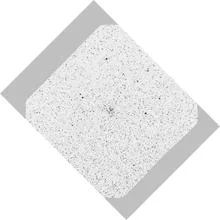
In the stellar family of the Phoenix galaxy, there are five old globular clusters, and the sixth child was long considered a foundling. The object Fornax 6, located just 270 parsecs from the galaxy's center, looked like a random clump of field stars or a compact group of distant galaxies. Astronomers argued over whether it deserved to be called a cluster.
Current in an ordinary metal flows like a crowd of people down a straight street: each electron is on its own, and if you turn on a magnetic field, the whole crowd shifts slightly sideways. This shift is called the Hall effect.
In nuclear physics, a puzzle has long been nagging: why among elements lighter than bismuth, only technetium (No. 43) and promethium (No. 61) have no stable isotope at all? All their neighbors in the periodic table can boast at least one long-lived variant, but these two seem to fall out of the general pattern.
A star's radius drops by a thousand kilometers. Not because its mass increased, but because its own magnetic field squeezed the crust like an invisible corset.
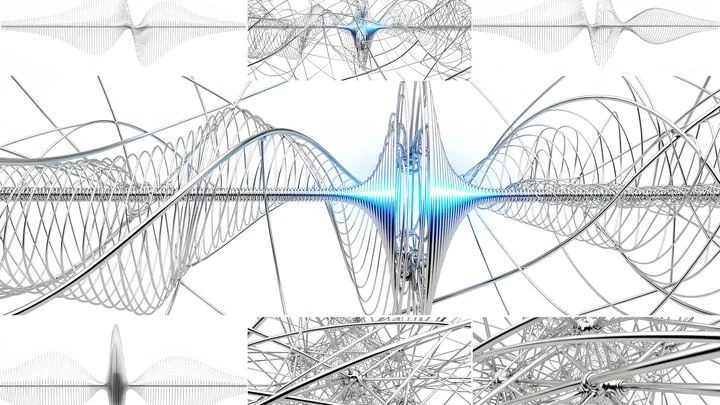
The Universe doesn't just expand — it resonates. After the Big Bang, stretched strings remained in its fabric — thin as a proton, yet heavy as a mountain range. Their oscillations give birth to gravitational waves, and in this radiation, like in a musical score, the history of fundamental symmetries is encoded.
A handful of sand weighing as much as a small mountain: that's roughly what strangelets are like: tiny clumps of 'strange' quark matter where particles are squeezed to unimaginable densities. In a new study, astrophysicists tested whether such objects could exist in nature and what they would look like.
In the LHCb detector, where protons collide, one unusual track was found among billions of decays. The particle, named $$D_{s1}$$(2933)^+, appears for a moment and immediately decays into other particles. Its lifetime is so short that it cannot be observed directly — only through its decay products can its existence be reconstructed.
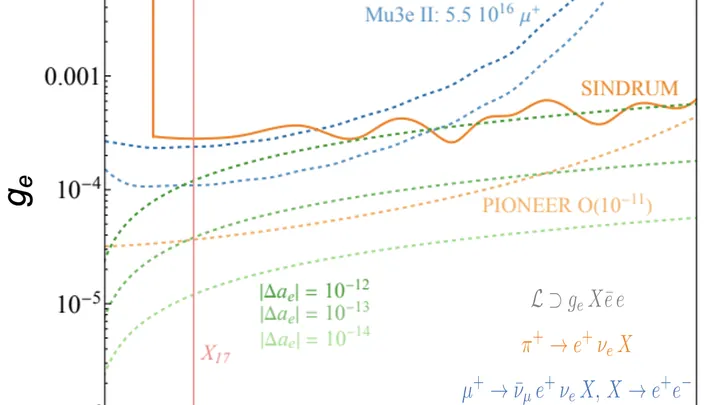
In nuclear transitions of beryllium-8, helium-4, and carbon-12, physicists from the ATOMKI collaboration have been seeing extra events since 2020—as if, when an excited nucleus decays, something else is sometimes born besides the usual photons. The energy of this "something" is always the same: about 17 million electron-volts.
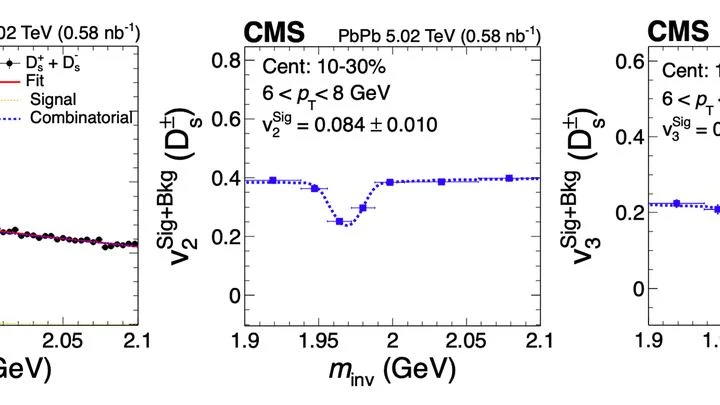
At the center of a collision between two lead nuclei, a tiny fireball is born for an instant — matter so hot that protons and neutrons melt, and quarks and gluons swim freely in this 'soup.' This soup is called quark–gluon plasma. It existed in the first microseconds after the Big Bang, and now it is recreated in accelerators.
NGC 3627, a spiral beauty in the constellation Leo, harbors a trail that fits no standard scenario. A narrow band of cold gas, a molecular trail, stretches more than 8 kiloparsecs (thousands of parsecs, each about 3260 light-years) with a width of about 200 parsecs. That is like a thread as long as a football field and as thick as a pencil.