1951- · quantum field theory, elementary particle physics, quantum computing
American theoretical physicist, Nobel laureate for the discovery of asymptotic freedom in quantum chromodynamics. Contributed to axion physics, anyons, and other ideas important for quantum computing.
Biography
Born in New York. Studied at the University of Chicago, PhD at Princeton under David Gross. Worked at the Institute for Advanced Study in Princeton, then professor at MIT. Nobel laureate (2004) together with Gross and Politzer.
Key discoveries
Asymptotic freedom in QCD (1973)
prediction of anyons (particles with intermediate statistics
used in topological quantum computing)
theory of axion as a candidate for dark matter
concept of 'time crystals'.
💡 Wilczek enjoys cooking and once compared the process of preparing an exotic dinner to creating a new theory.
Quote: "Physics is the art of asking questions that nature answers with beautiful mathematics."
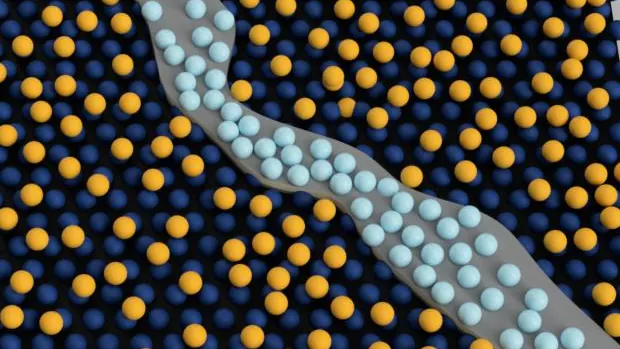
Using a simulation, scientists studied how the force strings connecting quarks break. The rupture turned out to be more complex: entire families of particles are born, and in a dense environment the process slows down. This discovery will help understand the microworld and can be tested on special d
Scientists have created a detector that catches axions—candidates for dark matter. The device, made of layered material in a magnetic field, turns axions into light particles. Resonance, like that of a musical instrument, amplifies the faint signal, and tilting instead of moving parts lets you tune
Scientists used special Rydberg atoms at room temperature to make light move in only one direction. This motion triggers collective oscillations, similar to a time crystal. The discovery helps understand how to control light in tiny optical chips and non-equilibrium systems.
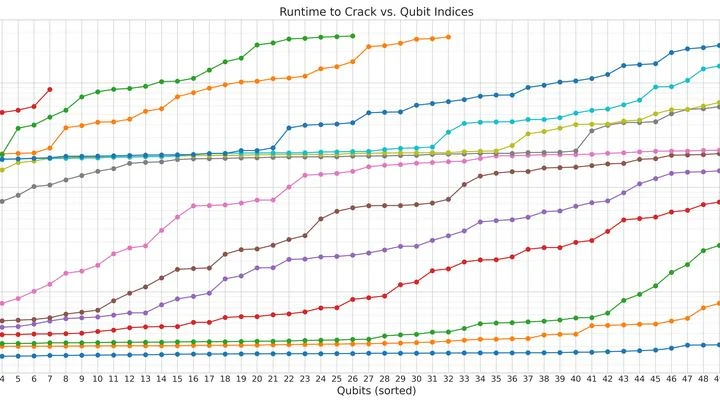
Scientists simulated a magnetic material with a kagome pattern on a quantum computer. They found that noise from extra qubits doesn't disrupt but actually prolongs periodic oscillations (a time crystal), and sometimes even creates them. This is a way to control quantum states using unavoidable error
When one atom is excited, its neighbors go quiet—this simple rule, known as Rydberg blockade, allows quantum braids to be woven. In such a pattern, the connections are protected from noise by the pattern itself. Scientists have shown how to build such a system by solving an inverse problem—they tail
On a lattice that resembles a woven carpet, particles settle into entirely immobile states. Through quantum interference, they don't mix with their surroundings, like pulled-tight knots. These 'locked' particles are perfect candidates for ideal memory—and when pairs of them are looped around each ot
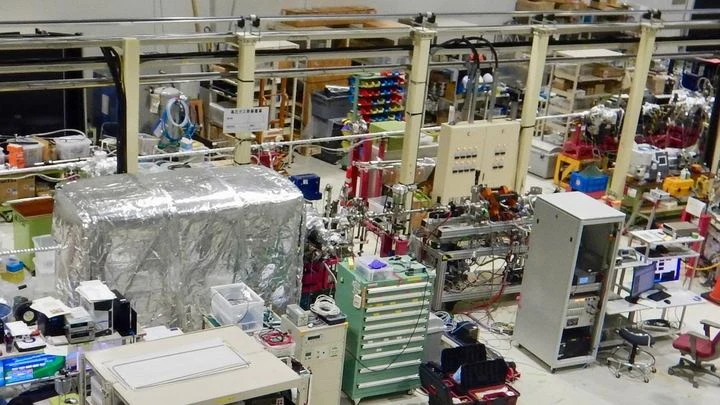
The first stage of ALPS II, a setup to search for axions—dark matter candidates—has concluded at DESY. No particles were detected, but the instrument's sensitivity proved 20 times better than previous records. The system is now being upgraded to boost accuracy another 100-fold.
Time crystals are matter that pulses in time like a perpetual metronome. Previously, stability was achieved by introducing chaos into the atomic lattice. The new scheme replaces chaos with a smooth electric field in a chain of super-sized atoms, making the crystal more durable and easier to work wit
Time crystals are a form of matter where atoms never come to rest, like a perpetual motion machine in the quantum world. By combining two kinds of such crystals, physicists created a hierarchical version: an extra rhythmic layer emerges, unprescribed by any laws. This discovery sheds light on the bi
Байесовский ансамбль уравнений состояния, построенный на гауссовских процессах, восстанавливает термодинамику холодной сверхплотной материи без предвзятых параметризаций. Ограничения от рентгеновских наблюдений NICER и гравитационно-волнового сигнала GW170817 заставляют скорость звука сначала взлете
Quantum gravity eludes experiments due to the Planck scale. But the 2026 Gravity Research Foundation award-winning work points to a natural super-amplifier: superradiant axion clouds around rotating black holes. This cosmic mechanism generates squeezed states with up to 10⁷ correlated gravitons, cre
Two entangled particles exchange energy: one gives, the other receives, but together they maintain balance. If you only watch the first, its oscillations seem eternal — the hidden partner acts as an invisible motor. This is reminiscent of time crystals — structures that change cyclically without ext
Light caught in the gravitational trap of a spinning black hole bounces around like a pinball and, under the influence of magnetic fields, turns into axions—prime dark matter candidates. This process betrays itself by a dimming of high-energy emission. Future telescopes could spot this 'dimming' and
Time crystals are a state of matter that pulses without external pushes, like a perfect clockwork mechanism. Physicists obtained three varieties of such 'ticking' in a cloud of atoms placed between mirrors. The light emerging from the trap allowed them to see these oscillations directly and distingu
About the work: Physicists explore time crystals — a state of matter that cyclically changes, even without energy input. What's new: A classification of these phases has been developed: discrete, continuous, and exotic — akin to different minerals. Why it matters: This will help purposefully create